The Sri Kalahasti Nayanmars connection links Kannappa, Appar, Sambandar, Sundarar, Manikkavacakar and Adi Shankaracharya to this Vayu Linga Shiva shrine.
The Sri Kalahasti Nayanmars connection is one of the most remarkable spiritual lineages in South Indian Shaiva tradition. Long before Sri Kalahasti became famous for its Rahu-Ketu pooja, it was sanctified by the footsteps of the greatest Saiva saints in Tamil history — Kannappa Nayanar, Thirugnana Sambandar, Appar, Sundarar, and Manikkavacakar. Additionally, the revered Adi Shankaracharya immortalised this shrine in verse. Understanding these connections transforms a routine darshan into a walk through 1,300 years of unbroken devotional history.
Quick Summary: Sri Kalahasti’s Saiva Saint Connections
Here is the complete map of saints linked to this Vayu Linga shrine in one glance:
- Kannappa Nayanar: The hunter-saint born at Sri Kalahasti who offered his eyes to Lord Shiva
- Thirugnana Sambandar: Composed Tevaram hymns praising Sri Kalahasti in the 7th century
- Appar (Thirunavukkarasar): Visited and sang devotional verses for the shrine
- Sundaramurthy Nayanar (Sundarar): 8th-century saint who included Sri Kalahasti in the Tevaram
- Manikkavacakar: Tamil saint-poet who also glorified this temple through song
- Adi Shankaracharya: Praised Kannappa’s devotion in Sivananda Lahari (verse 63)
- Status: One of only 10 Paadal Petra Sthalams located outside Tamil Nadu
Why the Sri Kalahasti Nayanmars Connection Matters
Before examining individual saints, we must understand the significance. The Nayanmars were 63 Tamil Shaivite saints who lived between the 6th and 10th centuries. They composed the sacred Tevaram — a corpus of over 8,300 devotional verses that shaped Tamil Shaiva Siddhanta philosophy.
Any Shiva temple praised in Tevaram becomes a Paadal Petra Sthalam (sung shrine). Therefore, of the 276 Paadal Petra Sthalams, 266 lie within Tamil Nadu. Consequently, Sri Kalahasti’s status as one of the rare 10 located outside Tamil Nadu makes it extraordinarily important.
Sri Kalahasti as a Paadal Petra Sthalam
This Andhra Pradesh shrine earned its Paadal Petra Sthalam status because the three primary Nayanmars — Sambandar, Appar, and Sundarar — each composed at least one pathigam (set of 10 verses) in its honour. Moreover, according to the official Srikalahasteeswara temple website, these saints visited during the 2nd and 3rd centuries CE and spread the temple’s fame through their songs.
Kannappa Nayanar: The Heart of Sri Kalahasti’s Saint Legacy
Of all the Nayanmars, none is more tied to Sri Kalahasti than Kannappa Nayanar. His entire spiritual journey happened at this very shrine. Born as Thinnanar (also called Dheeran) in a tribal hunter family near Sri Kalahasti, he became the 10th saint in the traditional list of 63 Nayanmars.
The Hunter Who Became a Saint
Kannappa’s father Nagan was the hunter-king of Uduppur in Pottapi Nadu. His mother Tattai was a devotee of Lord Subramanya. According to the Tirukalahasthi Puranam, Thinnanar was born after long prayers to Subramanya. Furthermore, some Saivite traditions consider him a reincarnation of Arjuna from the Mahabharata.
Even as a skilled archer, Thinnanar possessed unusual compassion. Notably, he refused to hunt young animals, pregnant females, or diseased creatures. This hint of divine empathy foreshadowed his saintly transformation.
The Moment of Awakening on Kalahasti Hill
One day while chasing a wild pig through the forest, Thinnanar climbed the Kalahasti hill with two companions — Nanan and Kadan. At the summit stood the Shiva Linga known as Kudumithevar. The moment Thinnanar saw the Linga, he was overwhelmed by divine love.
Interestingly, the Saivite tradition reads esoteric meaning into this event. The wild pig represents Anava Malam (ego). Additionally, Nanan symbolises good samskaras and Kadan represents evil samskaras. The seeker kills ego, retains the good, and leaves behind the evil before reaching the divine.
The Legendary Eye Offering: Sri Kalahasti’s Defining Moment
Kannappa’s worship was unconventional. He removed his sandals to brush the Linga clean. Additionally, he carried water in his mouth for the abhishekam. Moreover, he offered fresh meat as naivedyam — the only food he knew.
A temple priest named Sivagochariar was horrified by these practices. However, Lord Shiva saw Kannappa’s pure heart and decided to reveal his devotion publicly.
Shiva’s Test: The Bleeding Linga
One day, blood began flowing from the right eye of the Shiva Linga. Kannappa, seeing his Lord in pain, did not hesitate. Immediately, he plucked out his own right eye and placed it on the Linga. The bleeding stopped.
Then the left eye of the Linga began to bleed. Kannappa prepared to offer his second eye. However, he realised he would be blind and unable to see where to place it. Therefore, he marked the Linga’s left eye with his foot — a gesture that would have been considered sacrilege from anyone else.
Lord Shiva Appears and Grants Moksha
As Kannappa raised his arrow to pluck his second eye, Lord Shiva appeared and stopped his hand. The Lord called out “Kannappa!” three times — meaning “the one who gave his eye.” Consequently, Thinnanar was renamed Kannappa Nayanar and granted moksha on the spot.
Sivagochariar, the orthodox priest, learned a lifetime lesson in minutes — that God sees the heart, not the ritual. Kannappa’s story became the defining parable of Tamil Shaivism.
The Kannappa Temple on Sri Kalahasti Hill
Today, pilgrims visiting Sri Kalahasti can walk to the Kannappa shrine on the southern hill. The entrance begins near the Dakshina Gopuram of the main temple. Subsequently, around 250 stone steps lead to the hilltop shrine, also called Kannabeswara.
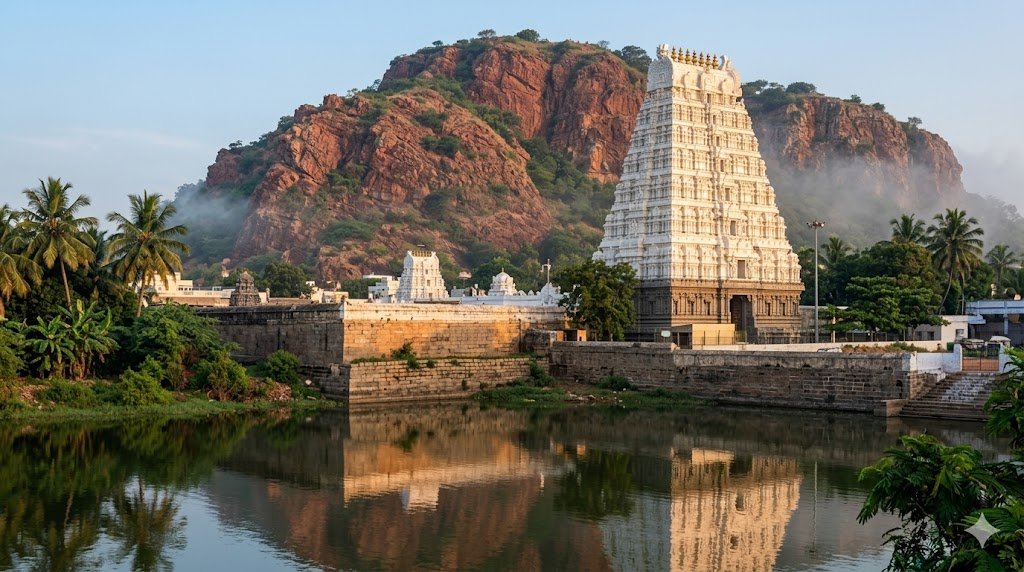
From this hilltop, you get a sweeping view of the entire Sri Kalahasti town, the Swarnamukhi river, and the main temple. Furthermore, during the annual Maha Shivaratri Brahmotsavam, the festival begins with the Dhwajarohanam at the Kannappa temple — a day before the flag-hoisting at the main shrine. This protocol honours Kannappa’s unmatched devotion.
Thirugnana Sambandar and the Tevaram at Sri Kalahasti
Among the three primary Nayanmars, Thirugnana Sambandar holds special status. Born in the 7th century CE at Sirkazhi (Tamil Nadu), he was a child prodigy who composed devotional hymns by age three. According to tradition, Goddess Parvati herself nursed him with divine milk, granting him the gift of holy poetry.
Sambandar composed 4,181 verses across 383 pathigams — making him the largest contributor to the Tevaram canon. Specifically, his verses form the first three Tirumurais (sacred books) of the 12-book Tamil Shaiva canon.
Sambandar’s Visit and Verses on Sri Kalahasti
Sambandar travelled across Tamil Nadu and into Andhra Pradesh during his spiritual journeys. At Sri Kalahasti, he composed a pathigam praising Lord Kalahasteeswara. His verses emphasise the Vayu (wind) nature of the Linga and the devotional purity of the site.
Consequently, Sri Kalahasti entered the formal Paadal Petra Sthalam list through his hymns. His visits are believed to have occurred in the 7th century CE, making them over 1,300 years old.
Appar (Thirunavukkarasar): The Senior Saint’s Blessings
Thirunavukkarasar, popularly known as Appar (“Father”), was the senior-most of the three Tevaram poets. Born Marulneekkiyar, he initially embraced Jainism before returning to Shaivism after a miraculous cure from a stomach ailment at Thiruvadigai.
Appar composed 3,130 surviving verses across 313 pathigams — found in Tirumurais 4, 5, and 6. Notably, his hymns are characterised by deep personal emotion and philosophical depth.
Appar’s Connection to Sri Kalahasti
The official temple records confirm that Appar visited Sri Kalahasti during the 7th century CE. He sang devotional verses that glorified the Kalahasteeswara Linga and the site’s unique Vayu tattva (wind element). Additionally, his stay further elevated the temple’s status across Tamil Shaivism.
Although Appar and Sambandar lived in overlapping periods, each saint visited the shrine independently, reflecting their shared reverence for this Andhra Pradesh location.
Sundaramurthy Nayanar: The Youngest of the Three
The third member of the Moovar (great trio), Sundaramurthy Nayanar or simply Sundarar, lived in the 8th century CE. His life story is dramatic — Lord Shiva appeared as a wandering ascetic at Sundarar’s wedding and claimed him as his own servant.
Sundarar composed 1,026 verses across 100 pathigams, forming the 7th Tirumurai. His hymns are famous for their intimate, almost friendly tone toward the divine.
Sundarar’s Praise of Sri Kalahasti
Like his predecessors, Sundarar travelled to Sri Kalahasti and sang in its praise. His inclusion of this Andhra Pradesh shrine in his Tevaram cemented the temple’s place among the most sacred Shiva sites of South India. Furthermore, this completed the “Moovar” (trinity) praise — meaning all three primary Nayanmars had sung here.
Temples sung by all three are called Moovar Paadal Petra Sthalam and enjoy the highest reverence. Naturally, Sri Kalahasti holds this coveted distinction.
Manikkavacakar: The Fourth Great Saint at Sri Kalahasti
While Manikkavacakar was not officially one of the 63 Nayanmars, he is ranked as the fourth of the “Nalvar” (great four) alongside Sambandar, Appar, and Sundarar. His Tiruvacakam is considered the emotional pinnacle of Tamil Shaiva devotional literature.
According to the Sri Kalahasti temple’s official records, Manikkavacakar also visited this shrine during his pilgrimages. Moreover, his hymns celebrating Shiva as the cosmic guide resonate powerfully with the Vayu Linga philosophy practised here.
The Nayanmars at Sri Kalahasti: Summary Table
| Saint | Period | Contribution at Sri Kalahasti |
|---|---|---|
| Kannappa Nayanar | Ancient (pre-Tevaram) | Offered his eyes; attained moksha on site |
| Thirugnana Sambandar | 7th century CE | Composed Tevaram pathigam |
| Appar (Thirunavukkarasar) | 7th century CE | Sang devotional verses |
| Sundaramurthy Nayanar | 8th century CE | Completed the Moovar praise |
| Manikkavacakar | 9th century CE (approx) | Additional Tamil devotional hymns |
| Adi Shankaracharya | 8th century CE | Praised Kannappa in Sivananda Lahari |
Therefore, across nearly a thousand years of spiritual history, the greatest saints of South India converged on this single Shiva shrine.
Adi Shankaracharya’s Tribute in Sivananda Lahari
Beyond the Tamil Nayanmars, Adi Shankaracharya — the 8th-century founder of the Advaita Vedanta school — also acknowledged Sri Kalahasti’s significance. In his devotional hymn Sivananda Lahari (Waves of the Bliss of Shiva), he dedicated a verse to Kannappa’s devotion.
The Famous Verse 63
Verse 63 of the Sivananda Lahari praises Kannappa’s unusual worship. In this Sanskrit shloka, Adi Shankaracharya writes that Kannappa’s sandals became sacred footwear for Shiva, the water from his mouth became divine abhisheka, and the chewed meat became sacred prasadam.
“What cannot devotion achieve? Even a forest-dweller becomes the foremost among devotees.” — Adi Shankaracharya’s summary line in the verse referencing Kannappa.
Consequently, this single verse elevated Kannappa’s story from a Tamil Nayanmar tradition into pan-Indian Sanskrit devotional literature. Furthermore, Shankaracharya’s endorsement brought Sri Kalahasti into the broader Advaita pilgrimage circuit.
Why the Saints Chose Sri Kalahasti
Modern pilgrims often wonder why so many saints travelled hundreds of kilometres across forests and kingdoms to reach this temple. The reasons are specific and layered.
The Vayu Linga Distinction
Sri Kalahasti is one of the Pancha Bhoota Sthalams — the five Shiva temples representing natural elements. Specifically, this shrine represents Vayu (wind). The swaying temple flame inside the sanctum, despite no air movement, is considered physical evidence of Vayu’s presence. Naturally, advanced spiritual seekers were drawn to experience this directly.
The Rahu-Ketu Kshetra Reputation
Additionally, Sri Kalahasti is famed for its Rahu-Ketu Sarpa Dosha remedies. Even in ancient times, astrologers and mystics recognised this site as uniquely powerful for serpent-related karmic cleansing. Saints like Sambandar would have been aware of this reputation.
The Dakshina Kailash Legend
Sri Kalahasti is also called Dakshina Kailash — the Kailash of the South. This title stems from three creatures — Sri (a spider), Kala (a serpent), and Hasti (an elephant) — who attained liberation here. The temple’s very name derives from these three devotees. Moreover, each represents a different scale of worship, making the shrine universally accessible.
How to Trace the Nayanmar Footsteps Today
Pilgrims who want to experience the Sri Kalahasti Nayanmars connection should follow this pilgrimage route:
- Step 1: Begin at the main Kalahasteeswara Swamy sanctum — the site sung by Sambandar, Appar, and Sundarar
- Step 2: Observe the flickering lamp flame inside the sanctum (Vayu Linga proof)
- Step 3: Complete the Rahu-Ketu pooja (optional but tradition-linked)
- Step 4: Exit through the Dakshina Gopuram toward the southern hill
- Step 5: Climb the 250 steps to the Kannappa Temple (Kannabeswara)
- Step 6: Visit the Bhuvaneshwari Devi Peetham enshrined by Adi Shankaracharya
- Step 7: Take darshan at nearby sub-shrines mentioned in Tevaram verses
Additionally, visit the Swarnamukhi river ghat where the Nayanmars would have performed ritual baths before temple entry. The full circuit takes approximately half a day.
The Living Legacy: What This Connection Means Today
The Sri Kalahasti Nayanmars connection is not merely historical. It shapes temple rituals, festival calendars, and devotional practice even now. For instance, during the annual Maha Shivaratri Brahmotsavam, the flag-hoisting begins at Kannappa’s shrine — a daily reminder that devotion outranks ritual.
Moreover, Tevaram verses by Sambandar, Appar, and Sundarar are still chanted during temple rituals. Consequently, every pilgrim who attends a major abhishekam here is participating in a tradition unbroken since the 7th century.
Future Outlook for Nayanmar Heritage at Sri Kalahasti
The Andhra Pradesh Endowments Department and the temple trust are increasingly investing in heritage preservation. Additionally, discussions around UNESCO-linked Shaiva pilgrimage circuits may soon include Sri Kalahasti. By 2028, expect more academic tourism, Nayanmar-themed guided walks, and digital archives of Tevaram verses specific to this shrine.
Final Thoughts: A Thousand Years of Sanctified Footsteps
To stand at the Sri Kalahasti sanctum today is to stand where Kannappa offered his eyes, where Sambandar sang the first Tevaram verses for this shrine, where Appar and Sundarar walked as pilgrims, and where Adi Shankaracharya acknowledged a hunter as the ideal devotee. The Sri Kalahasti Nayanmars connection is not ancient history — it is living architecture of devotion. Plan your next visit with this lens, and every step in the temple complex becomes a walk through 1,300 years of unbroken Shaiva tradition.
Frequently Asked Questions
Which Nayanmars visited Sri Kalahasti Temple?
According to the official Srikalahasteeswara Swamy Vari Devasthanam records, the Saiva Nayanmars Appar, Sundarar, Thirugnana Sambandar, and Manikkavacakar visited Sri Kalahasti during the 2nd-3rd centuries CE. Additionally, Kannappa Nayanar was born near Sri Kalahasti and attained moksha here. All three primary Nayanmars composed Tevaram hymns praising this shrine.
Who is Kannappa Nayanar and why is he connected to Sri Kalahasti?
Kannappa Nayanar is the 10th of the 63 Nayanmars, a hunter saint born as Thinnanar near Sri Kalahasti. He is famously known for plucking out his own eyes to replace the bleeding eyes of the Shiva Linga at Sri Kalahasti. Consequently, Lord Shiva granted him moksha on the spot, and his shrine stands on the southern hill of the temple complex.
Is Sri Kalahasti a Paadal Petra Sthalam?
Yes, Sri Kalahasti is one of the 276 Paadal Petra Sthalams — Shiva temples praised in the sacred Tevaram hymns. Notably, it is one of only 10 Paadal Petra Sthalams located outside Tamil Nadu, making it exceptionally significant. All three primary Nayanmars — Sambandar, Appar, and Sundarar — composed verses here, giving it “Moovar” status.
Did Adi Shankaracharya visit Sri Kalahasti?
Yes, Adi Shankaracharya visited Sri Kalahasti in the 8th century CE. He enshrined the Bhuvaneshwari Devi Peetham at this holy site. Additionally, in his famous composition Sivananda Lahari, verse 63, he praised Kannappa Nayanar’s unique devotion to Lord Shiva at this shrine.
What is the story of the three devotees — Sri, Kala, and Hasti?
The name “Sri Kalahasti” derives from three creatures who attained liberation here — Sri (a spider), Kala (a serpent), and Hasti (an elephant). Each worshipped the Shiva Linga in their own way, and all three received moksha. Their story is celebrated in temple sculptures and forms the foundational mythology of this shrine.
What is the connection between Kannappa and Arjuna?
According to the Tirukalahasthi Puranam, Kannappa was the reincarnation of Arjuna from the Mahabharata. Arjuna had worshipped Lord Shiva on Indrakiladri hill to obtain the Pasupata Astra. However, when Shiva appeared as a hunter, Arjuna failed to recognise him. Therefore, Arjuna was reborn as Thinnanar (Kannappa) the hunter to complete his devotional journey.
What makes Sri Kalahasti special among Shiva temples?
Sri Kalahasti is special because it combines three unique identities — a Pancha Bhoota Sthalam (Vayu element), a Paadal Petra Sthalam sung by all three primary Nayanmars, and the site of Kannappa Nayanar’s legendary eye sacrifice. Additionally, it is the foremost centre for Rahu-Ketu Sarpa Dosha remedies and is called Dakshina Kailash (Kailash of the South).

Independent pilgrim guide for Sri Kalahasti Temple. Curating darshan timings, Rahu Ketu Pooja booking, sevas, accommodation, Vayu Lingam significance, and complete travel guidance for devotees visiting the temple.
