Srikalahasti seva darshan is the darshan of the Vayu Lingam you receive as part of a paid pooja or arjita seva. It is not a separate ticket you buy on top of the seva. This one point clears up the biggest confusion first-time pilgrims carry to the Sri Kalahasteeswara Swamy Vari Devasthanam.
When you book a Rahu Ketu Sarpa Dosha Nivarana Pooja, an Abhishekam, or a Kalyanotsavam, your seva ticket already carries you to the sanctum for darshan. So you do not stand in the free queue again. You also skip buying a second darshan ticket for that visit.
Sri Kalahasti Temple Guide is an independent information guide. It is not affiliated with or endorsed by the Srikalahasti Temple administration or the Andhra Pradesh Endowments Department. We take no bookings, donations, or payments — use the official portal linked below for all reservations.
Srikalahasti seva darshan at a glance
- What it is: darshan bundled into a paid seva, so pooja participants proceed to the deity without a separate ticket.
- Who runs it: the Andhra Pradesh Endowments Department — not TTD, a mix-up many websites repeat.
- Where to book: temple seva counters, or the AP Temple Management System portal, never a third-party agent.
- Main sevas: Rahu Ketu Pooja, Abhishekam, Kalyanotsavam, Sahasra Deepalankarana, and Rudrabhishekam.
- Free option: Sarva Darshan runs all day at no cost, so a seva is a choice, not a requirement.
What is Srikalahasti seva darshan?
Srikalahasti seva darshan means the temple darshan you get by taking part in a ticketed ritual. You do not buy a stand-alone darshan pass. Because the seva itself ends at or near the sanctum, participants move to the Vayu Lingam directly after the ritual. In short, the pooja and the darshan come as one arrangement.
This matters because the arjita (paid) seva model at Srikalahasti bundles several things into one ticket. You get the ritual, a place in the mandapam, and the darshan that follows. Some sevas also add prasadam or a small gift. Since the darshan is built in, buying an extra ticket only wastes money and time.
The temple sits in Srikalahasti town, in the Tirupati district of Andhra Pradesh. It honours Lord Shiva as the Vayu Lingam, the air element among the Pancha Bhoota Sthalas. These are the five element-shrines of South India. Devotees also know it as the Rahu-Ketu Kshetra, because its signature ritual addresses the shadow planets.
The three ways to have darshan here
Srikalahasti offers three distinct darshan paths, and knowing the difference saves you from paying twice or queuing needlessly. Each suits a different pilgrim, so pick before you reach the counters.
| Darshan path | Cost | Best for |
|---|---|---|
| Free Sarva Darshan | No ticket | Devotees with time who only want darshan |
| Special (Sheeghra) Darshan | Small per-person fee, indicative | A quicker queue on busy days |
| Seva Darshan (via a pooja) | Seva ticket price | Those performing Rahu Ketu Pooja, Abhishekam, or another seva |
Free Sarva Darshan is always open, though it moves slowly during Amavasya and festival rushes. Special Darshan adds a modest fee for a faster line, and the amount changes from time to time. Seva darshan sits apart from both, because the darshan rides along with the ritual you booked.
Which sevas include darshan
Most ticketed poojas at Srikalahasti carry you to the sanctum once the ritual ends, so darshan is part of the package. The list below covers the sevas devotees ask about most. Our complete seva list adds the full slate with indicative prices.
Rahu Ketu Sarpa Dosha Nivarana Pooja
This is the temple’s most sought ritual, performed to ease the effects of Rahu and Ketu in a horoscope. Priests seat devotees in the mandapam and guide them through the pooja with two small silver idols. After it ends, you carry the idols to the sanctum for darshan. So the darshan follows the pooja naturally.
Abhishekam and Rudrabhishekam
Abhishekam is the ceremonial bathing of the lingam, and a ticket admits the holder and family to watch it up close. Because the seva happens at the shrine, darshan comes with it. Rudrabhishekam, chanted with the Rudram, follows the same pattern.
Kalyanotsavam and Sahasra Deepalankarana
Kalyanotsavam enacts the celestial wedding, while Sahasra Deepalankarana lights the deity with a thousand lamps in the evening. Both are arjita sevas, so ticket holders take part and then have darshan. The evening lamp seva, in particular, draws devotees for its atmosphere.
Srikalahasti seva darshan timings
The temple generally opens early morning and closes at night. Exact Srikalahasti seva darshan timings shift with the season and with festival schedules. As a broad guide, the temple runs from around 6:00 AM to about 9:00 PM. Confirm the current window on the official portal before you travel, since timings change without notice.
Rahu Ketu Pooja typically runs from early morning until the evening, and a single session lasts roughly 45 minutes. Abhishekam and other sevas fall into fixed morning and evening slots. Because these slots fill on auspicious days, arriving 30 to 45 minutes early gives you breathing room. Many pilgrims pair Srikalahasti with a Tirupati trip, since the two sit about 36 km apart, so a morning seva here leaves the afternoon free for Tirumala.
How Rahu Ketu Pooja leads into darshan
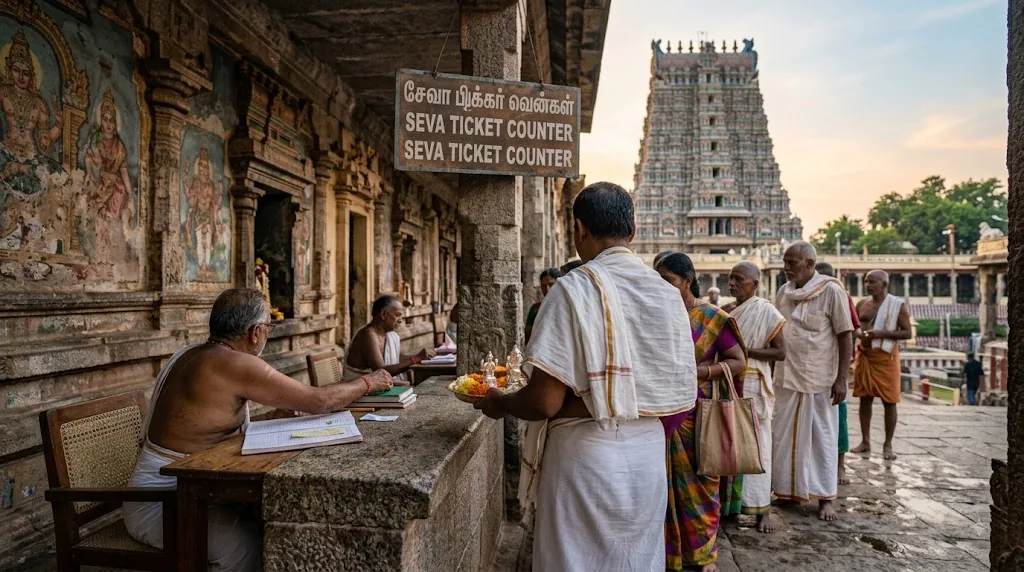
The Rahu Ketu ritual has a distinct flow that puzzles newcomers, so it helps to know the steps. You buy the ticket at the counter, collect the pooja materials, and sit in the assigned hall. A priest then leads the chanting with the two silver idols in front of you.
Once the pooja finishes, custom asks you to hold the idols close and walk to the sanctum for darshan without looking back. After the Shiva darshan, you drop the idols into the hundi.
Custom also asks devotees not to return by the same path, so plan your exit accordingly. This is exactly why the seva and the darshan are one continuous act, rather than two separate errands. Knowing the flow in advance keeps you calm when the hall is crowded.
How to book Srikalahasti seva darshan
Booking Srikalahasti seva darshan is straightforward once you know the correct channel. The temple issues most seva tickets at its own counters on the day of your visit. Same-day tickets are the norm outside peak dates. For advance planning, the Andhra Pradesh Endowments Department runs an online system where you can reserve select sevas and accommodation.
Here is where many guides get it wrong. The AP Endowments Department administers Srikalahasti, so its bookings do not go through the TTD website that serves Tirumala. If a page tells you to book Srikalahasti seva darshan on the TTD portal, treat it as a warning sign.
Use the AP Temple Management System instead, or simply the counter. Our step-by-step online booking guide walks through each screen. Online availability can vary by season, so the counter stays the most dependable route for most sevas.
Steps at the counter
- Reach the seva counters inside the temple, usually to the left of the main entrance.
- Choose your seva and the number of participants, since one ticket often covers two.
- Pay by cash or UPI, and keep the receipt safe.
- Show the receipt at the mandapam to collect your pooja kit.
- Complete the ritual, then proceed to darshan as guided.
Is seva darshan guaranteed, and what if it fails?
Seva darshan is reliable on ordinary days, yet it is not guaranteed on every date. Ticket quotas for a given seva can run out. Some sevas also pause during major festivals for crowd management. So it pays to know the failure points before you set out.
On Amavasya, Sravana Mondays, eclipse days, and Maha Shivaratri, demand spikes sharply. The temple sometimes suspends special or VIP darshan on the biggest days to keep access equal for all devotees. If your preferred seva is full, you still have clear fallbacks.
- Seva sold out: switch to another available seva, or take the free Sarva Darshan queue for that visit.
- Online slots closed: most seva tickets remain available at the counter on the day, so a counter visit usually works.
- Festival suspension: plan the seva for the next non-festival day, when normal seva darshan resumes.
- Quota exhausted for the date: there is no shortcut, so the practical answer is to try the next available day.
What first-time pilgrims get wrong
A few practical lessons save real trouble on the ground, and most guides skip them. These come from how the temple actually works on a busy morning.
Do not pay a tout who claims the seva tickets are sold out. Buy only at the official counter, because middlemen charge more and offer nothing extra. Prices you see online vary widely from site to site. So treat any figure as indicative, and confirm the current rate at the counter.
Carry a valid photo ID, since online bookings and some counters ask for it. Wear traditional dress, since the pooja expects it. Also remember that children below a certain age usually need no ticket for general darshan. Check at the counter if you are unsure.
Health and safety for your visit
Seva participation often involves fasting, long waits, and time on stone floors, so a little care protects your day. Carry water and any regular medication, and eat sensibly before a long ritual. Elderly pilgrims, pregnant women, and anyone with a health condition should pace the queues and rest when needed.
On eclipse and Amavasya days the crowds swell, and the wait can stretch, so build in buffer time. The Rahu Ketu Pooja is a ritual of faith and tradition. Treat it as such, rather than as a medical treatment. For any health concern, consult a qualified doctor before fasting or a strenuous, long visit.
Before you go
Srikalahasti seva darshan rewards a little planning, because the pooja and the darshan arrive together and save you a second queue. Decide which seva suits your purpose, reach the counter early, and route every payment through the official channel. Keep the free Sarva Darshan option in mind as a dependable fallback on the busiest days. Above all, verify current timings and rates on the official portal, since a temple this popular updates them through the year.
Frequently asked questions
Does Srikalahasti seva darshan include temple darshan?
Yes. A paid seva at Srikalahasti bundles the ritual and the darshan together, so participants proceed to the Vayu Lingam after the pooja. You do not need to buy a separate darshan ticket for that visit.
Do I need a separate darshan ticket if I book a Rahu Ketu Pooja?
No. The Rahu Ketu Pooja ticket already carries you to the sanctum for darshan once the ritual ends. Buying an extra darshan ticket on top of the seva is unnecessary.
Where do I book Srikalahasti seva darshan online?
Use the Andhra Pradesh Endowments Department’s Temple Management System, since Srikalahasti is an AP Endowments temple. It is not booked through the TTD website that serves Tirumala, despite what some pages claim.
How much does a seva at Srikalahasti cost?
Seva prices run in tiers and change periodically, so treat any online figure as indicative only. Confirm the current amount at the temple counter or on the official portal before you pay.
What are the Rahu Ketu Pooja timings?
Priests perform the pooja daily, broadly from early morning to the evening, and each session lasts around 45 minutes. Because timings shift on festival days, check the official portal close to your visit.
Can a couple perform a seva on one ticket?
Often yes, as one seva ticket at Srikalahasti commonly admits two participants, such as a husband and wife. Confirm the exact allowance for your chosen seva at the counter.
Is free darshan available at Srikalahasti?
Yes. Free Sarva Darshan runs all day at no cost, so a paid seva is a choice and not a requirement. Free darshan simply takes longer on Amavasya and festival days.
Is seva darshan available during Maha Shivaratri?
The temple limits or suspends some sevas and VIP darshan on the biggest festival days to keep access equal for all devotees. Plan special sevas for a normal day, and confirm the festival schedule on the official portal.

Independent pilgrim guide for Sri Kalahasti Temple. Curating darshan timings, Rahu Ketu Pooja booking, sevas, accommodation, Vayu Lingam significance, and complete travel guidance for devotees visiting the temple.
