
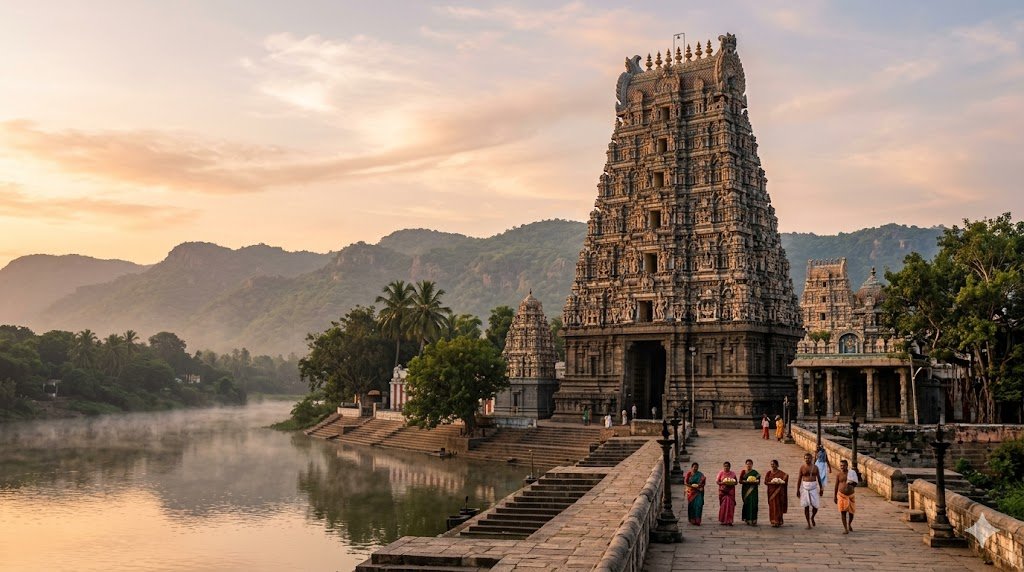
The Tirupati Srikalahasti spiritual connection unites Lord Venkateswara and Lord Shiva in a single sacred journey, completing every devotee’s pilgrimage circuit.
The Tirupati Srikalahasti spiritual connection is one of the most profound yet least understood threads in South Indian pilgrimage tradition. Most devotees travel to Tirumala for darshan of Lord Venkateswara and head home, unaware that their yatra remains incomplete without visiting Srikalahasti, just 36 kilometres away. Furthermore, ancient texts and temple traditions explicitly link these two shrines as complementary halves of a single spiritual experience — one representing the supreme Vishnu, the other embodying Lord Shiva as the element of air. Here is why seasoned pilgrims always plan both temples in the same trip.
Quick Summary: Why Tirupati and Srikalahasti Are Sacred Twins
Before diving into the deeper layers, here are the essentials every pilgrim should know.
- Distance: Srikalahasti is just 36 km from Tirupati, roughly a one-hour drive
- Tirupati deity: Lord Venkateswara — supreme form of Vishnu in Kali Yuga
- Srikalahasti deity: Lord Kalahasteeswara — Shiva as the Vayu (air) element
- Combined significance: Vaishnava and Shaiva harmony in a single yatra
- Pancha Bhoota link: Srikalahasti is one of five element-based Shiva temples
- Astrological power: Srikalahasti hosts the famed Rahu-Ketu Pooja
- Pilgrim tradition: Many believe darshan at Tirumala alone is incomplete without Srikalahasti
The Geographic Bond: Why These Two Temples Sit So Close
Notably, the proximity of Tirupati and Srikalahasti is not a coincidence. Ancient pilgrim circuits in South India deliberately positioned major Vaishnava and Shaiva shrines within easy travel distance of each other. As a result, devotees could honour both Vishnu and Shiva on the same journey, reinforcing the Hindu philosophical principle that the two deities are aspects of one supreme reality.
The road from Tirupati to Srikalahasti runs through the foothills of the Eastern Ghats, following an ancient pilgrim route. Today, the journey takes about an hour by car or bus. Moreover, frequent APSRTC services connect the two towns throughout the day, making the combined yatra accessible even for one-day pilgrims.
The Swarnamukhi River: A Sacred Boundary
Specifically, Srikalahasti sits on the banks of the Swarnamukhi river — a sacred waterway whose name means “golden-faced.” Pilgrims traditionally take a holy dip here before entering the temple. Furthermore, the river is mentioned in several Puranas as a site where cursed beings achieved liberation through bathing.
Vishnu and Shiva: The Theological Heart of the Tirupati Srikalahasti Spiritual Connection
Above all, the deepest meaning of the Tirupati Srikalahasti spiritual connection lies in Hindu theology itself. Lord Venkateswara at Tirumala represents Vishnu in his most accessible form for the Kali Yuga. Meanwhile, Lord Kalahasteeswara at Srikalahasti embodies Shiva in his rarest form — as Vayu, the cosmic wind that sustains all life.
Together, these two shrines reflect the principle of Hari-Hara — the unity of Vishnu and Shiva as one divine consciousness. Therefore, visiting both temples in sequence is considered spiritually complete in a way that visiting either alone is not.
What Devotees Believe About the Combined Darshan
According to traditional belief, darshan at Tirumala grants material and spiritual blessings, while darshan at Srikalahasti removes karmic obstacles and planetary doshas. Consequently, the combination addresses both prosperity and protection — the two pillars of a balanced spiritual life. Many priests in both temples actively recommend pilgrims complete the dual visit.
Srikalahasti as a Pancha Bhoota Sthala: The Element of Air
Importantly, Srikalahasti holds a unique cosmic position. It is one of the five Pancha Bhoota Sthalams — temples representing the five elements of nature. The presiding deity here, the Vayu Lingam, embodies the air element that connects all living beings.
| Element | Temple | Location |
|---|---|---|
| Earth (Prithvi) | Ekambareswarar Temple | Kanchipuram, Tamil Nadu |
| Water (Jala) | Jambukeswarar Temple | Thiruvanaikaval, Tamil Nadu |
| Fire (Agni) | Annamalaiyar Temple | Tiruvannamalai, Tamil Nadu |
| Air (Vayu) | Srikalahasteeswara Temple | Srikalahasti, Andhra Pradesh |
| Space (Akasha) | Nataraja Temple | Chidambaram, Tamil Nadu |
The Living Lingam That Moves
Interestingly, the Vayu Lingam at Srikalahasti is unique because it cannot be touched even by the priests. Instead, abhishekam is performed on the Utsava murti while the main lingam remains untouched. Additionally, lamps placed inside the sanctum flicker constantly — devotees believe this is the breath of Vayu himself, proving the deity’s living presence.
The Three Devotees Who Named Srikalahasti
The very name “Srikalahasti” embodies a story of devotion that resonates with the surrender central to Tirumala worship. According to legend, three devotees of different forms worshipped Lord Shiva at this site.
- Sri (the spider): Spun protective webs around the lingam
- Kala (the snake): Decorated the lingam with precious gems
- Hasti (the elephant): Bathed the lingam with water from the Swarnamukhi
Pleased with their devotion despite their humble forms, Lord Shiva granted them all moksha. Hence, the temple carries their combined names eternally. The presiding lingam itself bears symbolic markings — a cobra hood at the top, elephant tusks in the middle, and a spider carving at the base.
Kannappa Nayanar: The Story That Mirrors Tirumala’s Devotional Spirit
Furthermore, Srikalahasti is the site of one of the most powerful devotion stories in Hindu literature — that of Kannappa Nayanar. Kannappa was a tribal hunter who worshipped Lord Shiva with raw, unrefined devotion. When he saw blood flowing from the lingam’s eye, he plucked out his own eye and placed it there. Then, when the second eye began bleeding, he prepared to offer his remaining eye too.
Moved beyond measure, Lord Shiva appeared, restored Kannappa’s sight, and granted him moksha. Notably, this devotional intensity mirrors the surrender that pilgrims experience at Tirumala — where devotees offer their hair, gold, and worldly attachments to Lord Venkateswara. Both temples ultimately teach the same lesson: the form of devotion matters less than its purity.
Rahu-Ketu Pooja: Why Tirumala Pilgrims Add Srikalahasti
For most modern pilgrims, the practical anchor of the Tirupati Srikalahasti spiritual connection is the famous Rahu-Ketu Pooja. Srikalahasti is the foremost destination in India for this ritual. Above all, devotees believe it neutralises the malefic effects of these two shadow planets in their horoscope.
Rahu and Ketu are believed to cause delays in marriage, career setbacks, financial blocks, and family disharmony. Consequently, pilgrims visiting Tirumala for prosperity often extend their journey to Srikalahasti to remove the obstacles that block prosperity from manifesting. The two temples thus address opposite ends of the same spiritual goal.
How the Rahu-Ketu Pooja Is Performed
The ritual involves abhishekam to the lingam representing Rahu and Ketu. Priests use milk, ghee, panchamrita, and turmeric water during the ceremony. Furthermore, the pooja runs in multiple slots throughout the day, starting at 6:00 AM. Devotees can book at the temple counter directly or through authorised booking centres in Srikalahasti.
Architectural Bridge: Chola and Vijayanagara Patronage
Historically, the same dynasties that patronised Tirumala also developed Srikalahasti. The Chola emperor Rajendra Chola I built the main structure of Srikalahasti around the 11th century. Meanwhile, Kulottunga Chola I constructed the gopurams. Subsequently, the Vijayanagara emperor Krishnadevaraya commissioned the towering 120-foot main gopuram in 1516 CE.
Notably, Krishnadevaraya was also one of the most generous patrons of Tirumala, donating jewels and gold to Lord Venkateswara. As a result, both temples bear his architectural and devotional fingerprint. Pilgrims walking through both shrines today are essentially following a royal pilgrimage circuit established five centuries ago.
The Suggested Two-Day Pilgrim Route
For pilgrims who want to experience the full Tirupati Srikalahasti spiritual connection, here is the traditional two-day sequence followed by seasoned devotees.
Day 1: Tirumala Darshan
- Reach Tirupati by train, bus, or flight
- Travel to Tirumala via the ghat road or APSRTC bus
- Take darshan of Lord Venkateswara at the Sri Venkateswara Temple
- Visit Padmavathi Ammavari Temple at Tiruchanur
- Stay overnight in Tirupati
Day 2: Srikalahasti Darshan
- Travel from Tirupati to Srikalahasti (36 km, approximately one hour)
- Take a holy dip in the Swarnamukhi river
- Perform Rahu-Ketu Pooja at Srikalahasti temple (book in advance during peak months)
- Take darshan of Lord Kalahasteeswara and Gnana Prasunambika Devi
- Visit Pathala Vinayaka Temple inside the complex
- Tie a thread on the Sthala Vriksha (sacred banyan tree) and make a wish
Practical Pilgrim Information
For first-time pilgrims, here are the operational details that make the combined yatra smooth.
| Detail | Tirumala | Srikalahasti |
|---|---|---|
| Darshan Timings | 3:00 AM to 1:30 AM (next day) | 5:00 AM to 9:00 PM |
| Free Darshan | Sarva Darshan available | Yes, all days |
| Special Pooja Booking | TTD official website | Temple counter / authorised centres |
| Dress Code | Traditional Indian wear | Modest, traditional preferred |
| Nearest Railway Station | Tirupati (TPTY) | Srikalahasti (KHT) |
| Nearest Airport | Tirupati Airport (TIR) | Tirupati Airport (TIR) |
Best Time for the Combined Yatra
Generally, the months from October to March offer the most pleasant weather for both temples. Specifically, devotees consider Karthika masa (November) and Margashira masa (December) most auspicious for combined darshan. However, the Brahmotsavam at Tirumala (September–October) and Maha Shivaratri at Srikalahasti (February–March) draw record crowds. Therefore, plan early bookings during these festival periods.
How Common Is the Combined Yatra?
Plenty of pilgrims visit both temples on one trip, and tour operators serving Tirupati routinely sell a Srikalahasti leg as part of the package.
We have not found any official count of how many Tirumala pilgrims go on to Srikalahasti, so we do not publish a figure. If you see a percentage quoted elsewhere, check whether it names a source before relying on it.
Insider Tips for the Combined Pilgrimage
From the experience of regular pilgrims, here are practical tips that make the combined yatra meaningful.
- Book Tirumala darshan first: TTD slots fill faster; lock these before planning Srikalahasti
- Carry minimum luggage: Both temples have strict security; lockers are available but lines are long
- Eat light before darshan: Both temples offer prasadam — Tirumala laddu and Srikalahasti pulihora are world-famous
- Avoid Mondays and full moon days at Srikalahasti: These attract massive Shiva-devotee crowds
- Wear comfortable walking shoes: Both temples involve long walks within the complex
- Carry a thread for the Sthala Vriksha: The wish-fulfilling banyan tree at Srikalahasti is an essential ritual
Final Thoughts
The Tirupati Srikalahasti spiritual connection is more than a geographic convenience — it is a theological completion. Visiting only Tirumala honours Vishnu; visiting only Srikalahasti honours Shiva. Together, they reflect the unified vision of the divine that South Indian devotional tradition has preserved for centuries. Plan at least two days for the combined yatra, book your Rahu-Ketu Pooja in advance during festival months, and treat the journey as one continuous pilgrimage rather than two separate visits.
Frequently Asked Questions
How far is Srikalahasti from Tirupati?
Srikalahasti is approximately 36 kilometres from Tirupati, taking about one hour by road. Frequent APSRTC bus services and private taxis run between the two towns throughout the day, making it convenient for pilgrims to combine both temples in a single trip.
Can I visit Tirupati and Srikalahasti in one day?
Yes, but it requires careful planning. Most pilgrims start at Tirumala in the early morning, complete darshan by midday, and travel to Srikalahasti in the afternoon for evening darshan. However, a two-day trip is far more relaxed and allows you to perform special rituals like Rahu-Ketu Pooja without rushing.
Why is Srikalahasti called the southern Kailash?
Srikalahasti is known as Dakshina Kailasam because it is considered as spiritually powerful as Mount Kailash, the abode of Lord Shiva. The temple’s Vayu Lingam, ancient legends, and association with the Pancha Bhoota Sthalams give it a status equivalent to the original Kailash for South Indian devotees.
Is the Tirupati Srikalahasti spiritual connection mentioned in scriptures?
Both temples are referenced in major Puranas individually. Tirumala finds mention in the Varaha Purana and Bhavishyottara Purana, while Srikalahasti is described in the Skanda Purana and Shiva Purana. Pilgrim tradition combining both shrines has been documented for over a thousand years through Chola and Vijayanagara temple inscriptions.
What makes the Vayu Lingam at Srikalahasti unique?
The Vayu Lingam represents the air element among the five Pancha Bhoota Sthalams. Lamps placed inside the sanctum constantly flicker as if by an invisible breeze, even when there is no wind. Devotees believe this is the living breath of Vayu himself, and the lingam cannot be touched even by priests during abhishekam.
Should I book Rahu-Ketu Pooja at Srikalahasti in advance?
Yes, especially during weekends, festival periods, and the months of Karthika and Margashira. Booking can be done at the temple counter directly or through authorised booking centres. During peak periods, slots can fill several hours in advance, so reaching early is recommended.
Which temple should I visit first — Tirumala or Srikalahasti?
Most pilgrims visit Tirumala first because TTD darshan slots are time-bound and harder to reschedule. Srikalahasti has more flexible darshan timings throughout the day. However, scripturally there is no strict order — devotion and intent matter more than sequence.

Independent pilgrim guide for Sri Kalahasti Temple. Curating darshan timings, Rahu Ketu Pooja booking, sevas, accommodation, Vayu Lingam significance, and complete travel guidance for devotees visiting the temple.
