
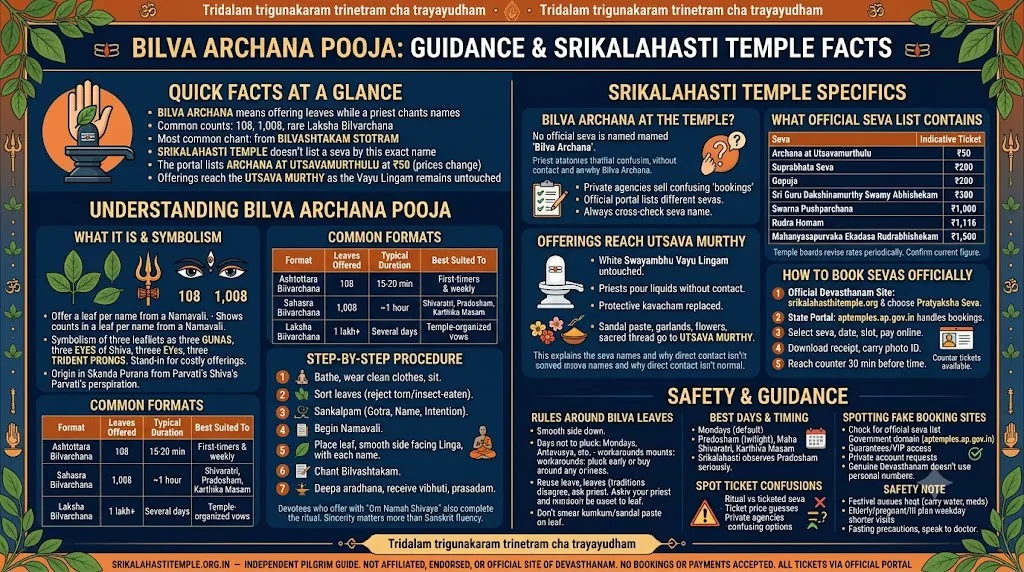
Bilva Archana Pooja is the Shaiva ritual of offering bilva leaves to Lord Shiva one at a time, with a divine name recited for each leaf. Most pages online blur two very different things. One is the ritual itself, which any devotee can perform. The other is a ticketed temple seva, which is a separate matter entirely.
SrikalahastiTemple.org.in is an independent pilgrim guide. We are not affiliated with, endorsed by, or the official website of Sri Kalahasteeswara Swamy Vari Devasthanam. We accept no bookings, donations, or payments of any kind. Every ticket and donation must go through the official Devasthanam portal linked in this guide.
Quick Facts at a Glance
- Bilva Archana means offering bilva leaves while a priest chants each divine name aloud.
- Common counts are 108 leaves, 1,008 leaves, and the rare Laksha Bilvarchana.
- The verse most devotees chant comes from the Bilvashtakam stotram.
- Srikalahasti Temple does not list a seva by this exact name on its official portal.
- The portal lists Archana at Utsavamurthulu at ₹50, and prices do change.
- The swayambhu Vayu Lingam here stays untouched, so offerings reach the Utsava Murthy.
What Is Bilva Archana Pooja?
Bilva Archana Pooja is a form of worship where a devotee or priest offers bilva leaves to Lord Shiva, placing one leaf for every name recited from a namavali. The count is usually 108 or 1,008. Because the leaf itself carries the offering, the ritual needs no elaborate materials.
The bilva tree, botanically Aegle marmelos, is also called bael or wood apple. Its leaf grows in a cluster of three leaflets. That trifoliate shape is why the ritual carries so much weight in Shaiva worship.
Archana simply means worship through the recitation of names. So a kumkumarchana uses vermilion, a pushparchana uses flowers, and Bilva Archana Pooja uses bilva leaves. The structure stays the same while the offering changes.
Why Bilva Leaves Matter So Much in Shiva Worship
The three leaflets are read as the three gunas, as Shiva’s three eyes, and as the three prongs of his trident. Devotional tradition also treats the leaf as a stand-in for far costlier offerings. That symbolism is the whole point of the ritual.
According to the Skanda Purana, the bael tree grew from drops of perspiration that fell from Goddess Parvati. Because of that origin story, devotees treat every part of the tree as sacred. Popular belief holds that even touching the leaf purifies.
These are matters of faith and Vedic tradition rather than verified outcomes. Devotees approach the ritual for peace of mind and continuity with an old practice. No temple or priest guarantees a specific result.
Bilva Archana Pooja Procedure, Step by Step
The sequence below reflects standard Shaiva practice at home and in temples. Priests adjust details according to local sampradaya, so treat this as the common shape rather than a fixed rule.
- Bathe, wear clean clothes, and sit facing the shrine or Shivalinga.
- Sort the leaves first, discarding any that are torn, dried, or insect-eaten.
- Perform a short sankalpam naming the gotra, the name, and the intention.
- Begin the namavali, whether the Ashtottara Shatanamavali or the Shiva Sahasranamavali.
- Place one bilva leaf with each name, smooth side facing the linga.
- Chant the Bilvashtakam once the offering is complete.
- Close with deepa aradhana, then receive vibhuti and prasadam.
An Ashtottara round of 108 names takes roughly fifteen to twenty minutes. A Sahasranamavali round with 1,008 leaves usually runs closer to an hour. Group sevas move faster because a priest leads the chanting for everyone.
The Mantra Devotees Chant During the Offering
The single most quoted line is from the Bilvashtakam: “Tridalam trigunakaram trinetram cha trayayudham.” It describes the three-leaved bilva as an emblem of the three gunas, offered to the three-eyed Lord who carries the trident. The verse then dedicates that one leaf to Shiva.
Many devotees do not know the full stotram, and that is perfectly acceptable. Devotees who offer each leaf with “Om Namah Shivaya” complete the ritual just as well. Sincerity matters more than Sanskrit fluency.
108, 1,008 or a Lakh: Choosing Your Count
The number of leaves changes the scale of the ritual, not its validity. Here is how the three common formats compare in practice.
| Format | Leaves offered | Typical duration | Best suited to |
|---|---|---|---|
| Ashtottara Bilvarchana | 108 | 15 to 20 minutes | First-timers and weekly practice |
| Sahasra Bilvarchana | 1,008 | About one hour | Shivaratri, Pradosham, Karthika Masam |
| Laksha Bilvarchana | One lakh and above | Several days, group-led | Temple-organised vows and sankalpams |
An Ashtottara round needs 108 leaves and costs very little when you buy them locally. That is why most families begin there before attempting anything larger.
Is Bilva Archana Pooja Available at Srikalahasti Temple?
On the official Sri Kalahasteeswara Swamy Vari Devasthanam portal, no seva is currently listed under the name Bilva Archana. The published Pratyaksha Seva list carries Archana at Utsavamurthulu, Swarna Pushparchana, several abhishekams, homams, and the Rahu Ketu Pooja categories. Anyone quoting a fixed Bilva Archana ticket price for this temple is guessing.
That distinction matters because dozens of pages sell “Bilva Archana booking” for South Indian temples. Some of those operators are private agencies, not the Devasthanam. Always cross-check the seva name against the official portal before paying anyone.
What the Official Seva List Actually Contains
The Devasthanam site carried the figures below at the time of writing. Temple boards revise rates periodically, so confirm the current amount on the official portal.
| Seva | Indicative ticket |
|---|---|
| Archana at Utsavamurthulu | ₹50 |
| Suprabhata Seva | ₹100 |
| Gopuja | ₹750 |
| Sri Guru Dakshinamurthy Swamy Abhishekam | ₹300 |
| Swarna Pushparchana | ₹1,000 |
| Rudra Homam | ₹1,116 |
| Mahanyasapurvaka Ekadasa Rudrabhishekam | ₹1,500 |
Why Offerings Here Reach the Utsava Murthy
Srikalahasti follows a tradition found at very few major shrines. The white swayambhu lingam representing Vayu is never touched by human hands, not even by the priests. Priests pour abhishekam liquids without contact, then replace a protective kavacham afterwards.
Sandal paste, garlands, flowers, and the sacred thread are therefore offered to the Utsava Murthy instead. That single fact explains the naming on the seva board. It also explains why a devotee cannot walk up and place bilva leaves on the main lingam here, unlike shrines in the north where direct contact is normal.
How to Book a Seva Through Official Channels
Sevas and darshan tickets for this temple move through the Andhra Pradesh Endowments booking system. The Devasthanam links every booking button to that same portal.
- Open the official Devasthanam site at srikalahasthitemple.org and choose Pratyaksha Seva.
- Sign in on the state portal at aptemples.ap.gov.in, since that system handles every seva booking.
- Select the seva, the date, and an available slot, then pay online.
- Download the receipt and carry the same photo ID used at booking.
- Reach the counter at least thirty minutes before the allotted time.
Counter tickets remain available on the day for several sevas, subject to availability. If online slots run out, the counter queue is still worth trying. Our complete Srikalahasti seva list sets out the wider menu.
Rules Around Bilva Leaves That Most Guides Get Wrong
Two points cause more confusion than anything else, so it helps to separate custom from scripture.
Which Side Faces the Linga
Tradition asks for the smooth, glossy surface to face downward toward the linga. Popular accounts link the upper surface with Lakshmi, while the underside belongs to Shiva. Many devotees reverse this without realising it.
Days When Leaves Are Not Plucked
Texts such as the Linga Purana warn against plucking on Chaturthi, Ashtami, Navami, Chaturdashi, Amavasya, Sankranti, and Mondays. The practical workaround is simple. Pluck the leaves a day earlier, or buy them, because purchase carries no such restriction.
Can Offered Leaves Be Reused
Here the traditions genuinely disagree, and no honest guide should pretend otherwise. One widely followed view holds that bilva never becomes stale, so devotees may wash and offer leaves again. Another view treats an offered leaf as finished and forbids reuse. Ask the priest at your temple rather than trusting a blog.
Best Days and Timing for Bilva Archana Pooja
Mondays are the default choice across Shaiva practice. Pradosham, the twilight window on the thirteenth tithi, carries especially strong significance. Maha Shivaratri and Karthika Masam draw the heaviest participation of the year.
The pradosha period begins roughly ninety minutes before sunset. Morning hours also suit the ritual well. Srikalahasti observes Pradosham with particular seriousness, and our Shivaratri schedule guide covers the festival crowd pattern.
What First-Time Devotees Get Wrong
Sorting the leaves before you sit down saves the most trouble. Torn and insect-bitten leaves are traditionally rejected, and hunting through the pile mid-chant breaks the rhythm badly.
Do not smear kumkum or sandal paste on the bilva leaf itself. Many traditions treat that as incorrect for this particular offering. Keep the leaf plain.
Buy leaves from vendors outside the temple only when the temple itself does not supply them. Seva tickets at most Andhra temples already include the required samagri. Asking at the counter first avoids paying twice.
Finally, do not assume the ritual must happen inside a famous temple. A home shrine with a small lingam serves the purpose completely, and the kumkumarchana guide shows how the same namavali structure works with a different offering.
Spotting Fake Pooja Booking Sites
Private portals now advertise temple poojas that the temples themselves do not list. Some charge several thousand rupees for a seva priced at ₹50 by the Devasthanam.
Check three things before paying. First, does the seva name appear on the temple’s own portal? Second, does the payment page sit on a government domain such as aptemples.ap.gov.in?
Third, does the site promise guaranteed outcomes, VIP access, or queue-skipping? Any of those promises is a warning sign.
A genuine Devasthanam never asks for payment through a personal number or a chat app. If someone shares a private account for a temple seva, walk away.
A Short Safety Note Before You Travel
Festival queues at Srikalahasti can stretch for hours in open heat, so carry water and any regular medication. Elderly pilgrims, pregnant women, and anyone with a medical condition should plan a shorter visit on a weekday. If you intend to fast alongside the ritual, speak to a doctor first when you have diabetes, low blood pressure, or a heart condition. Faith practices support wellbeing, yet they never replace medical treatment.
Before You Go
Bilva Archana Pooja stays one of the simplest and least expensive ways to worship Shiva, because a handful of leaves and an honest sankalpam are enough. Start with 108 leaves on a Monday and build from there.
If you are travelling to Srikalahasti specifically, book an Archana or an abhishekam through the official portal, and offer bilva through the priest rather than expecting direct access to the lingam. Verify every rate on the Devasthanam site before you pay, since the board revises seva rates from time to time. Our Rudrabhishekam booking guide is a useful next read.
Bilva Archana Pooja FAQs
How many bilva leaves are needed for the pooja?
Most devotees offer 108 leaves for an Ashtottara round or 1,008 for a Sahasranamavali round. There is no scriptural minimum, so even a single leaf offered sincerely counts. Larger vows use one lakh leaves and run as temple-organised group events.
Can Bilva Archana Pooja be done at home?
Yes, and the ritual suits a home shrine perfectly. You need a lingam or a photograph of Shiva, clean bilva leaves, water, and a namavali. Because the ritual involves no fire, you do not need a priest.
Is there an online booking for Bilva Archana Pooja at Srikalahasti?
No seva under that exact name appears on the official Srikalahasti Devasthanam portal at present. Devotees usually book Archana or an abhishekam instead. Check aptemples.ap.gov.in for the current list, because temple boards do add sevas over time.
Which side of the bilva leaf should face the linga?
The smooth, shiny surface should face down toward the linga. The rougher upper side faces the devotee. This is the single most common mistake among first-time worshippers.
Can bilva leaves be plucked on a Monday?
Tradition advises against plucking on Mondays, Amavasya, Chaturdashi, Ashtami, and during Sankranti. Leaves plucked a day earlier are perfectly acceptable. Purchased leaves carry no restriction at all.
What does the Bilvashtakam mantra mean?
It praises the three-leaved bilva as a symbol of the three gunas, offered to the three-eyed Lord who bears the trident. The verse says the offering destroys the sins of three lifetimes. Devotees who prefer something shorter chant “Om Namah Shivaya” with each leaf.
How much does Archana cost at Srikalahasti Temple?
The official Devasthanam portal showed Archana at Utsavamurthulu at ₹50 when we checked. The board revises rates periodically, so confirm the current figure before travelling. Higher-value archanas such as Swarna Pushparchana appeared at ₹1,000.
Is Bilva Archana Pooja different from Rudrabhishekam?
Yes, the two rituals work differently. Rudrabhishekam involves pouring liquids over the linga while priests chant the Rudram, whereas Bilva Archana Pooja offers leaves alongside a namavali. Many devotees combine both during a single temple visit.

Independent pilgrim guide for Sri Kalahasti Temple. Curating darshan timings, Rahu Ketu Pooja booking, sevas, accommodation, Vayu Lingam significance, and complete travel guidance for devotees visiting the temple.
