
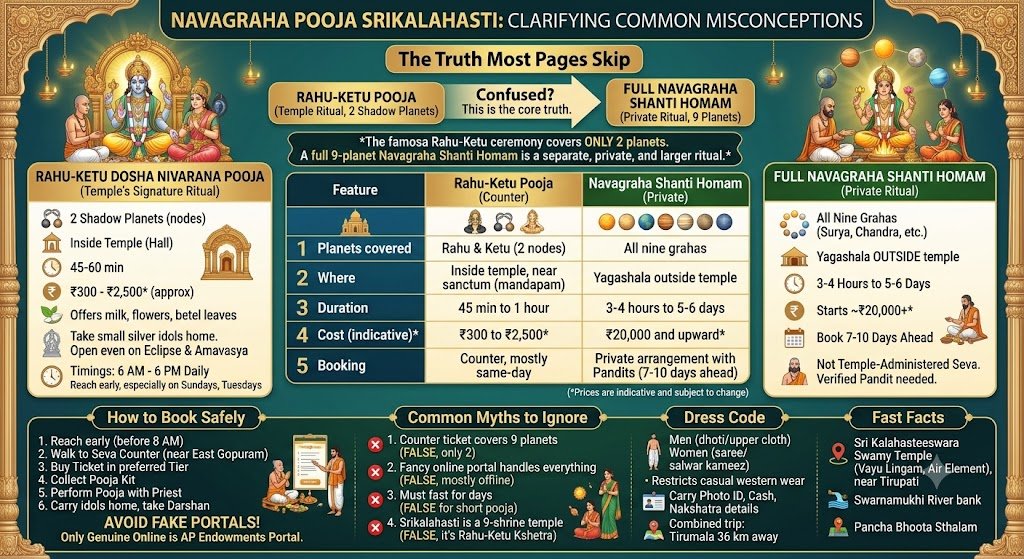
If you searched for Navagraha Pooja Srikalahasti expecting a single nine-planet ritual at the temple counter, here is the truth most pages skip. The famous ceremony at this Shiva shrine is the Rahu-Ketu Dosha Nivarana Pooja, and it covers only two of the nine planets. A complete nine-planet Navagraha Shanti Homam is a separate, larger, private ritual held outside the main temple.
Because the two get mixed up constantly, devotees often pay for the wrong thing. So this guide separates them clearly, with verified timings, real price ranges, and a safe booking path.
Navagraha Pooja Srikalahasti at a Glance
Before you plan the trip, here are the fast facts that matter most.
- Temple: Sri Kalahasteeswara Swamy Temple, Srikalahasti, near Tirupati, Andhra Pradesh.
- Signature planetary ritual: Rahu-Ketu Dosha Nivarana Pooja (two shadow planets), sold as a counter ticket.
- Full nine-planet option: Navagraha Shanti Homam, arranged privately in yagashalas outside the temple.
- Rahu-Ketu pooja timing: roughly 6:00 AM to 5:00 PM daily, even on eclipse and Amavasya days.
- Rahu-Ketu ticket tiers: ₹500, ₹750, ₹1,500, ₹2,500 and ₹5,000, as published by the AP Endowments Department.
- Booking: counter-first and mostly offline, because online slots stay limited.
What Navagraha Pooja Srikalahasti Actually Means
Navagraha Pooja Srikalahasti usually means the Rahu-Ketu Dosha Nivarana Pooja, not a full nine-planet ceremony. Rahu and Ketu are the two shadow planets, and this shrine is famous specifically as the Rahu-Ketu Kshetra. Because the temple has no cluster of nine planetary sub-shrines, the counter ritual naturally centres on these two nodes.
The nine grahas in Vedic astrology are Surya, Chandra, Angaraka, Budha, Brihaspati, Shukra, Shani, Rahu, and Ketu. A true Navagraha Shanti Homam honours all nine together. At Srikalahasti, however, the everyday ticketed ritual targets Rahu and Ketu, since these nodes are blamed for Kala Sarpa Dosha and Naga Dosha. For the full ritual detail, see this dedicated Rahu Ketu Pooja guide.
This shrine is one of the Pancha Bhoota Sthalams, and it honours Lord Shiva as the Vayu Lingam, the air element. According to Wikipedia’s Srikalahasti Temple reference, the shrine sits on the Swarnamukhi River and links closely to Rahu and Ketu in the astrological tradition.
This distinction matters because your horoscope decides which remedy fits. If an astrologer flagged Rahu-Ketu affliction, the counter pooja suits you. If several planets are troubling you, then a wider Navagraha remedy makes more sense.
Rahu-Ketu Dosha Nivarana Pooja: The Temple’s Signature Ritual
This is the ceremony that draws thousands here every single day. Devotees sit before the Rahu-Ketu mandap, and a priest guides the mantras while they offer milk, flowers, and betel leaves. After the ritual, you keep the small silver idols at home in your pooja room.
The whole thing usually takes 45 minutes to an hour, so it fits easily into a day trip. Because Srikalahasti stays open during solar and lunar eclipses, it remains one of the few temples where this remedy continues on Grahan days.
Timings and Where the Pooja Happens
The temple conducts the Rahu-Ketu pooja daily, between 6:00 AM and 5:00 PM. Separate halls near the sanctum handle the crowd, and batches run through the day. When you arrive, reach the counter at least 30 minutes before your intended slot.
Sundays, Tuesdays, Amavasya, and eclipse days stay the busiest, so morning arrival helps. Although the ritual is short, queues on Amavasya can stretch for hours because demand spikes sharply. For standard opening hours and quiet slots, check the temple’s darshan timings before you travel. To pick an auspicious day, cross-check Rahu Kalam on a trusted panchang such as Drik Panchang.
Ticket Prices You Should Expect
The Devasthanam publishes five Rahu-Ketu pooja ticket tiers: ₹500, ₹750, ₹1,500, ₹2,500 and ₹5,000. Older pages quoting a ₹150 or ₹300 slab are out of date. Because prices change with temple orders, treat every number here as indicative and confirm the live rate at the counter.
For two people, budget roughly ₹2,000 to ₹3,500 including idols and small offerings. The temple usually supplies the pooja kit, while priests guide the steps in Telugu and Sanskrit.
The Full Navagraha Shanti Homam Near Srikalahasti
A complete Navagraha Shanti Homam is a different animal altogether. Private pandits perform it in yagashalas outside the main temple, not at the seva counter. Because it invokes all nine planets, it takes far longer and costs much more than the Rahu-Ketu pooja.
A simple single-day version runs about 3 to 4 hours, with three or four priests chanting 1,008 mantras for each graha. A Paripoorna Navagraha Shanti Homam, the elaborate multi-day form, can stretch across five or six days. Reported starting costs begin around ₹20,000 to ₹23,000, and they climb with the Japa count and duration.
Since these homams are private arrangements, you must book them in advance, often 7 to 10 days ahead. Always verify the pandit’s credentials before paying, because this ritual is not a temple-administered seva.
Rahu-Ketu Pooja vs Full Navagraha Homam
The two rituals differ sharply in scope, time, and cost. This comparison shows which one truly matches your need.
| Feature | Rahu-Ketu Pooja (Counter) | Navagraha Shanti Homam (Private) |
|---|---|---|
| Planets covered | Rahu and Ketu (2 nodes) | All nine grahas |
| Where | Inside temple, near sanctum | Yagashala outside temple |
| Duration | 45 min to 1 hour | 3-4 hours to 5-6 days |
| Cost (indicative) | ₹500 to ₹5,000 | ₹20,000 and upward |
| Booking | Counter, mostly same-day | Private, 7-10 days ahead |
To put it plainly, the counter pooja handles Rahu-Ketu affliction at low cost, while the homam addresses wider planetary trouble at a premium.
Which Ritual Do You Actually Need?
Your Navagraha Pooja Srikalahasti choice should follow your horoscope, not the crowd. If a jyotishi flagged only Rahu-Ketu Dosha, Kala Sarpa Dosha, or Naga Dosha, then the counter Rahu-Ketu pooja is enough. It is affordable, quick, and performed here with deep tradition.
Choose the full Navagraha Shanti Homam only when multiple planets show affliction, or when an astrologer specifically recommends a nine-planet remedy. Because that homam demands time and money, do not opt for it on a vague hunch. When in doubt, get a chart reading first, so you spend on the right ritual.
Many families combine both wisely. They perform the quick Rahu-Ketu pooja during a temple visit, and they reserve the larger homam for a planned occasion. This layered approach appears in no single official source, yet it saves both money and repeat trips.
How to Book Navagraha Pooja Srikalahasti Safely
Booking Navagraha Pooja Srikalahasti safely means going counter-first and avoiding fake portals. The temple falls under the Andhra Pradesh Endowments Department, and that government portal is its only genuine online channel. Beyond that, most Rahu-Ketu tickets still change hands at the temple counter on the same day. For the wider ritual menu and current tiers, this all seva list stays handy.
Follow these steps for a smooth, scam-free visit.
- Reach the temple early, ideally before 8:00 AM on busy days.
- Walk to the seva counter beside the east gopuram.
- Buy the Rahu-Ketu pooja ticket in the batch tier you prefer.
- Collect the pooja kit, then move to the assigned hall.
- Follow the priest, offer milk and flowers, and complete the ritual.
- Carry the silver idols home, and then take darshan of Lord Kalahasteeswara.
Avoid agents who promise instant tickets for extra cash, because touts operate around every busy temple. For a private Navagraha Homam, deal only with a verified priest, and never wire large sums to an unknown “official” website.
Myths About Navagraha Pooja Srikalahasti to Ignore
Several myths about Navagraha Pooja Srikalahasti circulate online, and they cost devotees money. Correcting them is the whole point of an honest guide.
Myth 1: The counter ticket covers all nine planets. It does not. That ticket is the Rahu-Ketu pooja, so it addresses two nodes, not the full Navagraha set.
Myth 2: A fancy online portal handles every seva. In reality, the temple issues most tickets at the counter, and only the government portal is genuinely official. Some third-party sites even use look-alike domains, so verify before you pay.
Myth 3: You must fast for days. For the short Rahu-Ketu pooja, no long fast is required. Fasting suits the elaborate homam, yet priests advise against strict fasting for children and the elderly.
Myth 4: Srikalahasti is a nine-shrine Navagraha temple. It is not. The classic nine-planet Navagraha sthalams sit around Kumbakonam in Tamil Nadu, whereas Srikalahasti is the Rahu-Ketu Kshetra.
Dress Code, Timing and What to Carry
A little preparation saves a lot of stress at the counter. Men should wear a dhoti or panche with an upper cloth, while women should wear a saree or salwar kameez. Because the temple enforces the dress code during poojas, casual western wear can cause problems.
Carry a valid photo ID, some cash, and your birth nakshatra details if you know them. Priests sometimes use gotra and nakshatra to personalise the chants. Since phones stay restricted near the sanctum, keep valuables minimal.
Here is a tip most guides miss. If you plan a combined Tirupati trip, do Tirumala darshan in the morning, then reach Srikalahasti by afternoon for the pooja. The two sites sit only about 36 km apart, so one day covers both comfortably.
How to Reach Srikalahasti
Srikalahasti is easy to reach by air, road, and rail. The nearest airport is Tirupati Airport, roughly 25 km away, while Tirupati city lies about 36 km from the temple.
Regular buses run from Chennai, Bangalore, and Hyderabad, and the town has its own railway station. Because most pilgrims combine the visit with Tirupati, shared cabs and buses on this route stay frequent. The temple sits on the banks of the Swarnamukhi River, so the approach itself feels serene.
Before You Plan Your Visit
Navagraha Pooja Srikalahasti rewards devotees who understand what they are booking. Choose the Rahu-Ketu counter pooja for shadow-planet remedies, and reserve the full nine-planet homam for wider astrological needs. Buy tickets at the counter or through the official government portal, and steer clear of look-alike websites and touts.
Above all, treat every price here as indicative, because temple orders revise fees over time. Confirm the live rate, follow the dress code, and let devotion guide the rest.
Frequently Asked Questions
Is Navagraha Pooja and Rahu-Ketu Pooja the same at Srikalahasti?
No, they are not identical. The counter ritual most people call Navagraha Pooja here is actually the Rahu-Ketu Dosha Nivarana Pooja, covering two planets. A full nine-planet Navagraha Shanti Homam is a separate private ceremony held outside the temple.
How much does the Rahu-Ketu pooja cost at Srikalahasti?
The five published tiers are ₹500, ₹750, ₹1,500, ₹2,500 and ₹5,000. Because rates change, confirm the current price at the temple counter before booking.
Can I book Navagraha Pooja Srikalahasti online?
Online options stay limited for these rituals. The genuine online channel is the Andhra Pradesh Endowments portal, though most Rahu-Ketu tickets still sell at the counter. Avoid unofficial look-alike sites that request payment.
What are the Rahu-Ketu pooja timings?
The temple performs the pooja daily, roughly from 6:00 AM to 5:00 PM. It continues even on eclipse and Amavasya days, when many other temples close. Arrive early on Sundays, Tuesdays, and new-moon days to avoid long queues.
How long does a full Navagraha Shanti Homam take?
A simple single-day homam runs about 3 to 4 hours. The elaborate Paripoorna form can span five or six days with multiple priests. Book such a homam 7 to 10 days in advance through a verified pandit.
What should I wear for the pooja?
Men should wear a dhoti with an upper cloth, and women should wear a saree or salwar kameez. The temple applies the dress code strictly during poojas. Traditional attire is expected inside the sanctum area.
Can couples and children perform the pooja together?
Yes, couples routinely perform the Rahu-Ketu pooja together. Children can participate too, although very long homams may tire infants. For a short counter pooja, families of any age join comfortably.
Is Srikalahasti a Navagraha temple with nine shrines?
No, it is the Rahu-Ketu Kshetra, not a nine-shrine Navagraha temple. The classic nine-planet Navagraha sthalams lie near Kumbakonam in Tamil Nadu. Srikalahasti focuses on Rahu, Ketu, and serpent-related remedies.

Independent pilgrim guide for Sri Kalahasti Temple. Curating darshan timings, Rahu Ketu Pooja booking, sevas, accommodation, Vayu Lingam significance, and complete travel guidance for devotees visiting the temple.
