
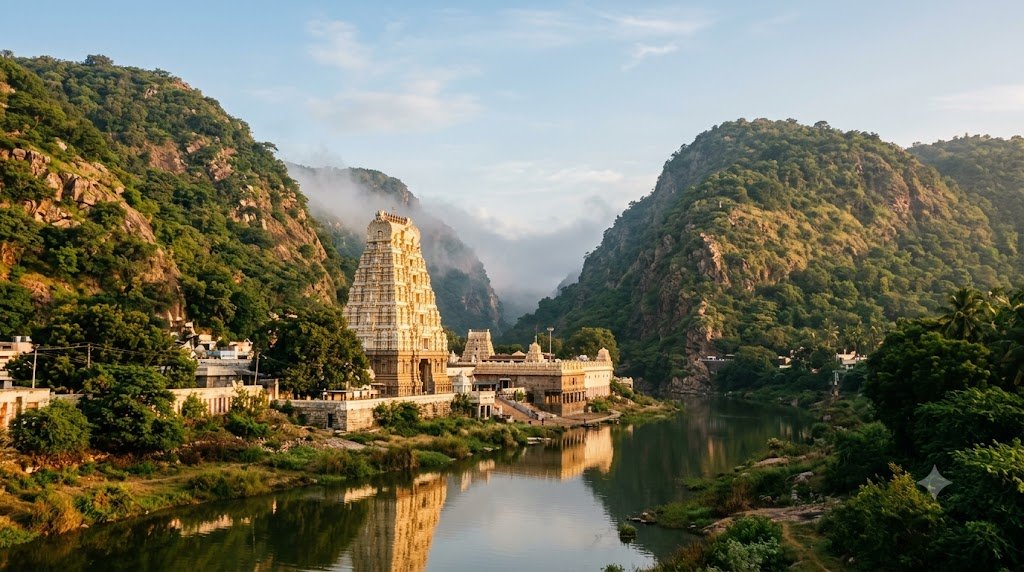
The Sri Kalahasti Vayu Lingam sits in one of the windiest natural pockets in southern Andhra Pradesh, and that placement was no accident. Devotees who reach this ancient Shiva shrine near Tirupati keep asking the same question. Why does a lamp inside the sealed sanctum flicker when there is no window, no open door, and no fan? The answer lies in the land itself. This temple rests in a narrow gap between two hills, beside a river, in a corridor that funnels moving air almost without pause.
Most guides repeat the legend and stop there. So here you get the geography, the structural facts, the corrected myths, and a clear visit plan, all in one place.
Sri Kalahasti at a Glance
- Location: Srikalahasti town, Tirupati district, Andhra Pradesh, about 36 km from Tirupati.
- Element: Air (Vayu), one of the five Pancha Bhoota Sthalams.
- Setting: Wedged between two steep hills, with the Swarnamukhi river along the western wall.
- The marvel: A lamp in the windowless inner sanctum that keeps moving without any breeze.
- Rare custom: The temple stays open during solar and lunar eclipses, when most temples close.
- Built by: Inner sanctum from the 5th century, with the Cholas and the Vijayanagara empire adding the rest.
Why the Sri Kalahasti Vayu Lingam Sits in a Wind Tunnel Zone
The Sri Kalahasti Vayu Lingam stands in a wind tunnel zone because the temple occupies a narrow valley between two hills, with the Swarnamukhi river running along its western wall. Wind squeezing through that gap speeds up and stays steady, so moving air is almost always present at the site. The element you came to worship greets you before you even step inside.
This is simple physics that the builders read in the landscape. When wind meets a tight channel between high ground, it accelerates. The two hills here, Sripuram and Mummidi-cholapuram, form exactly that channel. Because the river cuts a low corridor between them, breezes track along the water and past the temple walls through much of the day.
The Two Hills That Funnel the Wind
The temple lies between Sripuram hill and Mummidi-cholapuram hill, while Kannappa’s shrine crowns a nearby ridge. The Swarnamukhi flows past the west wall and turns north, carving a natural wind lane. Since hills on both sides press the moving air into a tighter space, the breeze gathers strength as it passes. Ancient sites were often chosen for such felt qualities, so a place where the air never fully rests suited a shrine to the wind perfectly.
The Flickering Lamp Inside the Windowless Sanctum
Step into the inner chamber and you meet the temple’s signature wonder. The garbhagriha, the innermost room, has no windows. Even so, the oil-lamp flames near the lingam sway and dance without pause. Priests and pilgrims have watched this for centuries, and many describe it as the living breath of Shiva.
There is a grounded reading too, and both can hold. Deep stone corridors, the doorway, and tiny gaps in old masonry let faint draughts reach the chamber. Meanwhile the valley outside keeps feeding moving air toward the temple. So the flame always has something to respond to, even when you feel still air on your own skin. Tradition calls it Vayu; the building simply lets it happen.
What Makes the Sri Kalahasti Vayu Lingam the Air Element Temple
The Sri Kalahasti Vayu Lingam is the air-element shrine among the Pancha Bhoota Sthalams, the five Shiva temples that each embody one element of nature. Here Lord Shiva is worshipped as Kalahasteeswara, the form of Vayu, the wind. The flickering lamp serves as the visible sign of that unseen element.
In Hindu thought, air means more than weather. It is Prana, the life-breath that moves through every being. Worshippers treat the constant motion of the flame as a reminder that the divine, like air, surrounds us yet stays unseen. That belief is offered here as tradition rather than proven fact. You can read more about the temple on the Incredible India portal.
The Pancha Bhoota Sthalam Connection
Five temples in South India hold this elemental scheme together, and each one shows its element in a physical way. At Srikalahasti the proof is moving air, while at Thiruvanaikaval water seeps up through the sanctum floor. The table below maps all five.
| Temple | Element | Place |
|---|---|---|
| Ekambareswarar | Earth | Kanchipuram |
| Jambukeswarar | Water | Thiruvanaikaval |
| Arunachaleswarar | Fire | Tiruvannamalai |
| Srikalahasteeswara | Air | Srikalahasti |
| Thillai Nataraja | Space | Chidambaram |
If you want the full set, you can pair this trip with the water-element temple at Thiruvanaikaval and the fire-element shrine at Tiruvannamalai on a longer Pancha Bhoota route.
How the Sri Kalahasti Vayu Lingam Differs From Other Shiva Lingams
The lingam here is swayambhu, which means self-manifested rather than carved and installed. It is white, tall, and shaped like an elephant’s trunk. Its base carries the marks of a spider, a serpent’s hoods, and an elephant’s tusks. Because the priests treat it as the living wind, they never touch it directly with their hands. Abhishekam, the ritual bathing, reaches it without hand contact, and that custom sets this shrine apart from most Shiva temples.
Did the Ancients Engineer the Airflow, or Find It?
Here is where careful thinking matters. Some blogs claim that ancient engineers built hidden airflow channels under the sanctum to keep the lamp moving. That claim has no verified source, and no archaeological study supports it. So treat it as an online myth, not history.
The honest answer is more interesting. The builders did not manufacture the wind. Instead they chose a site where moving air was already constant, then placed the shrine so that air could reach the deity. That is siting genius, not a hidden machine. Reading a landscape this well is itself an old and very real skill.
Misconceptions Worth Correcting
Several errors circulate about this temple, so it helps to set them straight before you visit.
Myth: the main shrine collapsed. It did not. The tall Rajagopuram, the gateway tower built in 1516 by Krishnadevaraya, fell on 26 May 2010, while the sanctum stayed untouched. Authorities rebuilt the tower at a cost of about ₹45 crore and reconsecrated it on 18 January 2017.
Myth: wind toppled the tower. It did not. The Archaeology Department traced the collapse to a shallow foundation, only about one-and-a-half feet deep, plus a crack that had spread for years after a lightning strike. The air-element temple was undone by weak ground, then made whole again.
Myth: the whole complex dates to one reign. The inner sanctum goes back to the 5th century. After that, the Cholas and the Vijayanagara kings added the outer temple and towers across later centuries.
What the Wind Means in Hindu Thought
For devotees, the moving air carries meaning beyond comfort. Vayu is one of the Pancha Bhootas, and tradition holds that without air there is no life and no movement of thought. So a shrine where the wind never stops becomes a place to steady the breath and the mind.
Many visitors sit quietly in the pillared halls and report an easy calm. Whether you read that as Prana or simply as a cool, breezy old stone hall, the effect feels gentle and real. The temple invites you to slow down and notice your own breathing.
Planning Your Visit to the Sri Kalahasti Vayu Lingam
Reaching the Sri Kalahasti Vayu Lingam is easy from Tirupati, which lies about 36 km away. Srikalahasti has its own railway station, code KHT, roughly 3 km from the temple. The nearest airport is Tirupati (Renigunta), around 40 km by road, with taxis and buses for the last stretch.
The temple generally opens early, around 6 AM, and stays active through the day. Because seva timings and festival days shift, check the Andhra Pradesh temples portal and our darshan timings and entry details before you travel. October to February brings the most pleasant weather for the journey.
What Most Guides Leave Out
A few practical notes can save you time and stress on the day.
- Phones and cameras stay outside. Use the free deposit counter near the gateway, since devices are not allowed near the sanctum.
- The Pathala Ganapati shrine sits about 20 feet below ground. The narrow steps admit only a few people at a time, so expect a short wait there.
- Watch the lamp, not just the lingam. The flame’s motion is the whole point of this air shrine, yet many devotees rush past it.
- Mornings stay calmer. Arrive before the Tirupati day-trippers, who often stop here on the way.
- Carry cash. Small sevas and counters still lean on cash payments.
Before You Go
The Sri Kalahasti Vayu Lingam earned its name from where it stands as much as from any legend. A valley between two hills, a river cutting a wind lane, and a windowless sanctum that still feels the breeze all point to one idea. The builders chose a place where the air element was already alive, then framed it in stone. Visit early, watch the flame, and let the wind do the rest. For timings and seva details, lean on the official portals before you set out.
Frequently Asked Questions
Why is the Sri Kalahasti Vayu Lingam the air-element temple?
Sri Kalahasti is the air-element shrine among the five Pancha Bhoota Sthalams, so Lord Shiva is worshipped here as Vayu, the wind. A lamp inside the windowless sanctum keeps flickering without any breeze. Tradition reads that constant motion as the living presence of air.
Is the temple really inside a wind tunnel zone?
The temple sits in a natural wind corridor, not a built tunnel. It lies in a narrow gap between two hills, with the Swarnamukhi river running alongside. Wind squeezing through that gap speeds up and stays steady, so moving air is almost always present.
Why does the lamp in the sanctum keep moving?
Faint draughts reach the chamber through the doorway and small gaps in the old stonework, even though the sanctum has no windows. The constant breeze from the valley outside feeds that air. Devotees honour the motion as the breath of Shiva, while the building quietly allows it.
Did ancient engineers build airflow channels under the temple?
No verified evidence supports that claim, so treat it as an online myth. The builders chose a site where the wind was already constant, then placed the shrine to face it. That is careful siting, not a hidden ventilation system.
Did the Sri Kalahasti temple collapse?
Only the tall Rajagopuram gateway tower fell, on 26 May 2010, while the sanctum stayed intact. A shallow foundation and an old crack caused it, not the wind. The tower was rebuilt and reconsecrated on 18 January 2017.
How old is the Srikalahasti temple?
The inner sanctum dates to about the 5th century, making the core well over a thousand years old. The Chola kings expanded it around the 11th century, and the Vijayanagara ruler Krishnadevaraya added the main tower in 1516.
Does the temple stay open during eclipses?
Yes. Unlike most Hindu temples, which close during solar and lunar eclipses, Srikalahasti remains open and even performs special abhishekam. This rare custom ties to its role as a Rahu-Ketu kshetra.
When is the best time to visit?
October to February offers the most comfortable weather for the trip. Early mornings stay calmer, since many Tirupati visitors arrive later in the day. Pick a weekday if you want a quieter darshan.

Independent pilgrim guide for Sri Kalahasti Temple. Curating darshan timings, Rahu Ketu Pooja booking, sevas, accommodation, Vayu Lingam significance, and complete travel guidance for devotees visiting the temple.
