
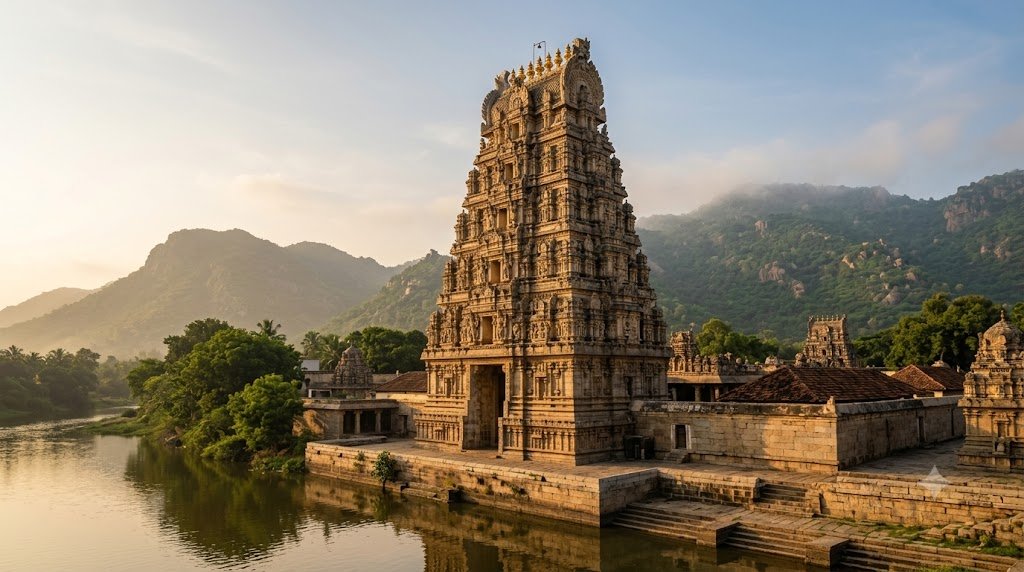
The Srikalahasti Temple history is a survival story that flattened lesser shrines but never broke this one. This thousand-year-old Shiva temple outlived the very empire that raised its grandest tower. It then stood back up after that tower crashed to the ground in living memory. If you want the honest account — patrons lost, a cyclone, decades of neglect, and a ₹45 crore rebuild — this is the full picture, not the myth.
Srikalahasti Temple History at a Glance
Before the deep dive, here are the facts most readers come looking for. Skim these, then read on for the story behind each one.
- Location: Srikalahasti town, Tirupati district, Andhra Pradesh, on the banks of the Swarnamukhi river.
- Deity: Lord Shiva as Sri Kalahasteeswara, worshipped as the Vayu Linga (wind element) — one of the five Pancha Bhoota Sthalams.
- Main builders: the Chola kings (10th–11th century) and the Vijayanagara emperor Krishnadevaraya (1516 CE).
- Famous tower: the towering Rajagopuram, raised by Krishnadevaraya, which collapsed on 26 May 2010.
- Reborn: a new gopuram was consecrated on 18 January 2017 at a cost of about ₹45 crore.
Who Actually Built the Srikalahasti Temple?
The temple was built in layers across many centuries, not by one king. The Cholas raised the main structure around the 10th–11th century, while the Vijayanagara emperor Krishnadevaraya added the giant entrance tower in 1516. Earlier references stretch back further still, so the shrine itself is older than any surviving stone.
So the Srikalahasti Temple history begins long before the Cholas. The Tamil Sangam-era poet Nakkeerar mentions the shrine, which tells us devotees worshipped here in very ancient times. Because of that, scholars treat the site as far older than its present walls.
The Chola Foundation
The Chola dynasty gave the temple its lasting shape. Emperor Rajendra Chola I is credited with the main structure around the 11th century, and Kulottunga Chola I added gateway towers soon after. Inscriptions of several Chola rulers still survive on the temple walls today.
These kings did more than build. They donated land, silver lamps, and ornaments, and they ranked Srikalahasti among their leading Shaivite centres. Since the Cholas anchored the temple in stone, it could outlast the dynasties that followed.
Krishnadevaraya and the Rajagopuram
Krishnadevaraya, the most famous Vijayanagara emperor, was a devotee who visited often. In 1516, he commissioned the soaring Rajagopuram — roughly 120 feet tall — along with a hundred-pillared hall of fine carvings. He raised the tower to mark his military victory over the Gajapati rulers of Odisha.
This single act shaped the skyline for five centuries. The seven-storey gopuram became the temple’s signature image, so its later fall struck a deep emotional chord across South India.
Did Invaders Ever Destroy the Srikalahasti Temple?
No reliable record shows an invading army sacking the Srikalahasti Temple itself. Unlike several famous shrines elsewhere in India, it was never plundered to ruin. Its real trials came from the collapse of its royal patrons and, much later, from nature and neglect — not from a siege.
This matters, because many travel blogs blur the picture. They imply dramatic raids that the historical sources simply do not confirm. Honest history is the better story here, so let us follow what actually happened.
Surviving the Fall of Vijayanagara
The temple’s greatest patron, the Vijayanagara Empire, fell after the Battle of Talikota in 1565. The Deccan Sultanates routed its army, and the capital Hampi was looted and destroyed over five long months. Many temples lost their funding and grandeur overnight.
Srikalahasti survived because it sat far from that doomed capital. Distance spared its stones while Hampi crumbled. Although royal patronage dried up, the shrine kept its rituals alive through local devotion and lesser donors.
From Nawabs to the British
After Vijayanagara, power passed through new hands. The Nawabs of Arcot and later the British both recognised the temple’s importance, even if their involvement varied. Worship never stopped, so the unbroken ritual line became the quiet backbone of the Srikalahasti Temple history.
That continuity is the real triumph. Empires rose and fell around it, yet the lamp in the sanctum kept flickering. Because faith outlasted politics, the temple endured every change of ruler.
The 2010 Rajagopuram Collapse
The temple’s hardest modern test came on 26 May 2010. The 500-year-old Rajagopuram crashed down around 8:30 PM, reduced to a mound of rubble within seconds. It was the most dramatic single event in the temple’s recent past.
Witnesses described a loud roar and a cloud of dust as the seven-storey tower descended. One pilgrim recalled having darshan of the gopuram that very evening, only to hear it crash minutes later. The shock spread quickly across Andhra Pradesh and beyond.
What Caused the Gopuram to Fall
The collapse had deep roots, not a single sudden cause. A worrying crack had been noticed years earlier, and some accounts trace warnings back more than two decades. Because the tower stood on a shallow foundation barely one-and-a-half feet deep, it was always vulnerable.
Then Cyclone Laila lashed the state in May 2010 with torrential rain. The downpour widened the fissure rapidly along the full face of the tower. Borewell digging nearby may also have weakened the ground, so several pressures combined at once.
How a Major Tragedy Was Averted
Quick action saved many lives. After experts — including a structural engineering team linked to IIT Madras — inspected the cracks, officials declared a 150-metre danger zone and evacuated the precinct. They barred devotees from the area a full day before the fall.
Because of that warning, no human lives were lost when the tower came down. Sadly, scores of monkeys living on the gopuram were feared crushed. Strikingly, the bronze statue of Krishnadevaraya just ten feet away survived untouched, with the debris resting at the emperor’s feet.
Timeline of Srikalahasti Temple History
This timeline maps the Srikalahasti Temple history into clear milestones. It shows how each era added a layer, and how the temple recovered after its hardest blow.
| Period | Event |
|---|---|
| Ancient era | Worship at the site; references in Tamil Sangam poetry |
| 10th–11th century | Cholas build the main structure; Rajendra Chola I and Kulottunga Chola I patronise it |
| 1516 CE | Krishnadevaraya raises the Rajagopuram and the hundred-pillar hall |
| 1565 CE | Vijayanagara falls at Talikota; the temple survives as the capital burns |
| 26 May 2010 | The historic Rajagopuram collapses after Cyclone Laila |
| 18 January 2017 | The rebuilt gopuram is consecrated |
Read top to bottom, the pattern is plain. Construction, loss, and revival repeat across the centuries, yet worship never truly stops.
The ₹45 Crore Reconstruction
Rebuilding the fallen tower became a major heritage project. The Andhra Pradesh government and the Archaeological Department launched restoration work soon after the collapse. The reconstructed Rajagopuram was finally consecrated on 18 January 2017 at a reported cost of about ₹45 crore — check the official AP Endowments portal for the latest details.
Navayuga Engineering Company carried out the work through the CVR Foundation. Engineers, masons, and sculptors rebuilt the tower in its original form at the same spot. So the newest chapter of the Srikalahasti Temple history honoured the old design while fixing its fatal flaw.
Traditional Methods, Modern Engineering
The rebuild blended ancient craft with modern strength. Builders followed Agama Shastra, the traditional rulebook for temple construction, to keep the design authentic. They used the best granite from the Chilakaluripeta quarries in Guntur district.
The crucial change lay underground. The team drove deep pile foundations to replace the shallow base that doomed the old tower. They still bonded the stone with traditional lime, sand, and jaggery, so the structure is built to last for many centuries to come.
What the Srikalahasti Temple History Teaches Us
The deepest lesson is simple. This shrine survived not by repelling armies but by outliving every power that ruled it. Faith and ritual proved more durable than any dynasty or stone tower.
There is a sharp engineering lesson too. The original Rajagopuram fell because of a shallow foundation and decades of ignored warnings, not because of any curse. Heritage survives when maintenance is taken seriously, so the rebuild’s deep piles matter as much as its carvings.
Looking ahead, the temple now faces its old enemies in new forms. Weathering, pollution, and heavy footfall threaten the soft stone and metal work. Because conservation never really ends, ongoing care will decide the next chapter of this story.
Heritage Notes Most Guides Skip
A few details rarely make it into the usual write-ups. They add real texture to the temple’s past and present.
- The original Rajagopuram was unusually built with brick and clay, not solid stone — which partly explains its fragility.
- The temple uniquely stays open during solar and lunar eclipses, while most shrines close.
- The Swarnamukhi river and the surrounding hills shaped an irregular temple plan, since the hill itself serves as a wall in places.
- Srikalahasti is nicknamed Dakshina Kasi, the “Kashi of the South,” for its deep Shaivite roots.
Planning a Visit Today
The temple is fully open and safe, with the rebuilt gopuram standing tall again. Most pilgrims pair it with Tirupati, since the two towns sit barely an hour apart. For practical timings and entry details, see our Srikalahasti darshan guide before you travel.
Many visitors also come for the famous Rahu-Ketu rituals performed here. If that is your goal, read our walkthrough of the Rahu Ketu pooja booking and cost. Travellers combining both shrines can check whether to visit Kalahasti before or after Tirupati to plan the trip well.
For official information, the Incredible India portal and the official AP Endowments portal are reliable starting points.
The Bottom Line
The Srikalahasti Temple history is ultimately a lesson in endurance through devotion. It was built by Cholas, crowned by Krishnadevaraya, and orphaned when Vijayanagara fell, yet it never stopped functioning. Even when its proudest tower collapsed in 2010, careful evacuation saved lives and a faithful rebuild restored its skyline by 2017. If you visit, stand before the new Rajagopuram and remember it marks five centuries of loss and revival — then plan your darshan early to beat the crowds.
Frequently Asked Questions
Who built the Srikalahasti Temple?
The Chola kings built the main structure around the 10th–11th century, with Rajendra Chola I and Kulottunga Chola I as key patrons. The Vijayanagara emperor Krishnadevaraya later added the famous Rajagopuram in 1516. The shrine itself is older than these stone additions.
When did the Srikalahasti gopuram collapse?
The historic Rajagopuram collapsed on 26 May 2010, at around 8:30 PM. The 500-year-old tower fell after a long-standing crack widened during heavy rain from Cyclone Laila. It was the most significant disaster in the temple’s recent history.
Why did the Rajagopuram fall?
The tower fell because of a shallow foundation, decades of structural weakening, and an ignored crack. Torrential rain from Cyclone Laila widened the fissure rapidly in May 2010. Nearby borewell digging may also have weakened the ground.
Was anyone killed in the 2010 collapse?
No human lives were lost in the collapse. Officials had declared a 150-metre danger zone and evacuated the area a day earlier, which averted a major tragedy. Many monkeys living on the tower, however, were feared killed.
How much did the reconstruction cost?
The reconstruction cost about ₹45 crore. Navayuga Engineering Company rebuilt the tower through the CVR Foundation, using deep pile foundations and traditional methods. The new gopuram was consecrated on 18 January 2017.
Was the Srikalahasti Temple ever destroyed by invaders?
No reliable record shows the Srikalahasti Temple being sacked by an invading army. It survived the collapse of the Vijayanagara Empire after 1565 because it lay far from the destroyed capital. Its real threats came from lost patronage and natural decay.
How old is the Srikalahasti Temple?
The temple is more than a thousand years old in its present form, with the Cholas building its main structure in the 10th–11th century. References in ancient Tamil Sangam poetry suggest worship at the site is far older still. It ranks among the oldest active Shiva shrines in South India.
Is the temple safe to visit now?
Yes, the temple is fully open and safe for pilgrims. The rebuilt Rajagopuram, consecrated in 2017, rests on deep, modern foundations. Daily darshan and special poojas run as usual throughout the year.

Independent pilgrim guide for Sri Kalahasti Temple. Curating darshan timings, Rahu Ketu Pooja booking, sevas, accommodation, Vayu Lingam significance, and complete travel guidance for devotees visiting the temple.
