
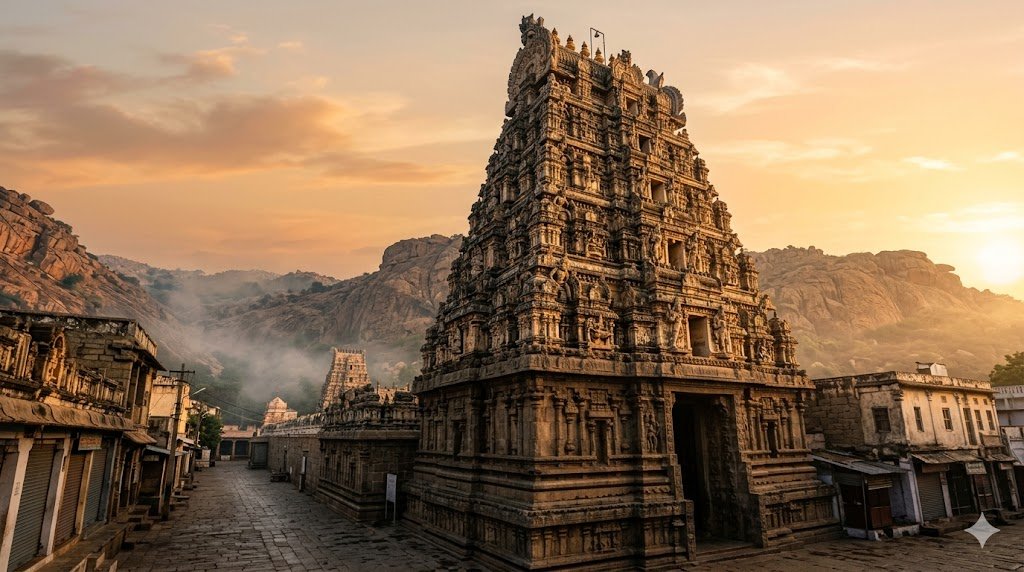
A Kalahasti Tirupati pilgrimage connects three powerful shrines in one compact circuit — Lord Venkateswara at Tirumala, the Vayu Lingam at Srikalahasti, and Goddess Padmavathi at Tiruchanur. Most pilgrims plan only the Tirumala leg, so they miss the temple order, the bookings, and the timing that make the full circuit work. This guide fixes that with verified timings, current ticket prices, and a tested two-day route.
Quick Facts
- The circuit covers three temples within 36 km of Tirupati city.
- Tirumala’s ₹300 Special Entry Darshan is booked online and sells out within minutes of release.
- Srikalahasti’s Rahu Ketu pooja runs daily from 6:00 AM to 5:00 PM, with tickets from ₹500 to ₹5,000.
- Rahu Ketu pooja tickets sell at the temple counter only — there is no official online booking.
- Tradition places Tiruchanur Padmavathi darshan before or after Tirumala, since she is the Lord’s consort.
- Two days cover the circuit comfortably; one day is possible but rushed.
What Does the Circuit Actually Cover?
The circuit pairs South India’s most visited Vishnu shrine with one of its most powerful Shiva shrines, plus the goddess temple that completes the family. Tirumala honours Lord Venkateswara, Srikalahasti houses the Vayu Lingam, and Tiruchanur is home to Sri Padmavathi Devi. Together they form a rare Hari-Hara circuit within a single district.
Few pilgrimage routes in India let you worship Vishnu, Shiva, and Lakshmi within an hour of each other. Because of this, the circuit attracts devotees seeking both Venkateswara’s blessings and relief from Rahu-Ketu doshas. Srikalahasti is also one of the Pancha Bhoota Sthalams, the five temples representing the natural elements, where it stands for air.
Kalahasti Tirupati Pilgrimage Route: Which Temple Comes First?
The traditional order on a Kalahasti Tirupati pilgrimage is Tiruchanur first, Tirumala second, and Srikalahasti last. Devotees worship Goddess Padmavathi before climbing the hill, because tradition holds that Lord Venkateswara is pleased when his consort receives darshan first. Srikalahasti then closes the circuit on the return journey.
You will read conflicting claims about this order online. However, no temple authority enforces any sequence — the order is custom, not rule. So if your darshan slot at Tirumala falls on day one, visit Srikalahasti and Tiruchanur on day two without worry.
The distances make planning simple, since everything radiates from Tirupati city.
| Route | Distance | Travel Time |
|---|---|---|
| Tirupati → Tiruchanur | 5 km | 15–20 min |
| Tirupati → Tirumala | 22 km ghat road | About 45 min |
| Tirupati → Srikalahasti | 36 km | About 1 hour |
In plain terms: Tiruchanur sits 5 km from Tirupati, Tirumala is 22 km up the ghat road, and Srikalahasti lies 36 km to the east. Andhra Pradesh State Road Transport Corporation (APSRTC) buses run frequently on all three routes, so you never need a private vehicle.
Tirumala Venkateswara Temple: Darshan Options Explained
Tirumala Tirupati Devasthanams (TTD) manages the hill temple of Lord Venkateswara, which functions almost around the clock with sevas starting near 2:30 AM. Pilgrims choose between free Sarva Darshan and the paid ₹300 Special Entry Darshan, also called Seeghra Darshan. The paid route is faster, while the free queue can stretch many hours on peak days.
Sarva Darshan needs no ticket, yet waiting times of 10 to 18 hours are common during festivals and weekends. The ₹300 ticket gives you a fixed time slot and a dedicated queue, so the full process usually takes two to four hours. Each ₹300 ticket also includes one free Tirupati laddu, and extra laddus cost ₹50 at the counters.
How Do You Book the ₹300 Special Entry Darshan?
Book on the official TTD portal at ttdevasthanams.ap.gov.in, where TTD releases each month’s quota in advance — roughly one month before, at 10 AM on the announced date. Register with your mobile number and Aadhaar, pick a slot, and pay ₹300 per person. Tickets for popular months finish within minutes.
Three booking habits separate successful pilgrims from disappointed ones. First, log in 15–20 minutes before the release time with payment details ready. Second, keep every pilgrim’s Aadhaar number saved, because the form asks for ID per person. Third, stay flexible on dates, since weekday slots last longer than weekend slots.
If you miss the quota, also check the portal regularly for cancelled-slot re-releases. Walking the Alipiri footpath, a climb of 3,550 steps, remains another devotional option that bypasses road traffic entirely.
Srikalahasti Temple: The Vayu Lingam and Rahu Ketu Pooja
Srikalahasteeswara Temple enshrines the Vayu Lingam, the air-element form of Lord Shiva, and is famous nationwide for its Rahu Ketu Sarpa Dosha Nivarana pooja. The temple generally stays open from about 5:00 AM to 9:00 PM. Unusually, it conducts poojas even during solar and lunar eclipses, when most Indian temples close — a practice devotees consider especially powerful here.
The temple’s inner shrine dates back many centuries, while Chola and Vijayanagara rulers built the outer structures. The shrine also carries the story of Bhakta Kannappa, the hunter-devotee who offered his own eyes to the Lord. These layers make it far more than a dosha-remedy stop.
Rahu Ketu Pooja: Timings, Tickets, and Procedure
The Rahu Ketu pooja runs daily from 6:00 AM to 5:00 PM, and tickets cost between ₹500 and ₹5,000 depending on the seating tier. You buy tickets at the temple counters on the day of the pooja. Each session takes roughly 45 minutes to an hour, and priests guide devotees in Telugu, Tamil, Hindi, and English.
| Ticket Tier | What You Get |
|---|---|
| ₹500 – ₹1,500 | Standard batch pooja in the mandapam |
| ₹2,500 | Smaller batch, seating closer to the sanctum side |
| ₹5,000 | Premium tier with the quietest setting |
Here is a correction worth knowing, because several websites claim you can book Rahu Ketu pooja online. The temple does not offer official online booking for this pooja — counters sell tickets directly, and third-party “booking” sites should be avoided. After the pooja, you deposit the silver naga idols in the hundi inside the temple; tradition says never carry them home.
Wear traditional dress for the pooja: dhoti or kurta-pyjama for men, saree or salwar kameez for women. Also verify the current tier prices at the counter, since temple boards revise pooja tariffs periodically.
Tiruchanur Padmavathi Temple: The Stop Most Pilgrims Skip
Sri Padmavathi Ammavari Temple at Tiruchanur, just 5 km from Tirupati, honours the consort of Lord Venkateswara, locally loved as Alamelu Manga. The temple stays open from about 5 AM to 9 PM, and APSRTC buses run from Tirupati bus stand roughly every 15 minutes. Darshan takes 20–30 minutes on weekdays, though weekends stretch toward an hour.
Fridays draw the largest crowds, since the day is auspicious for Goddess Lakshmi. TTD manages this temple too, so seva bookings sit on the same official portal. Skipping Tiruchanur to save an hour is the most common planning mistake on this circuit, because tradition treats her darshan as the proper start of the yatra.
How Many Days Does a Kalahasti Tirupati Pilgrimage Need?
Two days cover a Kalahasti Tirupati pilgrimage comfortably, including all three temples and the Rahu Ketu pooja. One packed day works only if your Tirumala darshan slot falls in the early morning. Three days suit families with elders, since the schedule then allows rest between temple visits.
A proven two-day plan looks like this:
- Day 1, morning: Reach Tirupati, then take darshan at Tiruchanur Padmavathi Temple by 8 AM.
- Day 1, midday: Travel up the ghat road to Tirumala before your Special Entry slot.
- Day 1, evening: Complete Venkateswara darshan, collect laddu prasadam, and return to Tirupati for the night.
- Day 2, early morning: Catch a 6 AM bus to Srikalahasti, then buy the Rahu Ketu pooja ticket at the counter.
- Day 2, midday: Finish the pooja and darshan, drop the naga idols in the hundi, and head back by afternoon.
Morning slots at Srikalahasti stay calmer, so reaching before 7 AM beats the post-breakfast rush. Rahu Kalam hours draw heavy crowds for the pooja because many devotees consider those windows especially effective.
Kalahasti Tirupati Pilgrimage Cost Breakdown
A Kalahasti Tirupati pilgrimage costs surprisingly little if you use TTD facilities and state buses. The major spends are the darshan ticket, the pooja tier you choose, and one night’s stay. Everything else — bus fares, meals, prasadam — stays modest.
| Item | Cost | Where |
|---|---|---|
| Special Entry Darshan | ₹300 per person | TTD portal (online) |
| Sarva Darshan | Free | Queue at Tirumala |
| Rahu Ketu pooja | ₹500–₹5,000 | Srikalahasti counter |
| Srikalahasti special darshan | ₹200 per person | Temple counter |
| Extra laddu | ₹50 each | Tirumala counters |
So a couple choosing the ₹300 darshan and a mid-tier ₹1,500 pooja spends about ₹2,100 on tickets for the whole circuit. Budget hotels in Tirupati and TTD accommodation keep stay costs low, although TTD rooms also release online and disappear fast. Check current room availability on the TTD portal the same day darshan tickets open.
Best Time to Visit and What to Wear
October to March offers the most comfortable weather, since summer afternoons in this region cross 40°C. Brahmotsavam seasons bring spectacular festivities but also the year’s biggest crowds. If dosha-pooja is your priority, weekday mornings outside festival windows give the smoothest Srikalahasti experience.
Traditional dress is mandatory for Tirumala’s Special Entry Darshan and for the Rahu Ketu pooja. Men wear dhoti or kurta-pyjama, while women wear saree, half-saree, or salwar kameez with dupatta. Carry minimal luggage, because mobile phones and cameras are not allowed inside Tirumala temple and must go into lockers.
What First-Timers Get Wrong
After watching pilgrims repeat the same errors on this route, a few warnings save real grief. Each one below costs either hours or money when ignored.
- Booking Tirumala darshan first and planning everything else around hope — lock the ₹300 slot before booking trains or flights, because quotas vanish in minutes.
- Paying agents for “online Rahu Ketu pooja tickets” — the temple sells them at the counter only, so any online seller is unofficial.
- Reaching Srikalahasti at noon — the midday rush doubles your wait, while a 6:30 AM arrival often means a near-immediate batch.
- Carrying the silver naga idols home after the pooja — tradition requires depositing them in the temple hundi.
- Wearing jeans or western wear to the pooja or paid darshan — entry gets refused at the gate, not negotiated.
- Ignoring Tiruchanur entirely — her darshan takes under an hour and completes the circuit as tradition intends.
Before You Go
Plan in this order: secure the ₹300 Tirumala slot the moment the monthly quota opens, fix your travel dates around it, and slot Tiruchanur and Srikalahasti on either side. Carry Aadhaar for every pilgrim, wear traditional dress, and keep cash for the Srikalahasti pooja counter. Verify timings on the official tirumala.org and the Andhra Pradesh Endowments portal at aptemples.ap.gov.in just before travel, since temple boards revise schedules around festivals. Done this way, the full circuit fits into two unhurried, deeply satisfying days.
Frequently Asked Questions
Should I visit Srikalahasti before or after Tirupati?
Either order is acceptable, because no temple authority prescribes a sequence. Popular custom places Tiruchanur first, Tirumala next, and Srikalahasti last. Many devotees also visit Srikalahasti first when the Rahu Ketu pooja is their main purpose. Plan around your confirmed Tirumala slot rather than the folklore.
What is the cost of Rahu Ketu pooja at Srikalahasti?
Tickets range from ₹500 to ₹5,000 depending on the tier, with higher tiers offering smaller batches and quieter seating. The pooja runs daily from 6:00 AM to 5:00 PM. Buy tickets at the temple counter, since official online booking is not available for this pooja.
How far is Srikalahasti from Tirupati?
Srikalahasti lies about 36 km east of Tirupati, roughly a one-hour drive. APSRTC buses run frequently from Tirupati central bus stand. Srikalahasti also has its own railway station close to the temple, so train travel works too.
Can I complete the whole circuit in one day?
Yes, but only with an early-morning Tirumala darshan slot and tight discipline. Start at Tiruchanur by 6 AM, finish Tirumala by early afternoon, and reach Srikalahasti before the 5 PM pooja cutoff. Two days remain the comfortable choice, especially with children or elders.
Is online booking available for the ₹300 Tirumala darshan?
Yes — the ₹300 Special Entry Darshan is booked only online, on the official TTD portal ttdevasthanams.ap.gov.in. TTD releases each month’s quota about a month in advance at 10 AM on the announced date. Tickets sell out within minutes, so log in early with Aadhaar and payment details ready.
What is the dress code for these temples?
Traditional dress is compulsory for Tirumala’s paid darshan and the Srikalahasti pooja. Men wear dhoti or kurta-pyjama, while women wear saree, half-saree, or salwar kameez with dupatta. Regular darshan at Srikalahasti allows formal wear, although traditional dress is always the safer choice.
Does the ₹300 darshan ticket include laddu prasadam?
Yes, each ₹300 Special Entry Darshan ticket includes one free Tirupati laddu. Additional laddus cost ₹50 each at the official counters near the exit. Keep your darshan ticket safe, because counters check it while issuing the free laddu.

Independent pilgrim guide for Sri Kalahasti Temple. Curating darshan timings, Rahu Ketu Pooja booking, sevas, accommodation, Vayu Lingam significance, and complete travel guidance for devotees visiting the temple.
