
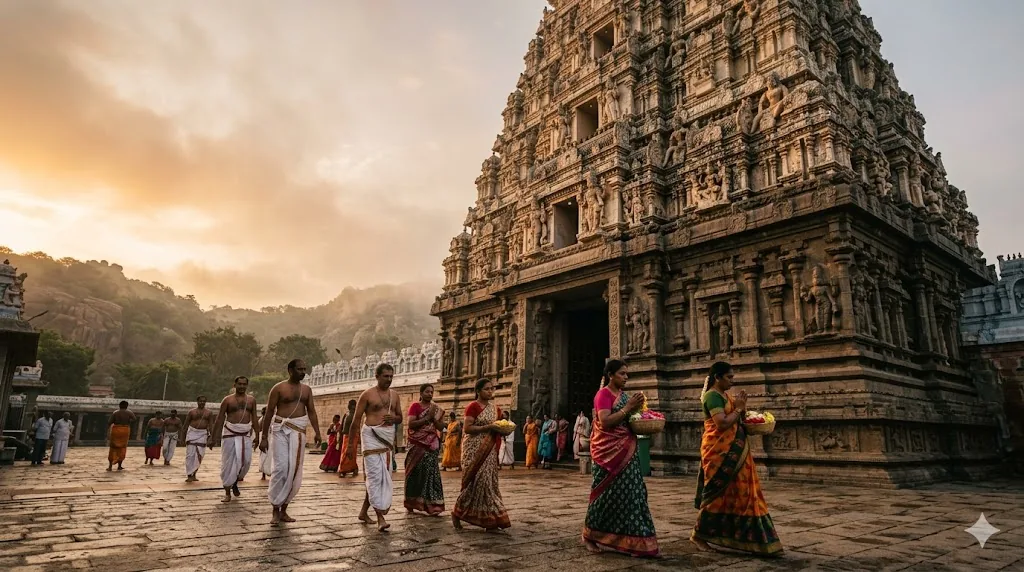
Kalahasti temple rules every devotee must know — Agama-based dos and donts on dress, conduct, sanctum entry, Rahu Ketu pooja etiquette, and offerings.
The Kalahasti temple rules drawn from the ancient Shaiva Agamas are not a list of restrictions — they form the spiritual operating manual that has governed devotee conduct at this Vayu Linga shrine for more than a thousand years. Most pilgrims arrive knowing only that they must remove footwear and dress modestly. However, the older code is far richer, and ignoring it quietly drains the merit of even the most expensive pooja ticket.
This guide unpacks every Agama-rooted dos and donts a devotee should know before stepping past the East Gopuram. Furthermore, it covers sanctum etiquette, Rahu Ketu pooja protocol, offering rules, and the small behavioural details priests at Sri Kalahasteeswara Swamy Vari Devasthanam still quietly enforce.
Quick Summary: Kalahasti Temple Rules at a Glance
- Dress code: Men in dhoti (vest removed for seva); women in saree, half-saree, or chudidar with dupatta
- Footwear: Removed at designated stands — leather items prohibited inside
- Mobile phones & cameras: Not allowed inside the temple premises
- Sanctum touch rule: Only Sivacharya priests handle the Vayu Linga; devotees never touch the idol
- Offerings: Only flowers, fruits, coconut, and bilva leaves — no synthetic items
- Timings: Temple opens 5:00 AM; main darshan 5:00 AM – 9:00 PM
- Rahu Ketu Pooja: 6:00 AM – 5:00 PM daily; tickets at counter, not online
- Contact: +91 8578 222240 | Pin code 517 644, Tirupati District, Andhra Pradesh
Why Agama-Based Rules Govern Kalahasti
The Srikalahasteeswara temple follows the Shaivite tradition rooted in the Shaiva Agamas — a body of scripture that, alongside the Vedas, forms the canonical basis of Shaiva Siddhanta. Specifically, these texts dictate how a temple is consecrated, who may enter the sanctum, what mantras govern each ritual, and how a devotee must conduct themselves during darshan.
Notably, the Agamas are described as direct dialogues between Lord Shiva and Parvati on the science of worship. Therefore, the rules at Kalahasti are not local conventions invented by priests. They are textual instructions over a thousand years old, refined and protected by the Adishaiva priest lineage trained in Saivagama practice.
What Makes Kalahasti Different From Other Shiva Temples
Kalahasti is one of the Pancha Bhuta Sthalams, representing the element of air (Vayu). Consequently, the linga is never directly touched even for abhishekam — the priest performs the ritual on the avudaiyar (base) below the linga. Moreover, the natural flame inside the sanctum flickers without any draught, a detail every Agama-trained priest will point out.
This is also the kshetra where Lord Shiva is believed to have granted moksha to Rahu and Ketu themselves. As a result, the Rahu Ketu Sarpa Dosha Nivarana Pooja here carries weight no other temple matches.
The Do’s: What Every Devotee Should Follow
The following Kalahasti temple rules come straight from how the Devasthanam staff and priests still guide visitors at the East Gopuram entrance. Importantly, none of these are optional if you want a sincere darshan experience.
1. Bathe and Arrive in Clean Traditional Wear
The Agamas insist on a clean body before approaching the sanctum. Therefore, take a fresh bath before darshan — ideally with a dip in the Swarnamukhi River for those staying nearby. Additionally, women should avoid darshan during menstruation, which is the traditional rule across all Pancha Bhuta temples.
For men, the prescribed dress is a dhoti, with the vest removed during any seva inside the sanctum. For women, a saree, half-saree, or chudidar paired with a dupatta is correct. Furthermore, lungis, shorts, nighties, skirts, and torn jeans are explicitly disallowed during special poojas.
2. Perform Sandhya Reverence Before Darshan
Devotees from twice-born communities are advised to complete their Sandhyavandanam before temple entry. Even those not initiated should sit silently for two minutes at the entrance, mentally chanting “Om Namah Shivaya” before crossing into the prakaram. This small act, recommended in Agama-based etiquette, settles the mind for darshan.
3. Walk Pradakshina Clockwise — Always
Circumambulate the sanctum clockwise, keeping the deity on your right. At Kalahasti, the prakarams follow the natural contour of the hill, so the path bends in unusual ways. Nevertheless, the clockwise rule remains absolute. Notably, completing three or eleven pradakshinas is traditionally recommended for Shiva temples.
4. Approach Goddess Gnana Prasunambika After Shiva
The temple houses Lord Kalahasteeswara and Goddess Gnana Prasunambika Devi in separate shrines. Specifically, the correct order is darshan of Lord Shiva first, then the Goddess. Furthermore, devotees performing Rahu Ketu Pooja should always conclude with darshan of the Goddess — this completes the spiritual cycle.
5. Carry Only Permitted Offerings
Bilva leaves, white flowers, fresh coconut, fruits, and pure ghee are the traditional Shaiva offerings. Additionally, sandalwood paste and vibhuti (sacred ash) are welcomed. However, never carry pre-cut commercial garlands wrapped in plastic — many devotees do this and it violates the purity principle of the Agamas.
6. Maintain Silence Inside the Sanctum
The Agamas treat speech inside the garbhagriha as a serious breach. Therefore, keep voices low in the inner prakaram and absolutely silent near the sanctum sanctorum. Moreover, this silence is what allows you to feel the Vayu Linga’s natural flame flicker — a darshan moment most visitors miss because they are chatting.
7. Buy Tickets Only at Official Counters
Sevas, archanas, and the Rahu Ketu pooja are ticketed at the official Devasthanam counters near the temple entrance. Consequently, avoid any tout offering “faster darshan” or “priest contacts” outside the gopuram. Moreover, prasadam should only be bought from the temple’s authorised counters — not from street vendors. Online booking availability for sevas varies, so verify on the official portal at aptemples.ap.gov.in before traveling.
The Don’ts: What Devotees Must Avoid
These prohibitions are the part most pilgrims regret learning the hard way. Specifically, breaking them at Kalahasti gets you stopped at the entrance, asked to leave the sanctum, or quietly denied a pooja ticket.
1. Don’t Carry Mobile Phones or Cameras Inside
Mobile phones, cameras, and electronic gadgets are not allowed inside the temple premises. Furthermore, mandatory cloak counters are available near the entrance for safe storage. Even more importantly, photography of the Vayu Linga is strictly prohibited under Agama tradition — the deity is meant to be received in darshan, not captured digitally.
2. Don’t Wear Leather Items
Leather belts, wallets, and handbags should be removed before entering. Additionally, this is an Agama-prescribed rule rooted in the principle of ahimsa — animal products should not approach the deity. Most visitors forget the belt; remove it at the cloak counter along with your footwear.
3. Don’t Touch the Linga or the Idols
Only Sivacharya priests trained in Saivagama may approach and touch the deity. Therefore, devotees stand at the prescribed distance, fold hands, and receive darshan visually. Touching, hugging, or attempting to garland the deity yourself is a clear Agama violation — the priest performs all offerings on your behalf.
4. Don’t Bring Non-Vegetarian Food or Alcohol
Any non-vegetarian food, alcohol, tobacco, or intoxicants are absolutely barred from the entire temple complex. Moreover, devotees are expected to have abstained from these for at least 24 hours before performing Rahu Ketu Pooja or any major seva.
5. Don’t Wear Footwear Inside
Footwear must be deposited at the designated stands near the entrance. Additionally, the rule extends to the entire temple complex — not just the inner sanctum. Walking barefoot across the granite floors of the prakaram is itself considered an act of humility before the deity.
6. Don’t Sit With Feet Pointing Toward the Sanctum
This is a subtle Agama-based rule most miss. While waiting in queue or sitting in the pooja hall, never extend your legs toward the sanctum. Specifically, sit cross-legged or with legs to the side. Pointing feet at the deity is treated as a direct sign of disrespect in every Shaiva temple.
7. Don’t Engage Agents or Unauthorised Guides
Touts outside the gopuram offer “VIP darshan,” “priest packages,” or “fast Rahu Ketu booking” — all of these are unofficial. As a result, devotees who pay them often lose money and still queue up at the regular counter. Furthermore, the Devasthanam has repeatedly warned pilgrims against these middlemen.
8. Don’t Talk on Phone Near Pooja Halls
Phone use is banned anywhere near the Rahu Ketu Pooja halls and the main sanctum. Even outside, in the prakaram, conversations should stay hushed. Loud calls disrupt the chanting and break the concentration of priests mid-ritual.
Sanctum Etiquette: The Inner Circle Rules
The garbhagriha is the spiritual core of any Agama-built temple. At Kalahasti, the rules tighten significantly as you move closer to the Vayu Linga.
How Close Can a Devotee Approach?
Devotees are allowed up to a marked line inside the antarala (the space just before the sanctum). Beyond that, only the trained Sivacharya enters. Moreover, during abhishekam tickets, sponsoring devotees may be allowed a closer view but still cannot touch the linga.
What to Do Once Inside
Fold both hands at chest level, look at the deity, and chant “Om Namah Shivaya” silently. Then, accept the priest’s vibhuti and theertham on your right palm, take it respectfully, and step aside without turning your back to the deity. Specifically, devotees should walk a few steps backward before turning — a subtle Agama courtesy rarely seen in modern visitors.
Rahu Ketu Pooja: Special Rules That Catch People Out
The Rahu Ketu Sarpa Dosha Nivarana Pooja is the temple’s signature ritual, performed continuously from 6:00 AM to 5:00 PM daily. Consequently, it has its own set of additional rules layered on top of the general Kalahasti temple rules.
| Aspect | Recommended | Avoid |
|---|---|---|
| Dress | White or blue traditional wear | Red, black, dark green |
| Footwear | Removed at counter | Carrying inside in hand |
| Booking | Counter ticket on same day | Unofficial online agents |
| Companions | Spouse or solo | Children below 5 in long sessions |
| Phone | Switched off, in cloak | Carrying into pooja hall |
| Diet (24 hrs prior) | Light vegetarian, no onion-garlic | Non-veg, alcohol, heavy meals |
Step-by-Step Pooja Conduct
- Reach the temple before 8:00 AM for the calmest session and shortest queue
- Purchase the pooja ticket directly at the official counter — no online booking
- Wash feet at the designated washing area before entering the pooja hall
- Sit only where the priest directs — never choose your own spot
- Repeat mantras after the priest; chant silently if uncertain
- Receive prasadam and small idols at the end — do not request extras
- Complete darshan of Lord Shiva and Goddess after the pooja, not before
The Pooja Material Rule
All pooja materials are provided by the temple. Therefore, devotees are not allowed to bring their own snake idols, kalashas, or substitute items. Moreover, this preserves Agama purity — every item used has been sanctified within the temple system.
Festival-Day Rules: Stricter Than Regular Days
During Maha Shivaratri, Karthika Masam, and Brahmotsavam, the standard Kalahasti temple rules intensify. Lakhs of devotees converge, and the Devasthanam tightens enforcement of every protocol.
Specifically, expect mandatory metal-detector checks, queue ropes restricting movement, and a near-total ban on bags larger than handheld size. Furthermore, dress code enforcement is stricter — even decent western wear may be refused on festival days. Plan accordingly and arrive in clean traditional attire if visiting on these dates.
What Doesn’t Change During Festivals
Interestingly, the temple remains open during eclipses and astrological events — a departure from many other Hindu temples that close their doors during these times. Devotees can continue both darshan and poojas during eclipses at Kalahasti, since the temple’s protective Agama consecration is considered uninterrupted.
Common Mistakes Even Regular Visitors Make
After observing thousands of pilgrims, certain repeated errors stand out. Recognising these saves you embarrassment at the entrance.
- Carrying flower garlands in plastic wrap — the plastic must be removed before entry
- Trying to perform self-abhishekam — only priests can touch the avudaiyar around the linga
- Booking Rahu Ketu Pooja through unofficial websites — only counter tickets work
- Sitting cross-legged but with one foot pointing at deity — adjust to side-seated posture
- Speaking on phone in cloak room queue — still within temple premises, rules apply
- Walking back-first toward the deity — the rule is exit walking backward facing the deity, then turn
- Skipping the Goddess shrine — incomplete darshan, especially after Rahu Ketu pooja
What to Expect in 2026 and Beyond
The Devasthanam under the Andhra Pradesh Endowments Department has been steadily modernising while preserving Agama-grounded practice. Looking ahead, three trends are clear.
First, digital queue management and QR-coded counter tickets are being introduced for major sevas. Second, the temple is expanding dedicated zones for senior citizens, differently-abled devotees, and mothers with infants. Third, expect tighter restrictions on commercial photography around the temple complex as the administration cracks down on social media reels that disturb darshan.
However, the core Agama-based dos and donts will not change. They have survived a thousand years precisely because they are designed to outlast trends.
Practical Information You’ll Need
| Detail | Information |
|---|---|
| Temple Name | Sri Kalahasteeswara Swamy Vari Devasthanam |
| Address | Srikalahasti, Tirupati District, Andhra Pradesh, PIN 517 644 |
| Phone | +91 8578 222240 |
| Official Website | aptemples.ap.gov.in |
| Temple Opens | 5:00 AM |
| Main Darshan | 5:00 AM – 9:00 PM |
| Rahu Ketu Pooja | 6:00 AM – 5:00 PM (counter ticket) |
| Distance from Tirupati | 36 km |
| Nearest Railway Station | Sri Kalahasti (2 km) |
The Bottom Line
The Kalahasti temple rules are not bureaucratic — they are Agama-rooted instructions designed to align the devotee’s body, speech, and mind before approaching one of the five Pancha Bhuta lingas. Specifically, dress traditionally, leave electronics in the cloak, respect the priest’s sole right to touch the deity, and follow the order of darshan: Shiva first, then the Goddess.
Get these basics right and you will experience the temple the way pilgrims have for over a thousand years. Furthermore, if you are coming for Rahu Ketu Pooja, arrive before 8:00 AM, wear traditional or blue attire, and rely on counter tickets only. The rest follows naturally.
Frequently Asked Questions
What is the dress code at Sri Kalahasti Temple?
Men should wear a dhoti with the vest removed during seva, though shirts and trousers are accepted for general darshan. Women should wear a saree, half-saree, or chudidar with dupatta. Additionally, lungis, shorts, nighties, and revealing outfits are not permitted during special poojas like Rahu Ketu.
Can I touch the Vayu Linga at Kalahasti?
No. As per Shaiva Agama tradition, only Sivacharya priests are permitted to touch the linga or perform abhishekam. Devotees receive darshan visually from the marked distance line and accept prasadam through the priest.
Are mobile phones allowed inside Sri Kalahasti Temple?
Mobile phones, cameras, and electronic gadgets are not permitted inside the temple premises. Therefore, cloak counters at the entrance provide safe storage. Photography of the sanctum is strictly prohibited under temple rules.
Can non-Hindus perform Rahu Ketu Pooja at Kalahasti?
Yes, devotees of any background can perform the Rahu Ketu Sarpa Dosha Nivarana Pooja. However, all devotees must follow the same dress code, conduct rules, and Agama-prescribed pooja etiquette regardless of background.
What offerings are accepted at the temple?
Bilva leaves, white flowers, fresh coconut, fruits, sandalwood paste, vibhuti, and pure ghee are the traditional Shaiva offerings. Furthermore, plastic-wrapped garlands should have the wrapping removed before entry. Synthetic items and pre-packaged commercial offerings are discouraged.
Is Rahu Ketu Pooja available online?
Online booking is not currently available for the daily Rahu Ketu Pooja at Kalahasti. Tickets are issued only at official counters near the temple entrance, on the same day of the pooja. Avoid unofficial agents offering online bookings.
What should I avoid eating before visiting the temple?
Devotees should avoid non-vegetarian food, alcohol, and tobacco for at least 24 hours before darshan or pooja. Additionally, a light vegetarian meal without onion or garlic is recommended on the day of the visit, especially for those performing Rahu Ketu Pooja.

Independent pilgrim guide for Sri Kalahasti Temple. Curating darshan timings, Rahu Ketu Pooja booking, sevas, accommodation, Vayu Lingam significance, and complete travel guidance for devotees visiting the temple.
