
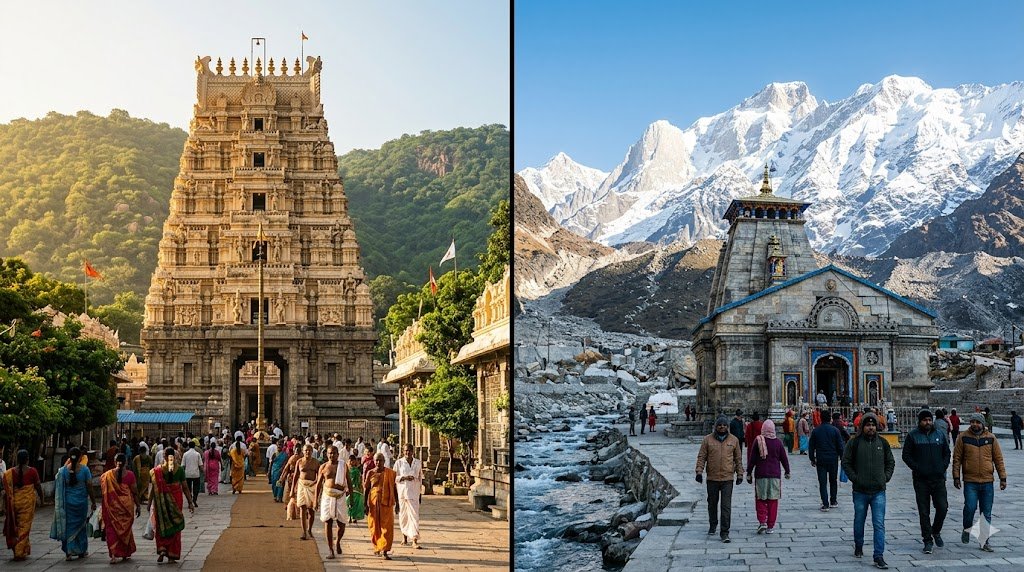
The Srikalahasti Kedarnath lingam comparison reveals two utterly distinct Shiva energies — one breathing as air, the other frozen as a Himalayan jyoti pillar.
The Srikalahasti Kedarnath lingam difference is one of the most fascinating contrasts in all of Shiva worship — two sacred stones, two opposite climates, two utterly different forms of the same Lord. Pilgrims often visit both shrines and walk away puzzled by what they actually felt. Therefore, this guide breaks down exactly why the energies differ, what each lingam represents, and how devotees experience them in practice.
Moreover, both temples are mentioned in the Skanda Purana and command staggering footfall every year. However, the way Shiva manifests at each site could not be more different. One is air. The other is a mountain.
Quick Summary at a Glance
- Srikalahasti lingam — Vayu (air) element, one of the Pancha Bhoota Sthalams, white swayambhu stone, located in Andhra Pradesh.
- Kedarnath lingam — Jyotirlinga (light pillar), shaped like a bull’s hump, one of the 12 Jyotirlingas, located in Uttarakhand Himalayas at 3,583 metres.
- Core energy difference — Srikalahasti carries the prana (breath) of life. Kedarnath carries the Sadashiva (formless eternal) frequency.
- Ritual focus — Srikalahasti is famous for Rahu-Ketu dosha pooja. Kedarnath is famous for ghee abhishekam on the hump-shaped stone.
- Access — Srikalahasti is open year-round. Kedarnath opens only from late April to early November.
What Makes the Srikalahasti Kedarnath Lingam Comparison So Unique
Most Shiva temples across India enshrine a standard cylindrical Shivalingam carved by sculptors or installed by sages. However, both Srikalahasti and Kedarnath break this mould entirely. Each is swayambhu — self-manifested — and each represents a completely different category of Shiva tattva (principle).
Furthermore, the two shrines sit at opposite ends of the subcontinent. Srikalahasti rests on the banks of the Swarnamukhi river in the warm plains of Chittoor district, Andhra Pradesh. Meanwhile, Kedarnath sits at 3,583 metres beside the Mandakini river in the Garhwal Himalayas of Uttarakhand. The climate, the silence, the altitude — everything shapes how the lingam energy is felt.
Why Devotees Group These Two Lingams Together
Notably, serious Shiva sadhakas often plan pilgrimages that cover both shrines. The reasoning is simple. Srikalahasti gives the experience of Shiva as living breath. Kedarnath gives the experience of Shiva as still, formless light. Together, they form a complete spiritual contrast.
In addition, the Srikalahasti Kedarnath lingam study sits at the heart of Shaiva tantra. The Pancha Bhoota system maps the five gross elements. The Jyotirlinga system maps Shiva’s infinite formless aspect. One is bhuta (matter). The other is jyoti (light).
Understanding the Srikalahasti Lingam — Shiva as Air
Srikalahasti enshrines one of the five Pancha Bhoota Sthalams, where Lord Shiva is worshipped as the Vayu Lingam, representing the wind element. The white stone is considered swayambhu — not carved by any human hand. Significantly, the lingam is said to vibrate with the prana that sustains every breathing being on earth.
Moreover, the temple’s most famous phenomenon is the flickering lamp. There is a lamp inside the inner sanctum that is constantly flickering despite the presence of air inside. The sanctum has no windows and no obvious draft. Yet the flame dances.
The Legend Behind the Vayu Lingam
According to ancient temple tradition, Vayu Deva — the wind god — performed intense penance for thousands of years to win a boon from Shiva. Furthermore, Vayu asked to be present inside every living creature like the Almighty himself. Shiva granted this and chose to manifest at this very spot as the Karpoora Vayu Lingam.
Additionally, the temple name itself encodes three devotees. Three great devotees — a spider (Sri), a snake (Kala), and an elephant (Hasti) — worshipped Lord Shiva here and achieved moksha. Their devotion gave the temple its sacred name.
What the Air Element Actually Means in Practice
Spiritually, vayu governs prana — the life force that rides on every inhale and exhale. Therefore, sadhakas who practise pranayama often feel an immediate connection at Srikalahasti. The air around the sanctum is said to carry charged prana that quickens the breath naturally.
Meanwhile, the temple is also one of the few in India that remains open during solar and lunar eclipses. This is because the Rahu-Ketu energies — the shadow planets associated with karmic obstructions — are believed to be neutralised most effectively here during those very hours.
Understanding the Kedarnath Lingam — Shiva as Sadashiva
Kedarnath enshrines a completely different form of Shiva. The jyotirlinga is in the shape of a conical rock formation inside the temple — Lord Shiva in his Sadashiva form. Sadashiva is the eternal, formless aspect — the Shiva who exists beyond time, space and creation.
However, the Kedarnath stone is not a polished lingam at all. It is a rough, naturally rising rock that represents the hump of a bull. The shape itself encodes a powerful Mahabharata legend.
The Pandava Legend and the Bull’s Hump
After the Kurukshetra war, the Pandavas sought Shiva’s forgiveness for the slaughter of their own kin. However, Shiva refused to face them and disguised himself as a bull grazing in the Garhwal hills. Bhima, the strongest amongst the Pandava brothers, spotted a bull grazing in the meadows around Guptkashi in the Garhwal Himalayas. He immediately recognized the bull to be Lord Shiva. Bhima chased the bull and caught hold of the hump of the bull. But the bull disappeared into the ground, while the hump remained in Kedarnath.
Furthermore, the other parts of the divine bull surfaced at four more sites — Tungnath, Rudranath, Madhyamaheshwar and Kalpeshwar — which together with Kedarnath form the Panch Kedar circuit. Each temple worships a different anatomical fragment of the original bull form.
Why Kedarnath Is Called a Jyotirlinga
According to the Shiva Purana, twelve sacred spots on earth received the original pillar of cosmic light when Shiva resolved the Brahma-Vishnu supremacy debate. Specifically, Shiva manifested as an infinite column of fire (jyoti stambha) with no beginning and no end. The places where this light touched ground became the twelve Jyotirlingas.
Kedarnath is the highest of the twelve. As a result, the temple is believed to carry the most rarefied vibration in the entire Jyotirlinga set — the frequency of Shiva at his most withdrawn and meditative.
Srikalahasti Kedarnath Lingam Energies — Side-by-Side Comparison
Although both stones invoke Shiva, the experiential difference is sharp. The table below maps the contrast on every meaningful axis. Notably, no other South Indian or North Indian shrine pair offers this exact symmetry of element versus light.
| Attribute | Srikalahasti Lingam | Kedarnath Lingam |
|---|---|---|
| Category | Pancha Bhoota Sthalam (1 of 5) | Jyotirlinga (1 of 12) |
| Element | Vayu (Air) | Jyoti (Light / Sadashiva) |
| Shape | White stone, trunk-like form | Conical rock, bull-hump shape |
| Origin | Swayambhu — self-manifested | Swayambhu — hump of Shiva’s bull form |
| Location | Chittoor district, Andhra Pradesh | Rudraprayag district, Uttarakhand |
| Altitude | 114 metres (plains) | 3,583 metres (high Himalayas) |
| Famous ritual | Rahu-Ketu sarpa dosha pooja | Ghee abhishekam on the hump |
| Open period | Year-round | Late April to early November only |
Why the Two Lingam Energies Feel So Different to Pilgrims
The body responds to environment. Therefore, the Himalayan thin-air silence of Kedarnath naturally slows the breath, quiets thought and pulls awareness inward. Many devotees report a meditative stillness that arrives unbidden after even ten minutes inside the sanctum.
In contrast, Srikalahasti’s atmosphere is alive. The flickering lamp, the moving air around a closed chamber, the chants vibrating through the granite — all of it activates prana rather than stilling it. Consequently, devotees often describe Srikalahasti as energising and Kedarnath as dissolving.
The Tantric View of This Difference
In Shaiva tantra, the five Pancha Bhoota lingams represent Shiva’s interaction with creation. Each element is one face of his manifest body. However, the Jyotirlingas represent something different. They mark Shiva beyond elements — light before form.
Hence, visiting Srikalahasti is a journey into Shiva-as-existence. Visiting Kedarnath is a journey into Shiva-as-source. Both are valid. Both are complete. They simply work on different layers of the seeker.
What Long-Time Sadhakas Often Say
Interestingly, devotees who have visited both repeatedly describe Srikalahasti’s effect as immediate and Kedarnath’s effect as slow-release. Srikalahasti is felt in the lungs and chest the moment darshan begins. Kedarnath’s impact, however, surfaces hours or even days after returning home.
Additionally, advanced practitioners often pair the two for a reason. The Vayu Lingam awakens prana. The Jyotirlinga then helps stabilise that awakened prana into stillness. As a result, the combination is considered exceptionally rare and complete.
Rituals and Worship — Two Completely Different Traditions
The ritual codes at each temple reflect their core energies. Specifically, Srikalahasti centres on planetary remedy worship, while Kedarnath centres on continuous abhishekam.
Srikalahasti’s Signature Rituals
The temple is best known for its Rahu-Ketu sarpa dosha pooja. Devotees with kalasarpa dosha, marriage delays, childlessness or chronic obstacles in their horoscope travel here specifically for this ritual. Moreover, abhishekam is performed multiple times daily on the Vayu Lingam itself.
Furthermore, the sahasra deepalankarana seva (lighting of a thousand lamps) is performed regularly. The temple’s main archana ticket is modestly priced, and Rahu-Ketu pooja tickets are typically available at the temple counter on the day itself. For the most current pooja schedule and pricing, devotees should check the official AP Endowments portal before travel.
Kedarnath’s Signature Rituals
At Kedarnath, the principal worship is the ghee abhishekam. Devotees personally rub pure cow ghee onto the rough hump-shaped stone — a tactile, intimate form of worship that exists nowhere else. Additionally, the morning Mahabhishek and the evening Shringar darshan are the most sought-after rituals.
Significantly, the temple opening and closing dates shift slightly each year based on the Hindu calendar. The shrine generally opens on Akshaya Tritiya and closes around Kartik Purnima. During winter, the utsava murti is moved to Ukhimath, where worship continues.
How to Plan a Combined Srikalahasti Kedarnath Pilgrimage
The two shrines sit roughly 2,200 km apart. However, a thoughtfully planned combined yatra is entirely feasible and increasingly popular. Below is a practical sequence many pilgrims follow.
- Start with Srikalahasti — Fly into Tirupati (about 36 km away) or Chennai. Spend one full day for darshan, Rahu-Ketu pooja and the Swarnamukhi river bath.
- Combine with Tirumala — Most pilgrims add Tirupati Balaji darshan on the same trip, as both shrines are within an hour’s drive.
- Return and prepare for Kedarnath — Allow at least one week’s gap. The altitude shift is severe and requires basic acclimatisation and warm clothing.
- Fly to Dehradun — From there, take a road journey to Sonprayag via Rudraprayag. The drive is roughly 9-10 hours depending on traffic and weather.
- Trek or helicopter to Kedarnath — The 16-km trek from Gaurikund is moderately difficult. Helicopter services operate from Phata, Sersi and Guptkashi, but seats book out fast.
- Allow buffer days — Weather in the Himalayas is unpredictable. Always plan one or two extra days in case of flight or trek delays.
Best Time for Each Temple
Srikalahasti is open year-round, but the most spiritually charged days are Maha Shivaratri, Karthika Pournami and the days surrounding solar or lunar eclipses. Meanwhile, the temple is most pleasant to visit between October and March.
For Kedarnath, the season is narrow. May, June and September are considered the most reliable months. July and August carry significant monsoon and landslide risk. October offers stunning weather but progressively colder nights.
Common Misunderstandings About the Two Lingams
Many first-time pilgrims arrive at both shrines with mistaken expectations. Therefore, a few myths are worth clearing up before the visit.
“Both Are Jyotirlingas” — A Common Mix-up
Notably, Srikalahasti is not a Jyotirlinga. It belongs to the separate Pancha Bhoota Sthalam list, which is a South Indian Shaiva classification. The 12 Jyotirlingas are a pan-Indian Shaiva category drawn from the Shiva Purana. The two lists do not overlap.
Additionally, Kedarnath is sometimes confused with Kedareshwar in Maharashtra or other regional Kedars. The Jyotirlinga is specifically the one in Rudraprayag district of Uttarakhand.
“The Kedarnath Lingam Has a Carved Shape”
Clearly, this is wrong. The Kedarnath stone is rough, irregular and naturally rising — exactly as the legend describes the bull’s hump. Devotees are encouraged to touch it directly during ghee abhishekam, which adds to its raw, primal feel.
“Srikalahasti Is Only for Rahu-Ketu Pooja”
Although the Rahu-Ketu pooja is the temple’s most famous offering, it is far from the only reason to visit. The Vayu Lingam darshan itself is the primary spiritual draw. Furthermore, many pilgrims visit purely for the sahasra deepalankarana, the panchamukha darshan and the nearby Kannappa shrine on the hill.
Original Insight — A Forecast for Both Shrines in the Coming Years
Looking ahead, both temples are evolving in opposite directions. Specifically, Kedarnath has seen massive infrastructure upgrades since the 2013 flood, including the new Adi Shankaracharya samadhi memorial, helicopter expansion and the Char Dham road project. As a result, footfall is expected to keep climbing through 2026 and beyond, with the season already breaking records most years.
Meanwhile, Srikalahasti has remained quieter and more traditional. However, with the renovation of the Krishnadevaraya gopuram (originally built in 1516 AD and damaged in 2010) progressing, the temple is likely to return to peak prominence. Furthermore, increased domestic flight connectivity to Tirupati is making Srikalahasti far more accessible than even a decade ago.
Therefore, devotees planning the combined yatra would do well to act sooner rather than later. Crowds, costs and queue times are all rising at both sites.
The Bottom Line
The Srikalahasti Kedarnath lingam comparison ultimately teaches one core truth — Shiva is both element and source, both breath and stillness, both motion and silence. The Vayu Lingam in Andhra Pradesh activates the life force. The Jyotirlinga in the Himalayas dissolves it back into pure awareness.
Therefore, the smartest pilgrim approach is to treat the two not as alternatives but as complements. Visit Srikalahasti to feel Shiva move within you. Visit Kedarnath to feel Shiva beyond you. Both visits together form one of the most complete Shaiva experiences possible in a single human lifetime.
Frequently Asked Questions
Is Srikalahasti a Jyotirlinga?
No, Srikalahasti is not a Jyotirlinga. It is a Pancha Bhoota Sthalam representing the air (vayu) element. The Pancha Bhoota Sthalams are a separate South Indian Shaiva classification of five temples, while the Jyotirlingas are a distinct pan-Indian list of twelve shrines drawn from the Shiva Purana.
What is the main difference between the Srikalahasti and Kedarnath lingam energies?
Srikalahasti’s lingam carries the energy of vayu — the air element and the life-breath that sustains creation. Kedarnath’s lingam carries the energy of Sadashiva — the formless eternal aspect of Shiva beyond all elements. One activates prana, the other dissolves it into stillness.
Why is the Kedarnath lingam shaped like a bull’s hump?
According to legend, Shiva took the form of a bull to avoid the Pandavas, who sought forgiveness for their sins in the Kurukshetra war. Bhima caught the bull’s hump as it tried to disappear into the ground at Kedarnath. The hump remained as the sacred stone now worshipped at the temple.
Can both temples be covered in one pilgrimage trip?
Yes, but careful planning is essential. The two shrines are roughly 2,200 km apart. Most pilgrims fly into Tirupati for Srikalahasti, then take a separate flight to Dehradun before continuing by road to Kedarnath. Allow at least 10-12 days for a comfortable combined yatra including buffer days for weather.
Which temple is older, Srikalahasti or Kedarnath?
Both shrines are ancient and mentioned in the Skanda Purana. Srikalahasti’s initial structure dates to the 5th century, with the main gopuram built in 1516 AD by Krishnadevaraya. Kedarnath’s present structure is attributed to Adi Shankaracharya around the 8th century, built on an even older Pandava-era shrine.
What ritual is each temple most famous for?
Srikalahasti is most famous for the Rahu-Ketu sarpa dosha pooja, which is believed to remove planetary afflictions. Kedarnath is most famous for the ghee abhishekam, where devotees apply pure cow ghee directly onto the hump-shaped lingam — a tactile worship found nowhere else in Shiva tradition.
When is Kedarnath temple open each year?
Kedarnath generally opens on Akshaya Tritiya (April or early May) and closes around Kartik Purnima (October or November). Exact dates shift each year based on the Hindu calendar and are announced officially by the Shri Badarinath Kedarnath Temple Committee. During winter, worship continues at Ukhimath.

Independent pilgrim guide for Sri Kalahasti Temple. Curating darshan timings, Rahu Ketu Pooja booking, sevas, accommodation, Vayu Lingam significance, and complete travel guidance for devotees visiting the temple.
