
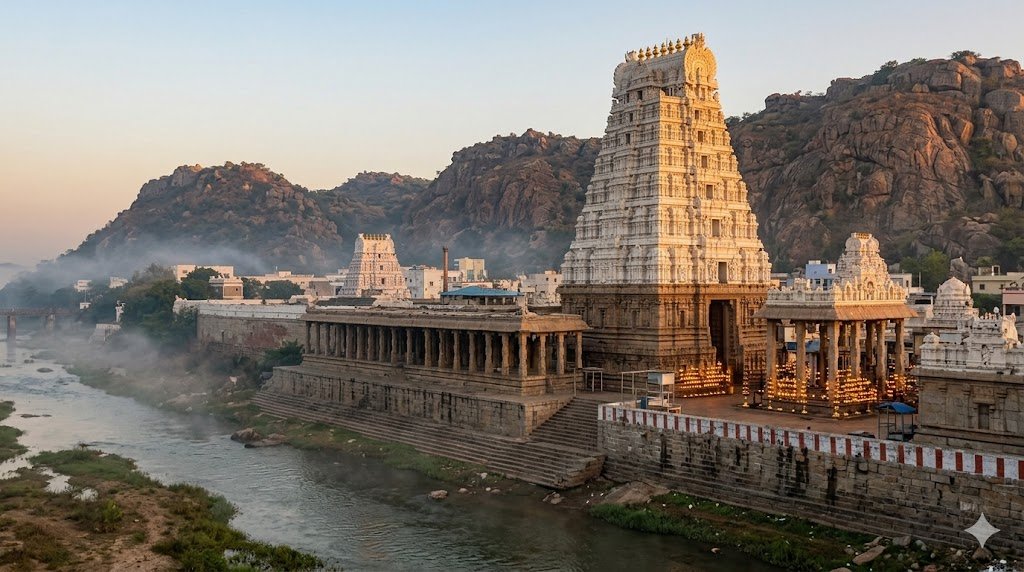
These little-known Sri Kalahasti rituals set the temple apart: the untouched Vayu Linga, eclipse-time abhishekam and the famous Rahu-Ketu dosha nivarana pooja.
The Sri Kalahasti rituals stand apart from those at almost every other temple in India. This ancient Shiva shrine near Tirupati follows customs you will not find elsewhere. It stays open during eclipses, never lets a hand touch its main linga, and treats Rahu Kalam as sacred. This guide reveals the lesser-known practices that make the temple so unusual.
Key Takeaways
- Srikalahasti is widely cited as the only temple that stays open during eclipses.
- Priests never touch the white Vayu Linga with their hands.
- A lamp in the windowless sanctum flickers without any breeze.
- The famous Rahu-Ketu pooja runs even during Rahu Kalam.
- The temple sits on the Swarnamukhi river, about 36 km from Tirupati.
- It is the Vayu (air) shrine among the Pancha Bhoota Sthalams.
Srikalahasti at a Glance
First, here are the basics behind these unusual customs. Keep them in mind as you read the rituals below. Note that pooja timings can shift with astrological conditions.
| Detail | Information |
|---|---|
| Deity | Lord Kalahasteeswara (Vayu Linga) |
| Goddess | Gnana Prasunambika Devi |
| Element | Vayu (Air), Pancha Bhoota Sthalam |
| Location | Srikalahasti, ~36 km from Tirupati |
| Rahu-Ketu pooja | Daily, roughly 6:00 AM – 5:00 PM |
| River | Swarnamukhi |
What Makes Sri Kalahasti Rituals Unique
Most Sri Kalahasti rituals flow from one idea: the Lord here is the air element itself. The white linga is Swayambhu, or self-manifested, and represents Vayu. Because air is invisible and untouchable, the worship reflects that nature.
Moreover, the temple links closely to Rahu and Ketu, the shadow planets of Hindu astrology. Devotees believe these planets cause eclipses and certain horoscope troubles. As a result, the shrine became the go-to place for Rahu-Ketu remedies.
The table below shows how the temple breaks from common temple norms. Each of these Sri Kalahasti rituals defies a practice most shrines follow. Read on for the story behind every one.
| Practice | Most Temples | Srikalahasti |
|---|---|---|
| During eclipse | Closed | Open, special abhishekam |
| Rahu Kalam | Avoided | Treated as auspicious |
| Main linga | Touched, decorated | Never touched by hand |
The Linga No Hand May Touch
At most Shiva temples, priests bathe and decorate the main linga directly. Here, though, no one touches the Vayu Linga, not even the head priest. The white stone stays untouched throughout the year.
Instead, priests perform abhishekam by pouring a mixture from above. This blend includes water, milk, camphor, and panchamrita. So the sacred bath honours the linga without any physical contact.
Furthermore, sandal paste, flowers, and the sacred thread go to the Utsava Murti, the processional idol. The main linga itself receives no alankaram. This rule keeps the air element pure and undisturbed.
Grahana Kala Abhishekam: Worship During an Eclipse
Across India, temples shut their doors during solar and lunar eclipses. Even the Tirumala temple closes and purifies afterwards. Srikalahasti, however, does the exact opposite.
During an eclipse, priests perform the Grahana Kala Abhishekam at the midpoint of the event. They bathe Lord Kalahasteeswara and Goddess Gnana Prasunambika with full ritual. Because the shrine is the Rahu-Ketu kshetram, the eclipse counts as deeply auspicious here.
Consequently, eclipses draw huge crowds rather than empty halls. Many devotees time their Rahu-Ketu pooja for these rare hours. This single custom makes Srikalahasti stand alone among Indian temples.
Rahu-Ketu Pooja During Rahu Kalam
Most Hindus avoid starting anything during Rahu Kalam, the daily inauspicious window. At Srikalahasti, that logic flips completely. The temple performs its signature Rahu-Ketu pooja right through this period.
Devotees come seeking relief from Sarpa Dosha and Kala Sarpa Dosha in their horoscopes. According to belief, these afflictions can delay marriage, careers, or children. The pooja aims to calm the influence of the two shadow planets.
Notably, the priests conduct it in a fixed, step-by-step manner with the devotee present. The ceremony runs daily, roughly from 6:00 AM to 5:00 PM. New Moon days and eclipses are seen as especially powerful for it.
The Lamp That Never Stops Flickering
Inside the inner sanctum sits a lamp that behaves strangely. The chamber has no windows and no visible airflow. Yet the flame flickers gently and never stays still.
Even when priests close the sanctum doors, the air-linga’s lamp keeps moving. Devotees take this as living proof of the Vayu element. Many describe it as the very breath of Lord Shiva.
Planning to Witness the Sri Kalahasti Rituals
Seeing the Sri Kalahasti rituals in person takes a little planning. The Rahu-Ketu pooja in particular needs a ticket and an early arrival. Follow these steps for a smooth visit.
- Reach Srikalahasti, about 36 km from Tirupati, the day before if you can.
- Book the Rahu-Ketu pooja ticket at the temple counter or online.
- Choose your slot, since timings shift with the daily Rahu Kalam.
- Carry a valid ID and wear traditional dress.
- Arrive early, as the pooja draws large crowds.
For ticket details, check the Andhra Pradesh Endowments portal. You can also confirm eclipse and Rahu Kalam times on a reliable panchang. Therefore, plan your date around the timing that suits your prayer.
Insider Tips for Your Visit
From experience, weekends and eclipse days get extremely crowded. So pick a weekday morning for a calmer darshan. Couples often perform the Rahu-Ketu pooja together for a shared sankalpa.
Also pair the trip with nearby Tirupati, which sits close by. Many pilgrims cover Tirumala and Srikalahasti on the same circuit. These Sri Kalahasti rituals reward an unhurried, early visit far more than a rushed one.
The Bottom Line
Few temples hold customs as distinct as these. The untouched linga, the eclipse abhishekam, and the flickering Vayu lamp all point to one truth: this is the shrine of the air element. Above all, time your visit around the Rahu-Ketu pooja or an eclipse for the fullest experience. Witnessing the Sri Kalahasti rituals once leaves a lasting impression on most devotees.
Frequently Asked Questions
What are the unique Sri Kalahasti rituals?
The Sri Kalahasti rituals include the eclipse-time Grahana Kala Abhishekam and the Rahu-Ketu pooja. The temple also never lets a hand touch its main Vayu Linga. A lamp in the sanctum flickers without any breeze.
Why does Srikalahasti stay open during an eclipse?
Srikalahasti is revered as the Rahu-Ketu kshetram, so eclipses are seen as auspicious here. Priests perform a special abhishekam at the eclipse midpoint. It is widely cited as the only major temple to remain open at such times.
Is the Srikalahasti linga really never touched?
Yes, priests do not touch the white Vayu Linga with their hands. Abhishekam is done by pouring a mixture of water, milk, camphor, and panchamrita. Decorations are offered to the processional idol instead.
What is the Rahu-Ketu pooja at Srikalahasti?
It is a ritual to ease the effects of Rahu and Ketu in one’s horoscope. Devotees perform it for relief from Sarpa Dosha and related troubles. The pooja runs daily, between 6:00 AM and 5:00 PM.
How far is Srikalahasti from Tirupati?
Srikalahasti lies about 36 km from Tirupati. Many pilgrims combine it with a Tirumala visit on the same trip. Buses and taxis run frequently between the two towns.
What does the flickering lamp signify?
The lamp flickers in a windowless sanctum with no visible airflow. Devotees view this as proof of the Vayu, or air, element. Many regard it as the breath of Lord Shiva.

Independent pilgrim guide for Sri Kalahasti Temple. Curating darshan timings, Rahu Ketu Pooja booking, sevas, accommodation, Vayu Lingam significance, and complete travel guidance for devotees visiting the temple.
