
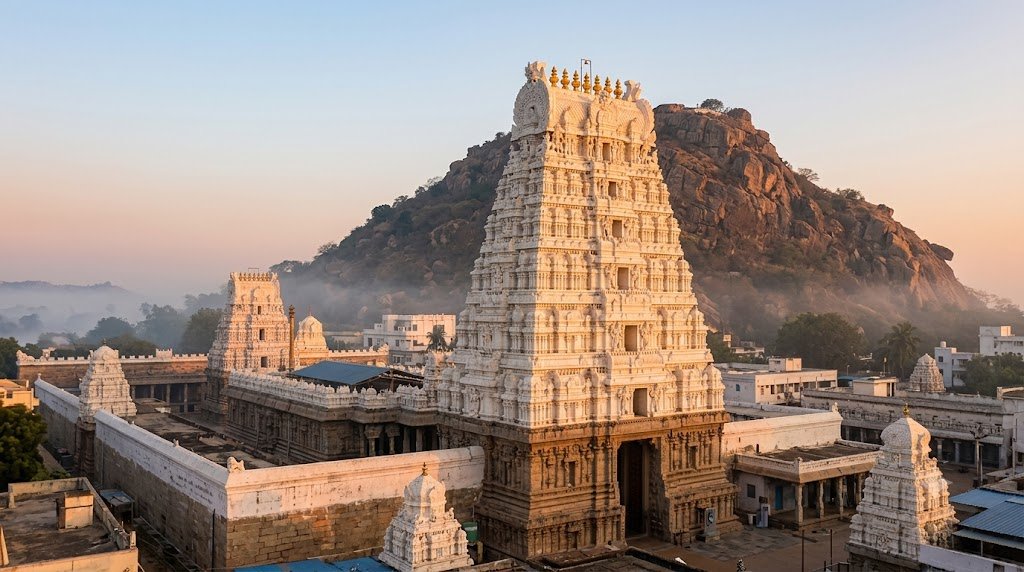
A devotee’s guide to the most powerful Kalahasti Shiva mantras for chanting before and after your visit to the sacred Vayu Lingam at Srikalahasti temple.
The right Kalahasti Shiva mantras, chanted with a settled mind before and after darshan, can transform an ordinary temple visit into a deeply personal spiritual experience. Srikalahasti is no ordinary shrine. It is the Vayu Lingam, one of the five Pancha Bhoota Sthalams, where Lord Shiva is worshipped as the very element of air. Pilgrims travel here from across South India, often after their Tirumala darshan, carrying questions about which chants truly suit this powerful kshetra. This guide answers all of them.
Notably, the temple sits at the foot of a hill in Chittoor district, roughly 36 km from Tirupati. The Srikalahasteeswara Lingam here is a swayambhu, a self-manifested form. Inside the sanctum, a single lamp flickers endlessly even though no wind reaches it. That detail alone tells you why sound, breath, and mantra matter so much at this particular shrine.
Quick Summary: Kalahasti Shiva Mantras at a Glance
- Best mantra before darshan: Panchakshari Mantra (Om Namah Shivaya) to calm the breath and focus the mind.
- Best mantra during darshan: Mahamrityunjaya Mantra for protection, healing, and release from fear.
- Best mantra after darshan: Rudra Gayatri to carry the blessing home.
- Why here: Srikalahasti is the Vayu (air) Lingam, so breath-led chanting feels especially potent.
- Rahu-Ketu link: Many pilgrims chant before the Rahu-Ketu Pooja, performed daily from 6:00 AM to 5:00 PM.
- Golden rule: Quality of attention beats quantity of repetitions.
Why Mantras Carry Special Power at the Vayu Lingam
Every mantra is essentially structured sound carried on the breath. Srikalahasti, meanwhile, is the shrine of air itself. The connection is hard to miss. When you chant here, you are using the very element the deity embodies, which is why devotees describe the chanting at this temple as unusually vivid.
Furthermore, the temple’s deep history reinforces this. Srikalahasti is celebrated in the Tevaram hymns of the Tamil Saiva saints, making it one of the 275 Paadal Petra Sthalams. It is also called Dakshina Kailasam, the southern abode of Shiva. Saints sang here precisely because they felt sound and devotion travel further at this spot.
The temple’s founding legend adds another layer. A spider (Sri), a serpent (Kala), and an elephant (Hasti) each worshipped the Lingam in their own way and attained moksha. Their names fused into “Srikalahasti.” For modern pilgrims, the takeaway is simple. Sincere devotion, not elaborate ritual knowledge, is what the Lord here values most.
Kalahasti Shiva Mantras to Chant Before Your Visit
Before you reach the gopuram, your mind is usually scattered with travel, queues, and logistics. Chanting on the journey or in the queue settles all of that. Below are the three most effective preparatory chants, with their meanings.
1. The Panchakshari Mantra (Om Namah Shivaya)
This five-syllable mantra is the heart of Shaiva worship. It needs no preparation and suits everyone, regardless of background or fluency in Sanskrit. For first-time visitors, this is the single best chant to begin with.
ॐ नमः शिवाय
Om Namah Shivaya
Meaning: “I bow to Shiva, the auspicious one and the inner Self.”
Therefore, repeat it slowly in the queue. Sync each repetition with one full breath. By the time you reach the sanctum, your mind will have quietened considerably.
2. The Mahamrityunjaya Mantra
This Rig Vedic verse (RV 7.59.12) is addressed to Tryambaka, the three-eyed Rudra. Devotees chant it for healing, protection, and freedom from untimely fear. Many pilgrims who come seeking relief from illness or grief favour this one above all.
ॐ त्र्यम्बकं यजामहे सुगन्धिं पुष्टिवर्धनम् ।
उर्वारुकमिव बन्धनान्मृत्योर्मुक्षीय माऽमृतात् ॥
Om Tryambakam Yajamahe Sugandhim Pushtivardhanam,
Urvarukamiva Bandhanan Mrityor Mukshiya Maamritat.
Meaning: “We worship the three-eyed Lord who nourishes all beings. As a ripe cucumber falls from its stem, may He free us from death and grant immortality.”
Moreover, the imagery here is gentle, not morbid. It speaks of a fruit ripening and falling naturally, a release rather than a struggle. Chant it three times before entering if time is short.
3. The Rudra Gayatri (Shiva Gayatri)
This invocation calls on Mahadeva to awaken the seeker’s higher mind. It pairs beautifully with the Vayu Lingam’s emphasis on inner awareness. Use it as your final chant just before you step into the queue line.
ॐ तत्पुरुषाय विद्महे महादेवाय धीमहि ।
तन्नो रुद्रः प्रचोदयात् ॥
Om Tatpurushaya Vidmahe Mahadevaya Dhimahi, Tanno Rudrah Prachodayat.
Meaning: “May we know the Supreme Person; may we meditate on the great God; may Rudra inspire our understanding.”
Mantras to Chant During Darshan and After Leaving
Inside the sanctum, you will have only moments before the queue moves on. So keep it short. The Panchakshari is ideal here because a single “Om Namah Shivaya” fits in that brief window. Hold the Lord’s image in your mind as you say it.
After darshan, however, the temptation is to rush off to the next stop. Resist that. Sit quietly in the prakara, the temple’s outer corridor, for even five minutes. Chant the Mahamrityunjaya or the Rudra Gayatri once more. This sealing step helps the visit’s calm stay with you on the journey home.
A Simple Mantra for Gratitude After the Visit
Additionally, many devotees close their visit with a short thanksgiving chant. The line below works well and is easy to remember.
ॐ नमः शिवाय शिवाय नमः ॐ
Om Namah Shivaya, Shivaya Namah Om
Chant this on the steps as you leave. It frames the entire darshan as an offering received, not just a task completed.
Comparing the Core Kalahasti Shiva Mantras
Different chants suit different purposes and different moments. The table below helps you choose quickly, especially if your time at the temple is limited.
| Mantra | Best Time | Main Purpose |
|---|---|---|
| Om Namah Shivaya | Queue & sanctum | Focus, surrender, simplicity |
| Mahamrityunjaya | Before & after darshan | Healing, protection, courage |
| Rudra Gayatri | Before entering | Clarity, higher awareness |
| Shivaya Namah | On leaving | Gratitude, closure |
A Step-by-Step Chanting Routine for Your Darshan
Pilgrims often ask for a clear sequence rather than a loose list. Here is a tested routine you can follow from arrival to departure.
- On the journey: Chant Om Namah Shivaya softly, one repetition per breath, for as long as feels natural.
- At the temple gate: Pause and recite the Rudra Gayatri three times to set your intention.
- In the queue: Return to the Panchakshari. Let it run quietly in the background of your mind.
- At the sanctum: Offer a single, heartfelt “Om Namah Shivaya” while gazing at the Lingam.
- In the prakara afterwards: Sit and chant the Mahamrityunjaya once or three times.
- On the steps out: Close with the gratitude line before you re-enter the everyday world.
How Mantras Connect to the Rahu-Ketu Pooja
Srikalahasti is famous across India as a Rahu-Ketu kshetra. Most temples avoid this pooja because Rahu and Ketu are considered difficult shadow planets. This shrine, in contrast, performs the Rahu-Ketu Pooja daily from 6:00 AM to 5:00 PM.
Consequently, many pilgrims chant a Shiva mantra before sitting for the pooja. The Mahamrityunjaya is the natural choice, since it addresses fear and obstacles head-on. The temple supplies all pooja materials, and tickets range from roughly ₹500 to ₹5,000 depending on the category. Booking is mostly done at the counter on the spot, so reach early.
For the most up-to-date timings and ticket details, the official Andhra Pradesh temples portal is the safest reference. You can check it at aptemples.ap.gov.in before you travel. Prices and pooja slots can change, so verify close to your visit date.
Insider Tips Most Guides Miss
First, chanting works best when it is quiet and internal here. The sanctum area is busy, and loud recitation disturbs others. Keep your chant under your breath or fully mental.
Secondly, do not count beads obsessively. At a crowded shrine, the pressure to complete 108 repetitions can pull your attention away from devotion. Even three sincere chants outweigh a distracted hundred.
Furthermore, the eternal lamp in the sanctum is worth a quiet moment. It flickers without any obvious draught, a living symbol of the Vayu Lingam. Watching it for a few seconds while you chant deepens the experience in a way no instruction can replace.
Finally, plan your darshan for early morning, ideally between 6 AM and 8 AM. The queues are shortest then, and the calm makes mantra practice far easier. Tuesdays and Sundays draw the largest Rahu-Ketu crowds, so weekday mornings are gentler.
Best Time to Visit and Chant
The temple generally opens early and stays open late into the evening. Specifically, the most peaceful window for chanting is the first two hours after the gates open. The afternoon break splits the day, so confirm current darshan slots before you arrive.
Maha Shivaratri is the temple’s grandest occasion. In 2026 the Maha Shivaratri Brahmotsavam ran for 13 days, from 10 to 23 February; the next Maha Shivaratri falls on Saturday, 6 March 2027. Crowds peak sharply during this festival, so mantra practice during this period demands extra patience and an even earlier start.
The Bottom Line
The most powerful Kalahasti Shiva mantras are not the longest or the rarest. They are the ones you can chant with genuine attention, breath by breath, at the shrine of the air element. Start with the Panchakshari, lean on the Mahamrityunjaya when you need strength, and close with gratitude. If you remember only one thing, let it be this: arrive early, chant quietly, and give the visit your full presence. The Lord who granted moksha to a spider and an elephant asks for nothing more than sincere devotion.
Frequently Asked Questions
Which mantra is most powerful at Srikalahasti temple?
Om Namah Shivaya, the Panchakshari Mantra, is the most universally recommended chant. It suits every devotee and needs no Sanskrit training. For healing and protection, the Mahamrityunjaya Mantra is the next strongest choice.
Can I chant Kalahasti Shiva mantras inside the sanctum?
Yes, but keep it quiet or fully mental. The sanctum is crowded and the queue moves quickly. A single heartfelt “Om Namah Shivaya” while viewing the Lingam is enough.
How many times should I chant a Shiva mantra at the temple?
There is no fixed number for a temple visit. Three sincere repetitions with full attention are more valuable than a rushed 108. Quality of devotion matters more than the count.
Should I chant before or after the Rahu-Ketu Pooja?
Both help, but chanting before the pooja is especially calming. The Mahamrityunjaya Mantra is most fitting, as it directly addresses fear and obstacles. The temple provides all materials, so simply arrive early and focus on your chant.
Do I need to know Sanskrit to chant these mantras correctly?
No. Sincere intention carries more weight than perfect pronunciation. Use the transliterations in this guide, chant slowly, and the meaning will deepen with practice.
What is the best time to chant at Srikalahasti?
Early morning, between 6 AM and 8 AM, offers the calmest atmosphere. Queues are shortest and the temple is quietest then. Weekday mornings are easier than Tuesdays and Sundays.
Why is mantra chanting considered special at this temple?
Srikalahasti is the Vayu Lingam, representing the air element. Since mantras travel on the breath, devotees feel chanting here aligns naturally with the deity’s form. The eternally flickering lamp in the windless sanctum reinforces this symbolism.

Independent pilgrim guide for Sri Kalahasti Temple. Curating darshan timings, Rahu Ketu Pooja booking, sevas, accommodation, Vayu Lingam significance, and complete travel guidance for devotees visiting the temple.
