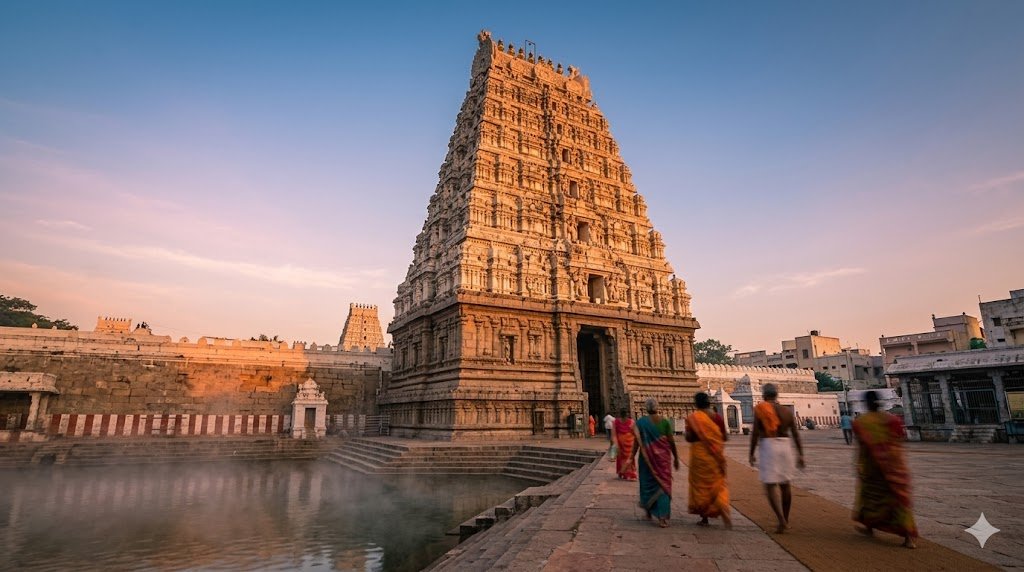
The Rahu Ketu Srikalahasti story reveals how two cursed shadow planets sought Lord Shiva’s grace. Uncover the ancient legend behind this powerful pilgrimage.
The Rahu Ketu Srikalahasti story begins with a moment of cosmic deception — a single drop of stolen nectar that split one being into two shadow planets, forever bound to chase the Sun and Moon across the sky. For thousands of years, devotees have travelled to this ancient Andhra Pradesh shrine carrying one quiet hope: that the same Lord Shiva who granted these celestial outcasts a permanent home will lift their planetary suffering too. Behind the famous Rahu Ketu Pooja lies a mythological narrative most pilgrims never fully hear — and understanding it transforms the entire experience.
Notably, this is not just another temple legend. The tale weaves together the Samudra Manthan, Lord Vishnu’s Sudarshana Chakra, the sin of an ambitious asura, and Shiva’s unmatched compassion. Moreover, it explains exactly why this single Vayu Lingam shrine — among thousands of Shiva temples in India — became the karmic capital for those carrying Rahu Dosha, Ketu Dosha, or Kala Sarpa Dosha.
Quick Summary: The Rahu Ketu Srikalahasti Story at a Glance
- Origin: Rahu and Ketu were born from a single asura named Swarbhanu during the Samudra Manthan (churning of the cosmic ocean).
- The deception: Swarbhanu disguised himself as a deva to drink the nectar of immortality (amrita).
- The punishment: Lord Vishnu severed his head with the Sudarshana Chakra — but the nectar had already touched his throat.
- The split: The head became Rahu, the body became Ketu — two immortal shadow planets.
- The refuge: Tormented and cursed, they performed penance at Srikalahasti and earned Shiva’s grace.
- The result: Srikalahasti became the only earthly shrine where Rahu Ketu Dosha Nivarana Pooja is performed daily — even during eclipses.
The Cosmic Origin: Samudra Manthan and the Birth of Swarbhanu’s Curse
To truly grasp the Rahu Ketu Srikalahasti story, you have to begin at the ocean of milk. The devas and asuras had agreed to churn the Kshira Sagara together to obtain amrita, the nectar of immortality. Mount Mandara served as the churning rod. The serpent king Vasuki became the rope. Lord Vishnu took the form of the tortoise Kurma to support the sinking mountain.
After centuries of churning, fourteen divine treasures emerged — Goddess Lakshmi, the celestial cow Kamadhenu, the moon Chandra, the halahala poison that Shiva swallowed. Finally, Dhanvantari rose from the waves holding the pot of amrita itself.
Vishnu’s Mohini Avatar and the Asura’s Plan
Therefore, a problem emerged. If the asuras drank the nectar, the cosmic balance would shatter forever. Lord Vishnu manifested as Mohini, an enchantress of unmatched beauty. The asuras, captivated, agreed to let her distribute the amrita.
Furthermore, Mohini cleverly arranged the devas in one line and the asuras in another. She began serving the nectar only to the devas. However, one asura saw through the divine ruse.
Who Was Swarbhanu?
Swarbhanu was no ordinary demon. According to the Shani Mahatmya, he was the son of the asura Viprachitti and Simhika, sister of Hiranyakashyap — making him a cousin to the great devotee Prahlada. Clever, cunning, and ambitious, Swarbhanu disguised himself as a deva. Quietly, he slipped into the line of gods and sat between Surya and Chandra.
Mohini, distracted by the long line of devas, served him the amrita. But Surya and Chandra recognised the impostor instantly. Immediately, they alerted Lord Vishnu.
The Sudarshana Chakra and the Birth of Two Shadow Planets
What happened next is the heart of the Rahu Ketu Srikalahasti story. In a single divine motion, Lord Vishnu released the Sudarshana Chakra. The spinning discus severed Swarbhanu’s head from his body.
However, a crucial detail changed everything. The nectar had already touched Swarbhanu’s lips. It had begun travelling down his throat. As a result, his head and body could not die — both had tasted immortality.
| Aspect | Rahu (Head) | Ketu (Body) |
|---|---|---|
| Physical Form | Snake’s body with human/asura head | Human body with snake’s tail/head |
| Astronomical Position | North Lunar Node (Ascending) | South Lunar Node (Descending) |
| Astrological Nature | Material desire, ambition, illusion | Spiritual detachment, moksha, liberation |
| Eclipse Role | Causes Chandra Grahan (lunar eclipse) | Causes Surya Grahan (solar eclipse) |
| Element Affinity | Smoke, shadow, fear | Fire, flame, transcendence |
Why Rahu and Ketu Hate the Sun and Moon
Because Surya and Chandra exposed his theft, Rahu vowed eternal revenge. To this day, Hindu cosmology explains, the severed head chases the Sun and Moon across the sky. Periodically, he catches them and swallows them — causing eclipses. Yet since he has no body, the celestial bodies pass through and escape.
Meanwhile, Lord Brahma granted the two halves planetary status, calling them chhaya grahas or shadow planets. Even so, their suffering had only begun.
The Torment: Why Rahu and Ketu Sought Refuge
Immortality without form is a torture few can comprehend. Rahu — a head without digestive ability — was condemned to eternal hunger. Ketu — a body without a head — could feel everything but understand nothing. Both wandered the cosmos in agony.
Moreover, they had been cursed by the devas. Cast out from the celestial assembly. Branded forever as betrayers of cosmic order. Their malefic influence on every human horoscope made them the most feared forces in Vedic astrology — capable of delaying marriage, blocking childbirth, ruining careers, and clouding the mind with confusion.
The Journey to Lord Shiva
Tormented beyond bearing, the two shadow planets turned to the only deity who could offer refuge — Lord Shiva, the destroyer who is also the great compassionate one. Specifically, they came to a sacred spot already charged with divine power: the banks of the Swarnamukhi River, beneath a small hill in what is now Tirupati district of Andhra Pradesh.
This place was no random choice. Already it was famous as Dakshina Kailasam — the southern Kailash — where Vayu Deva himself had once worshipped Shiva and earned the boon that Lord Shiva would forever manifest here as the Vayu Lingam.
Why They Reside in Srikalahasti: The Divine Refuge Explained
Here is where the Rahu Ketu Srikalahasti story takes its most powerful turn. The two shadow planets performed intense penance at this Vayu Lingam shrine. Day after day, they chanted Shiva’s name. They begged for relief from the curse that bound them. Above all, they sought a way to convert their malefic energy into something that could serve devotees rather than torment them.
Pleased by their unbroken penance, Lord Shiva manifested before them. He could not undo their immortality. Nor could he reverse Vishnu’s punishment. However, he granted them something extraordinary.
Shiva’s Boon to the Shadow Planets
Lord Shiva declared that henceforth, Rahu and Ketu would eternally reside at this very shrine. Furthermore, any devotee suffering under their malefic influence could come here. They could perform a specific pooja. Then they would be released from Rahu Ketu Dosha, Sarpa Dosha, and Kala Sarpa Dosha.
Consequently, the shadow planets’ curse became a doorway. Their suffering became other devotees’ salvation. The very forces that caused eclipses agreed to soak up the negative karma of anyone who sincerely sought relief at this temple.
The Unique Eclipse Tradition
This boon explains one of the most remarkable facts about Srikalahasti. It is the only major Hindu temple in India that remains open during solar and lunar eclipses. Every other temple closes its doors — because during a grahan, malefic energies peak.
However, at Srikalahasti, eclipses are considered the most powerful time to perform Rahu Ketu Pooja. After all, this is precisely when Rahu and Ketu are most active. Naturally, their willingness to absorb a devotee’s dosha is at its strongest.
The Three Devotees Who Gave the Temple Its Name
The name Srikalahasti itself carries another mythological layer that runs parallel to the Rahu Ketu Srikalahasti story. Three humble creatures attained moksha at this very spot — and their devotion infused the lingam with such power that even shadow planets could find peace here.
- Sri — a spider who wove webs around the Shiva Lingam to protect it from rain and dust
- Kala — a serpent who brought precious gems from Nagaloka to adorn the lingam
- Hasti — an elephant who bathed the lingam daily with water from the Swarnamukhi River
Eventually, the three devotees fought over their offerings, sacrificing their lives in the process. Moved beyond measure, Lord Shiva merged their names into one — Sri-Kala-Hasti — and granted them all moksha. To this day, the carvings of the spider, serpent, and elephant’s tusks are visible on the main lingam itself.
Why This Matters for the Rahu Ketu Connection
Above all, notice the symbolic thread. A serpent — Kala — is already enshrined in the temple’s identity. Rahu and Ketu, in Vedic iconography, are depicted with serpent bodies. Therefore, the entire temple resonates with sarpa (serpent) energy. This is precisely why Rahu Ketu Sarpa Dosha Nivarana Pooja works most powerfully here.
Performing the Rahu Ketu Pooja Today: What Devotees Should Know
The mythology is timeless. But devotees visiting in 2026 need practical clarity too. Here is what current pilgrims actually encounter at the temple.
Daily Pooja Timings
The Rahu Ketu Pooja runs continuously throughout the day. Specifically, the first batch begins around 6:00 AM. The last batch ends by 5:00 PM. A short pause is observed around midday, though the Devasthanam does not publish a fixed time for it. Each pooja batch lasts roughly 30 to 45 minutes.
Ticket Categories and Prices
| Ticket Category | Price (₹) | What You Get |
|---|---|---|
| Standard | 300 | Group seating, basic pooja kit |
| Individual | 750 | Better seating, full pooja materials |
| Premium Individual | 1,500 | Closer seating, faster batch entry |
| Couple Ticket | 2,500 | Seat for two, premium location |
| VIP Couple | 5,000 | Closest to main pooja area, fastest darshan |
Prices may be revised by the temple administration — always check the official AP Temples portal before travelling.
Step-by-Step Pooja Procedure
- Reach the temple early — ideally by 5:45 AM for the first batch.
- Buy your ticket at the designated counters near the south gopuram (Gate 4).
- Collect your pooja kit — contains black and red garments, coconut, flowers, turmeric, kumkum, grains, and small metal idols of Rahu and Ketu.
- Change into traditional attire if not already wearing it.
- Enter the designated pooja hall and find seating per your ticket category.
- Follow the priest’s chants — mantras are conducted in Telugu, Tamil, Hindi, and English.
- Offer flowers and coloured ash onto the metal Rahu-Ketu idols as instructed.
- Return the metal idols to the designated collection box after the ritual.
- Proceed for darshan of Sri Kalahasteeswara and Gnana Prasunambika Devi.
Auspicious Days for Maximum Benefit
Although the pooja is performed daily, certain days carry significantly higher spiritual potency. Notably, these align with traditional Vedic understanding of when shadow planet energy peaks.
- Amavasya (New Moon) — when lunar nodes exert strongest gravitational and karmic pull
- Pournami (Full Moon) — particularly powerful for Ketu-related doshas
- Sundays and Tuesdays — traditionally associated with planetary remedy rituals
- Solar and Lunar Eclipses — the most powerful days; only Srikalahasti remains open
- Maha Shivaratri — combines Shiva’s grace with Rahu Ketu shanti
- Your own Janma Nakshatra day — your birth star’s monthly recurrence
Common Mistakes Pilgrims Make
Many first-time visitors arrive expecting a Tirumala-style experience. However, Srikalahasti operates differently. Avoid these errors that frequently disappoint pilgrims.
First, never follow auto drivers who claim the temple has no facilities and steer you toward private hotels. This is a documented scam. Always ask to be dropped at Gate 4 near the south gopuram. Second, do not skip the pooja kit and bring your own materials. The temple-issued kit contains specific items consecrated for the ritual.
Third, never lose track of the metal Rahu-Ketu idols you receive. These must be returned to a designated priest after the pooja. Fourth, photography is strictly prohibited inside the inner sanctum. Lastly, do not assume you need to know your gotra or nakshatra in advance — the priests can perform the pooja without these details.
How to Reach Srikalahasti Temple
Srikalahasti is highly accessible for pilgrims. Strategically, it sits roughly 36 km from Tirupati, making it a natural extension of any Tirumala yatra.
By Air
The nearest airport is Tirupati Airport (TIR), approximately 40 km away. Regular flights connect from Hyderabad, Chennai, Bengaluru, and Delhi. Prepaid taxis from the airport cost roughly ₹800 to ₹1,200 one way.
By Train
Sri Kalahasti (KHT) railway station sits on the Renigunta–Gudur section of the South Central Railway. It is just 2 km from the temple. Free temple shuttle buses run from 4:00 AM. Auto-rickshaws charge around ₹20 to ₹50 for the short ride.
By Road
APSRTC buses connect Srikalahasti with Tirupati every 10 minutes. From Chennai, the drive via NH16 takes about 3 hours. From Bengaluru, it is roughly 6 hours via Tirupati.
The Deeper Spiritual Meaning
Above all, the Rahu Ketu Srikalahasti story is more than mythology. It is a teaching encoded in narrative form. Rahu represents the insatiable hunger of unfulfilled desire. Ketu embodies the directionless wandering of a soul that has lost its purpose.
Together, they form what Vedic astrology calls the karmic axis — the line of unfinished business carried from past lifetimes into this one. Notably, when Shiva granted them refuge at Srikalahasti, he did not destroy their nature. He transformed it.
Consequently, when a devotee performs Rahu Ketu Pooja here, the same shadow planets that block marriages, delay children, and confuse minds become willing absorbers of that karmic weight. The temple, in essence, is where suffering itself learns to serve.
The Bottom Line
The Rahu Ketu Srikalahasti story is not just an ancient legend frozen in scripture. It is a living explanation of why this particular Vayu Lingam shrine holds singular power for those carrying Rahu Dosha, Ketu Dosha, or Kala Sarpa Dosha. The shadow planets were once cosmic outcasts. Lord Shiva turned them into custodians of relief. That transformation continues every single day, in every pooja batch, for every pilgrim who arrives sincerely.
If you carry the weight of unexplained delays, planetary afflictions, or repeated karmic patterns in your life, this temple deserves a place on your pilgrimage map. Plan an early-morning visit. Book through the official portal at aptemples.ap.gov.in. Bring an open heart. The mythology is real — and so is the relief.
Frequently Asked Questions
What is the real story behind Rahu and Ketu at Srikalahasti?
Rahu and Ketu were originally one asura named Swarbhanu who was beheaded by Lord Vishnu during the Samudra Manthan after stealing the nectar of immortality. The head became Rahu and the body became Ketu. Tormented by their curse, they performed penance at Srikalahasti where Lord Shiva granted them permanent residence and the power to absorb devotees’ planetary doshas.
Why is Srikalahasti the only temple open during eclipses?
Lord Shiva’s boon to Rahu and Ketu specifically empowered this shrine to function during eclipses. Since Rahu causes lunar eclipses and Ketu causes solar eclipses, these are the times their absorptive power peaks. All other Hindu temples close during eclipses, but at Srikalahasti, eclipse-time Rahu Ketu Pooja is considered the most spiritually potent.
Can the Rahu Ketu Pooja really change my life?
Devotees report relief from marriage delays, career stagnation, childbirth issues, and mental confusion after performing the pooja sincerely. Traditional belief recommends repeating the pooja annually for three to five years for maximum benefit. The pooja works as a karmic reset rather than an overnight miracle — sincerity and consistency matter most.
Do I need to know my gotra and nakshatra for the Rahu Ketu Pooja?
It helps but is not mandatory. If you know your gotra, janma nakshatra, and rashi, the priest can personalise the sankalp. However, if you do not know these details, the pooja is still performed effectively. The priests handle the procedure regardless of your astrological awareness level.
What is the difference between Rahu Ketu Pooja and Kala Sarpa Dosha Pooja?
At Srikalahasti, both are essentially the same ritual conducted as a combined Sarpa Dosha Nivarana Pooja. Kala Sarpa Dosha occurs when all planets in a horoscope fall between Rahu and Ketu. The standard Srikalahasti pooja addresses all three conditions — Rahu Dosha, Ketu Dosha, and Kala Sarpa Dosha — in a single ritual.
How many times should I perform the Rahu Ketu Pooja at Srikalahasti?
Traditional guidance recommends one pooja per year for general planetary balance. For active Rahu or Ketu Mahadasha periods, devotees often repeat the pooja every six months for three to five years. Once is enough for first-time exposure, but lasting transformation typically requires repeated visits.
Complete Library of Vedic Doshas
The Rahu-Ketu shadow planets feature in multiple Vedic doshas beyond Kaal Sarp — including Pitru Dosha (Sun-Rahu conjunction), Grahan Dosha (eclipse imprint), and Guru Chandal Dosha (Jupiter-Rahu conjunction). See the comprehensive Vedic Dosha library covering all 9 major doshas with scripture-sourced remedies, Sanskrit + Telugu mantras, and cancellation rules.

Independent pilgrim guide for Sri Kalahasti Temple. Curating darshan timings, Rahu Ketu Pooja booking, sevas, accommodation, Vayu Lingam significance, and complete travel guidance for devotees visiting the temple.
