Rahu Ketu remedies Kalahasti hit harder than at Kukke or Thirunageswaram — find out why the Vayu Lingam, eclipse access and Pancha Bhoota status matter so much.
The Rahu Ketu remedies Kalahasti offers carry a reputation that few other Hindu temples can match — and for good reason. Astrologers across India routinely send their most difficult Kala Sarpa Dosha cases here rather than to Kukke Subramanya, Thirunageswaram, or Trimbakeshwar. However, very few articles actually explain why. Is it just tradition? Marketing? Coincidence? Or is something genuinely different happening at this Andhra Pradesh temple that makes the shadow-planet remedies hit harder? This guide breaks down the seven spiritual, astronomical, and ritual factors that set Srikalahasti apart — and what every devotee should understand before committing to the journey.
Quick Summary at a Glance
Before going deep into the reasoning, here’s why pilgrims and astrologers consistently rank this temple first for shadow-planet remedies. Notably, no single factor explains it — the strength comes from a rare combination.
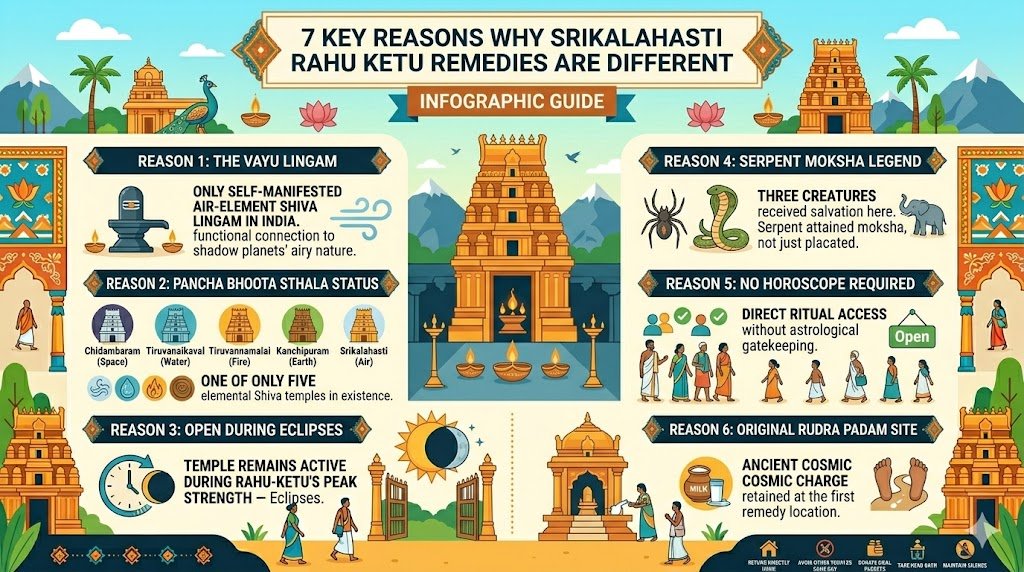
- Vayu Lingam: The only self-manifested air-element Shiva lingam in India
- Pancha Bhoota Sthala: One of only five elemental Shiva temples in existence
- Eclipse access: The temple stays open during Rahu-Ketu’s peak strength — eclipses
- Daily pooja: Sarpa dosha pooja runs every single day, including festivals and grahanam
- No horoscope needed: Direct ritual access without astrological gatekeeping
- Trinity site: Spider, serpent and elephant all attained salvation here
- Rudra Padam: The original ancient spot where the remedy was first performed
Understanding Why Rahu Ketu Remedies Kalahasti Are Different
Rahu and Ketu are not physical planets at all. Specifically, they are mathematical points — the lunar nodes — where the moon’s orbit intersects the ecliptic. Astronomically, they cause eclipses. Astrologically, they govern karma, shadow forces, illusion, and ancestral imprints.
For these shadow energies, ordinary temples are not enough. Furthermore, classical Hindu astrology insists that remedies must be performed at sites with a specific cosmic alignment to the affliction. This is exactly where the Srikalahasti temple breaks from every other shrine in the country.
The Astronomical Logic Behind the Remedy
Eclipses occur when Rahu or Ketu align precisely with the Sun and Moon. Therefore, classical texts treat these days as the periods when shadow-planet energy peaks. Most temples in India shut their sanctums during grahanam to protect deities from inauspicious vibrations.
However, Srikalahasti does the opposite. The temple remains open and the sarpa dosha pooja continues uninterrupted during eclipses. This single fact — accepted by the Andhra Pradesh Endowments Department as official policy — signals that this is a temple built specifically to absorb and neutralise Rahu-Ketu energy at its strongest.
Reason 1: The Vayu Lingam — A Unique Cosmic Anchor
The main deity at Srikalahasti is Lord Kalahasteeswara, worshipped as the Vayu Lingam — the air-element Shiva lingam. Notably, this is the only place in India where Shiva is worshipped in this specific elemental form.
You can actually see the Vayu element at work. Specifically, the lamps inside the sanctum flicker continuously even when no air currents are present. Devotees who visit the inner sanctum consistently observe this phenomenon, which priests demonstrate during darshan.
Why Air Element Matters for Shadow Planets
Rahu and Ketu are classified in Vedic astrology as airy, mental, and emotional shadow forces. Therefore, the air element directly governs the same plane on which these graham operate. The match is not symbolic — it is functional.
For instance, ailments from Rahu and Ketu typically manifest as anxiety, confusion, restlessness, sudden disruption, and karmic obstacles. All of these are vata or air-imbalance conditions in Ayurveda too. Hence, performing the remedy at the Vayu Lingam targets the energetic source directly.
Reason 2: Pancha Bhoota Sthala Status
The Pancha Bhoota Sthalas are five temples representing the five primal elements of creation. Specifically, they are Chidambaram (space/akasha), Tiruvanaikaval (water), Tiruvannamalai (fire), Kanchipuram (earth), and Srikalahasti (air).
| Temple | Element | Location |
|---|---|---|
| Chidambaram | Akasha (space) | Tamil Nadu |
| Tiruvanaikaval | Jala (water) | Tamil Nadu |
| Tiruvannamalai | Agni (fire) | Tamil Nadu |
| Kanchipuram (Ekambareswarar) | Prithvi (earth) | Tamil Nadu |
| Srikalahasti | Vayu (air) | Andhra Pradesh |
Of all five, only Srikalahasti carries the dual reputation of being both an elemental temple and a primary Rahu-Ketu remedy site. Additionally, no other dosha temple — Kukke Subramanya, Thirunageswaram, or Trimbakeshwar — belongs to the Pancha Bhoota category.
What This Means Spiritually
Pancha Bhoota Sthalas are considered foundational anchors of the physical universe in Saiva siddhanta philosophy. Furthermore, performing dosha-removal at one of these five sites is believed to dissolve karma at a more fundamental cosmic layer than at regular temples.
For example, devotees report that Kala Sarpa Dosha relief at Srikalahasti often shows results within months. However, at non-Pancha Bhoota dosha temples, the same relief is described in years. The pattern is consistent enough that astrologers explicitly recommend Srikalahasti for severe cases.
Reason 3: Daily Pooja Even During Eclipses
This is perhaps the strongest differentiator. Specifically, Srikalahasti is the only major Indian temple where sarpa dosha pooja and Rahu-Ketu pooja continue every single day — including amavasya, pournami, solar eclipses, lunar eclipses, and natural calamity days.
Most temples close or reduce service during grahanam. However, Srikalahasti runs sevas through eclipse periods because the cosmic theory behind the temple actively welcomes Rahu-Ketu energy for purification.
Why Eclipse-Day Access Matters
Performing Rahu-Ketu remedy during a solar or lunar eclipse is considered by many astrologers to amplify the pooja’s effect dramatically. Furthermore, no other dosha temple in India offers this access window consistently.
- Kukke Subramanya — partially closes during eclipse hours
- Thirunageswaram — restricted access during grahanam
- Trimbakeshwar — sanctum closes during eclipse
- Srikalahasti — open and active throughout eclipses
This open-during-eclipse policy is not casual. Additionally, it has been maintained for centuries based on the temple’s founding sthala purana, which directly connects the site to shadow-planet energy.
Reason 4: The Spider, Serpent, Elephant Legend
The temple’s name itself — Sri Kalahasti — comes from three creatures who attained moksha here. Specifically, Sri means spider, Kala means serpent (Kala the snake), and Hasti means elephant. All three worshipped the Vayu lingam in their own way and received salvation.
The serpent angle is critical here. Moreover, in Hindu astrology, Rahu is depicted as half-serpent with a human body, and Ketu as half-human with a serpent body. Therefore, a temple where a serpent itself attained moksha through Shiva-worship becomes the natural seat for serpent-dosha remedies.
How This Differs From Snake-Worship Temples
Kukke Subramanya is dedicated to Lord Subramanya as a serpent form, and Thirunageswaram features Rahu with his two consorts. However, both treat the serpent as the deity itself rather than as a soul liberated by Shiva.
At Srikalahasti, the serpent is shown attaining moksha — which means the dosha can be dissolved rather than merely placated. For instance, this distinction is why senior astrologers describe Kalahasti’s pooja as “nivarana” (removal) while other temples are described as “shanti” (pacification).
Reason 5: No Horoscope Required
At many traditional dosha temples, priests insist on viewing your horoscope, computing planetary positions, and prescribing customised rituals. However, Srikalahasti has democratised the remedy entirely.
Any devotee can walk in, purchase a ticket between ₹500 and ₹2,500 depending on seating category, and perform the full ritual without astrological gatekeeping. Furthermore, the priests guide the procedure in Telugu, Tamil, Hindi, and English so pilgrims from every state can follow along.
The Spiritual Reasoning Behind Open Access
Classical Saiva texts treat Shiva as the destroyer of all dosha without precondition. Therefore, requiring a horoscope before performing a Shiva remedy is considered a corruption introduced by intermediary astrologers, not a scriptural requirement.
The temple administration has consistently rejected this gatekeeping. Additionally, this accessibility is one reason why devotees report Srikalahasti feels more direct and personal than other dosha temples where the focus often shifts to astrological consultation fees.
Reason 6: The Original Rudra Padam Site
Most devotees never visit Rudra Padam — and most articles never mention it. Specifically, this is the original ancient spot, located about 100 feet from the Patala Ganapathi temple, where the Rahu-Ketu Kala Sarpa Dosha pooja was first performed centuries ago.
Today’s pooja mandapams are newer infrastructure. However, Rudra Padam retains the original cosmic charge of the very first ritual. Devotees who want maximum effect typically perform an additional milk abhishekam at Rudra Padam before the main pooja.
The Rudra Padam Procedure
- Take a head bath at your hotel or home in the early morning
- Reach Rudra Padam before the main pooja begins
- Perform milk abhishekam with 1 litre of milk on the idols
- Complete 3 pradakshinas around the idols
- Sprinkle milk gently — no elaborate decoration needed
- Proceed to the main mandapam for the official ticketed pooja
- Donate 2–3 meal packets to the poor outside the temple after pooja
This combination of ancient site plus modern ticketed pooja is unique to Srikalahasti. Furthermore, no other dosha temple in India offers an equivalent dual-layer ritual structure.
Reason 7: Comparing Kalahasti Against the Major Alternatives
Several temples claim Rahu-Ketu remedy authority. However, a head-to-head comparison reveals exactly why Srikalahasti consistently ranks first.
| Temple | Key Strength | Key Limitation |
|---|---|---|
| Srikalahasti (AP) | Vayu Lingam, Pancha Bhoota, eclipse-open | Crowds on amavasya and weekends |
| Kukke Subramanya (Karnataka) | Sarpa Samskara homam strength | Limited daily slots, advance booking required |
| Thirunageswaram (TN) | Rahu in human form, milk abhishekam | Restricted eclipse-day operations |
| Trimbakeshwar (Maharashtra) | Kala Sarpa shanti homam | Eclipse closure, longer ritual duration |
| Thirupampuram (TN) | Equivalent power, less crowd | Limited infrastructure, fewer batches |
When to Choose Kalahasti Specifically
Srikalahasti is the right choice when your case involves any of the following. Therefore, evaluate honestly before travelling.
- Severe Kala Sarpa Dosha — all seven planets between Rahu and Ketu
- Long-standing marriage delays or breakdowns
- Childlessness with confirmed Naga Dosha
- Chronic career obstacles despite hard work
- Pitru Dosha or ancestral karmic patterns
- Pooja desired during an upcoming solar or lunar eclipse
- Limited time available — single-day completion possible
Pooja Ticket Categories and Costs
The temple offers tiered ticketing based on seating proximity and ritual elaboration. Notably, the cosmic effect of the pooja is considered the same across all tickets — the difference is mainly comfort and viewing access.
| Ticket Category | Approximate Cost | Seating Position |
|---|---|---|
| Basic | ₹500 | Outer mandapam |
| Standard | ₹750 | Middle mandapam |
| Premium | ₹1,500 | Inner mandapam |
| VIP | ₹2,500 | Near Sahasra Linga |
A higher ₹5,000 category is also issued at the counter. Prices may revise periodically — confirm current rates at the temple counter or the official portal. Additionally, the pooja samagri kit comes free with every ticket category.
Best Days and Timings for the Pooja
While the pooja runs daily from 6:00 AM to 5:00 PM, certain days amplify its effect. Specifically, Rahu Kalam timings on Tuesdays and Sundays are considered the strongest windows.
Recommended Days in Order of Power
- Solar or lunar eclipse day — maximum strength, must book early
- Ashlesha Nakshatram — direct serpent constellation alignment
- Amavasya — new moon for shadow-planet potency
- Panchami and Chaturthi — traditionally favoured tithis
- Sundays during Rahu Kalam — 4:30 PM to 6:00 PM window
- Tuesdays during Rahu Kalam — 3:00 PM to 4:30 PM window
Avoid major festival days unless that is your specific goal. However, festival energy can be overwhelming for first-time visitors due to crowd density.
What to Do After the Pooja
The post-pooja conduct is as important as the ritual itself. Furthermore, breaking these rules is believed to reduce the pooja’s effect substantially.
- Return directly home. Do not visit other temples on the same day.
- Avoid friends’ or relatives’ houses on the journey back.
- Donate meal packets to the poor immediately after the pooja.
- Take a head bath after reaching your accommodation.
- Sleep on the floor the night before and the night of the pooja.
- Maintain silence for the rest of the day.
- Eat only sattvic vegetarian food for 24 hours before and after.
External Resources for Verification
For official temple timings, ticket categories, and seva schedules, always rely on primary sources. Timings and seva schedules do change at short notice, so confirm them at the temple’s own enquiry counter or by phone before you travel — any online listing, including this one, can lag a change. Furthermore, Drik Panchang remains the gold standard for checking Rahu Kalam, Ashlesha nakshatram, and eclipse dates before planning your visit.
For the temple’s official Pancha Bhoota status and historical background, the Srikalahasteeswara Temple reference page provides a useful overview drawing on temple inscriptions and Tamil Sangam literature.
Final Thoughts
The reasons Rahu Ketu remedies Kalahasti offers consistently outperform other temples are not mystical or accidental. Furthermore, the combination of Vayu Lingam, Pancha Bhoota Sthala status, eclipse-open access, original Rudra Padam location, and the spider-serpent-elephant moksha legend create a stack of spiritual factors that no competitor matches. If your astrologer has flagged Kala Sarpa Dosha, severe Naga Dosha, or persistent karmic obstacles, this temple deserves serious consideration over Kukke or Thirunageswaram. Plan around Rahu Kalam timings, follow the Rudra Padam pre-pooja step, and return home directly to honour the remedy’s full effect.
Frequently Asked Questions
Why are Rahu Ketu remedies at Kalahasti considered more powerful?
Srikalahasti is the only Pancha Bhoota Sthala dedicated to the Vayu (air) element, which directly governs Rahu-Ketu’s airy, mental nature. Additionally, the temple remains open during eclipses when Rahu-Ketu energy peaks. This combination of elemental alignment, eclipse access, and the original Rudra Padam ritual site makes the remedies measurably stronger than at other dosha temples.
Is Srikalahasti better than Kukke Subramanya for Sarpa Dosha?
For Rahu-Ketu Dosha and Kala Sarpa Dosha, Srikalahasti is generally considered more direct because of the Vayu Lingam and eclipse-day access. However, Kukke Subramanya remains strong for Sarpa Samskara homam specifically — a different ritual aimed at ancestral serpent-related sins. Many astrologers recommend visiting both temples for severe cases.
Can I perform Rahu Ketu pooja at Kalahasti during a solar eclipse?
Yes, Srikalahasti is one of the very few major temples in India that stays open during solar and lunar eclipses. The sarpa dosha pooja continues uninterrupted during grahanam, and the eclipse window is considered the most powerful time to perform the remedy. Book your ticket early as demand peaks dramatically on eclipse days.
Do I need a horoscope to perform the pooja at Srikalahasti?
No, Srikalahasti does not require a horoscope, birth chart, or astrological consultation before performing the Rahu Ketu pooja. Any devotee can walk in, purchase a ticket, and complete the ritual. The temple priests guide the procedure in Telugu, Tamil, Hindi, and English without any gatekeeping based on astrological prerequisites.
What is Rudra Padam and should I visit it?
Rudra Padam is the original ancient site within the Srikalahasti temple complex where the Rahu Ketu Kala Sarpa Dosha pooja was first performed centuries ago. Located about 100 feet from the Patala Ganapathi temple, devotees who want maximum effect perform a milk abhishekam here with 1 litre of milk and 3 pradakshinas before the main ticketed pooja.
How much does the Rahu Ketu pooja cost at Kalahasti?
Tickets range from approximately ₹500 to ₹5,000 depending on seating category. Basic tickets cost ₹500, standard ₹750, premium ₹1,500, and the VIP category near the Sahasra Linga is ₹2,500. The cosmic effect of the pooja is considered identical across all categories — the difference is mainly seating proximity and comfort.

Independent pilgrim guide for Sri Kalahasti Temple. Curating darshan timings, Rahu Ketu Pooja booking, sevas, accommodation, Vayu Lingam significance, and complete travel guidance for devotees visiting the temple.
