Srikalahasti Temple Aksharabhyasam complete guide for parents: ritual significance, booking, timings, dress code, and step-by-step ceremony procedure.
The Srikalahasti Temple Aksharabhyasam is one of the most spiritually charged ways to begin your child’s educational journey in South India. Performed at the famous Medho Dakshina Murthy shrine within this ancient Pancha Bhoota Sthalam, this sacred ritual marks the moment when a child writes their very first letters under divine blessing. Parents from Andhra Pradesh, Tamil Nadu, Karnataka, and Telangana travel here specifically for this ceremony, believing that starting education at the feet of Lord Dakshina Murthy and Goddess Gnana Prasunamba sets a child up for a lifetime of wisdom and academic success.
Quick Summary: Key Takeaways
- Aksharabhyasam at Srikalahasti is performed at the Medho Dakshina Murthy temple within the main complex.
- The ideal age for the ceremony is between 2 and 5 years, just before formal schooling begins.
- Tickets are available only at the temple counter — no online booking exists for this seva.
- The ritual cost is modest, typically ranging from ₹100 to ₹500 depending on the package selected.
- Vijayadashami, Vasant Panchami, and Saraswati Pooja days draw the largest gatherings of families.
What Is Srikalahasti Temple Aksharabhyasam?
The Srikalahasti Temple Aksharabhyasam is the sacred Vidyarambham ritual where a young child is formally initiated into the world of letters and learning. Specifically, the ceremony involves the child writing their first alphabet on a plate of rice, guided by a temple priest. Notably, this happens in the divine presence of Lord Dakshina Murthy — the form of Shiva worshipped as the supreme guru and teacher.
Furthermore, the ritual takes place at the Medho Dakshina Murthy shrine, a smaller but spiritually powerful temple within the main Srikalahasti complex. Moreover, the location is significant because Dakshina Murthy is considered the cosmic teacher who imparts knowledge through silence. As a result, performing Aksharabhyasam here carries unique blessings unavailable at most other temples.
Why Srikalahasti Is Special for Aksharabhyasam
While Basara Saraswati temple is the most famous destination for this ritual, Srikalahasti offers something distinct. Specifically, this is one of the rare places where the ceremony is performed in the presence of both Shiva (as Dakshina Murthy, the guru) and Goddess Gnana Prasunamba (Parvati as the embodiment of wisdom). Therefore, devotees believe the dual blessing makes Srikalahasti uniquely powerful for educational initiation.
Religious Significance of Aksharabhyasam at Srikalahasti
The legend behind Goddess Gnana Prasunamba directly connects to the wisdom theme of Aksharabhyasam. According to Srikalahasti temple history, Parvati performed intense penance here and was granted divine knowledge by Lord Shiva himself. Consequently, she came to be worshipped as Gnana Prasunamba — the goddess who blossoms with knowledge.
Moreover, the form of Dakshina Murthy enshrined within the complex is believed to be the original cosmic teacher who taught the four sages (Sanaka, Sanandana, Sanatana, and Sanat Kumara) through silent gestures. Therefore, parents who bring their children here are symbolically placing them at the feet of the universe’s first guru. As a result, the ritual carries profound spiritual weight beyond a simple writing ceremony.
The Connection with Lord Dakshina Murthy
Notably, Dakshina Murthy is the patron deity of all students, scholars, and seekers of knowledge. Specifically, Hindus across South India invoke him before starting any educational pursuit. Furthermore, Thursday is considered his special day, making it the most auspicious choice for Srikalahasti Temple Aksharabhyasam ceremonies.
Best Age for the Ceremony
Traditionally, Aksharabhyasam was performed when a child turned five years old. However, with the early onset of preschool education, families now conduct the ritual much earlier. Specifically, ages between 2 and 5 are considered ideal in modern practice.
| Child’s Age | Suitability | What to Expect |
|---|---|---|
| 2 years | Earliest acceptable | Child may need parental help throughout |
| 3 years | Most popular age | Just before preschool starts |
| 4 years | Highly recommended | Child can write basic letters |
| 5 years | Traditional age | Child fully engaged in ritual |
Additionally, parents should choose an age when the child can sit through a 20-30 minute ritual without distress. Furthermore, the child must be able to hold a finger steady enough to trace a letter on rice. As a result, most families settle on ages 3 to 4 as the sweet spot.
Auspicious Days for Srikalahasti Temple Aksharabhyasam
Choosing the right day amplifies the spiritual benefits of the ceremony. Specifically, certain festivals and tithis are considered especially powerful for initiating a child’s education at this temple.
Most Auspicious Festivals
- Vijayadashami (Dussehra): The single most popular day for Aksharabhyasam across South India
- Vasant Panchami: Saraswati’s birthday in the month of Magha (January-February)
- Saraswati Pooja during Navratri: Especially Mula Nakshatra day
- Akshaya Tritiya: Considered eternally auspicious for new beginnings
- Guru Purnima: The day dedicated to teachers and gurus
- Ugadi: Telugu New Year, ideal for fresh starts
Best Days of the Week
Furthermore, Thursday is universally considered the best weekday because it is sacred to Guru (Brihaspati) and Dakshina Murthy. Moreover, Wednesday is also favored as it is connected to Mercury, the planet governing intelligence and communication. However, Mondays carry special significance at Srikalahasti as the temple is dedicated to Shiva.
How to Book Srikalahasti Temple Aksharabhyasam
The booking process for the Srikalahasti Temple Aksharabhyasam is refreshingly simple. Specifically, the temple does not offer any online booking facility for this seva. Therefore, parents must visit the temple in person and obtain tickets at the authorized counter.
Step-by-Step Booking Process
- Reach the temple early: Arrive at Srikalahasti by 6:00 AM for best availability.
- Locate the seva counter: The ticket counter is near the main temple entrance.
- Request Aksharabhyasam ticket: Specifically ask for the ritual at Medho Dakshina Murthy shrine.
- Provide child’s details: Carry the child’s date of birth and basic identification.
- Pay the seva fee: Cash payment is accepted at the counter.
- Receive the ritual time slot: The priest will assign a specific timing.
- Reach the shrine on time: Arrive 15 minutes before your scheduled slot.
Notably, ticket prices for Aksharabhyasam at Srikalahasti generally range from ₹100 to ₹500 depending on the chosen package. However, prices may vary, so confirm at the counter on the day of your visit. Furthermore, there is no upper booking limit, and walk-ins are welcome on most days.
What to Bring for the Ceremony
Coming prepared makes the entire experience smoother for both parent and child. Specifically, certain items are essential while others enhance the ritual’s beauty. Below is a comprehensive checklist of what to carry.
Essential Items Checklist
- A new slate or wooden writing board (palaka)
- Slate pencil or chalk
- A small notebook and pen for symbolic use
- Fresh flowers (especially lotus or jasmine)
- Camphor and incense sticks
- Coconut, betel leaves, and betel nuts
- Fruits (especially banana and apple)
- Sweets or laddu for offering
- Yellow turmeric and red kumkum
- Rice (raw, uncooked) for the writing ritual
- Dakshina (token money) for the priest
Items the Temple Provides
Additionally, the temple authorities sometimes provide a basic kit including a slate, slate pencil, and laddu prasadam. Moreover, during organized annual Aksharabhyasam events, the devasthanam distributes notebooks and writing materials free of cost. However, bringing your own items ensures a more personalized ceremony experience.
Step-by-Step Ritual Procedure
Understanding what happens during the ceremony helps parents prepare their child mentally. Specifically, the entire ritual takes about 20 to 30 minutes from start to finish. Below is the typical sequence followed at Srikalahasti.
Phase 1: Preparation and Sankalpa
Firstly, the priest invokes Lord Ganesha to remove obstacles. Furthermore, the family takes a sankalpa (formal vow) stating the child’s name, gotra, and the purpose of the ritual. Moreover, this establishes the spiritual intention of the ceremony.
Phase 2: Saraswati and Dakshina Murthy Invocation
Secondly, prayers are offered to Goddess Saraswati and Lord Dakshina Murthy. Specifically, the priest chants the Saraswati mantra: “Saraswati Namastubhyam Varade Kamarupini, Vidyarambham Karishyami Siddhir Bhavatu Me Sada.” Therefore, divine blessings are invoked before the child begins writing.
Phase 3: The First Letters
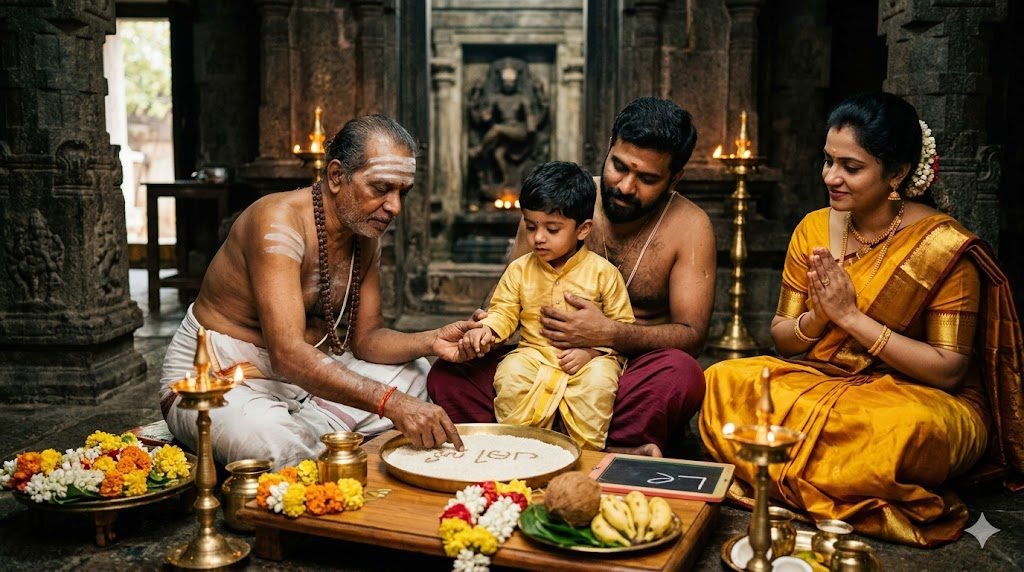
Next comes the most significant moment of the entire ceremony. Specifically, the child sits on the lap of the father, paternal uncle, or maternal uncle. Furthermore, the priest holds the child’s right index finger and helps trace the sacred syllable “Om” on a plate of rice. Moreover, the first Telugu letters “అ ఆ ఇ ఈ” or Sanskrit “Om Namah Shivaya” are then written.
Phase 4: Blessings and Prasadam
Finally, the priest blesses the child by placing his hand on the head while chanting Vedic mantras. As a result, the child receives the divine grace of beginning education under sacred protection. Notably, prasadam is distributed and the family proceeds for darshan of the main deity.
Temple Timings for Aksharabhyasam
The Srikalahasti temple is open daily from early morning until late evening. Specifically, Aksharabhyasam can be performed during most temple hours, but morning slots are highly recommended. Below are the general temple timings to plan your visit.
| Activity | Timing | Best For |
|---|---|---|
| Temple opening | 5:00 AM | Early arrival |
| Morning Aksharabhyasam | 7:00 AM – 11:00 AM | Most auspicious slot |
| Midday | 11:00 AM – 4:00 PM | Aksharabhyasam not usually performed; other sevas continue |
| Evening Aksharabhyasam | 4:00 PM – 7:00 PM | Backup option |
| Temple closing | 9:00 PM | Final darshan |
However, timings may shift slightly on festival days and during eclipse periods. Furthermore, confirm the day’s schedule at the temple ticket counter before you begin, since timings can change at short notice.
Dress Code for Parents and Child
While Srikalahasti does not enforce a strict dress code like Tirumala, traditional attire is strongly recommended for ritual ceremonies. Specifically, the sanctity of Aksharabhyasam calls for modest, traditional clothing. Below are the recommended outfits.
For the Child
Notably, boys traditionally wear a small dhoti with a kurta or a pancha. Furthermore, girls wear a pavada (long skirt) with a blouse, or a small saree. Moreover, dressing the child in yellow is considered especially auspicious for educational rituals.
For Parents
Additionally, fathers should wear traditional dhoti or pancha with a shirt. Mothers are recommended to wear a saree or salwar kameez with a dupatta covering the head. Therefore, the entire family presents a respectful and devotional appearance during the sacred ceremony.
How to Reach Srikalahasti Temple
Srikalahasti is located about 36 km from Tirupati in the Tirupati district of Andhra Pradesh. Specifically, the temple is well-connected by road, rail, and air making it easy to reach from anywhere in South India.
- By Air: Tirupati International Airport (TIR) is just 26 km away with daily flights from Hyderabad, Bengaluru, and Chennai
- By Train: Srikalahasti Railway Station (KHT) is only 2-3 km from the temple with direct trains from major cities
- By Road: APSRTC operates frequent buses from Tirupati, Chennai, Nellore, and surrounding districts
- By Taxi: Cabs from Tirupati to Srikalahasti take approximately one hour
Moreover, many pilgrims combine their Srikalahasti visit with Tirumala darshan, making it part of a broader spiritual itinerary.
The Bottom Line
Performing the Srikalahasti Temple Aksharabhyasam is among the most beautiful spiritual gifts you can offer your child at the start of their educational journey. With its unique combination of Lord Dakshina Murthy as the cosmic teacher and Goddess Gnana Prasunamba as the embodiment of wisdom, this ancient Pancha Bhoota Sthalam offers blessings unavailable elsewhere. Therefore, plan your visit on an auspicious day like Vijayadashami or Vasant Panchami, arrive early, bring all the essential items, and dress your family in traditional attire. Above all, approach the ceremony with devotion — your child will carry these blessings throughout their lifetime of learning.
Frequently Asked Questions
Can I book Srikalahasti Temple Aksharabhyasam online?
No, Srikalahasti temple does not offer online booking for Aksharabhyasam or any other seva. You must visit the temple in person and purchase the ticket at the authorized counter inside the complex. Therefore, plan to arrive early in the morning to secure a good time slot.
What is the cost of Aksharabhyasam at Srikalahasti temple?
The Aksharabhyasam ticket cost at Srikalahasti generally ranges from ₹100 to ₹500 depending on the package chosen. However, prices may vary based on the day and time, so confirm at the temple counter on the day of your visit. Additional offerings like coconut, flowers, and dakshina are extra.
What is the best age for Aksharabhyasam at Srikalahasti?
The ideal age for Aksharabhyasam is between 2 and 5 years old, just before the child begins formal preschool education. Most parents prefer ages 3 to 4 because the child can sit calmly through the 20-30 minute ritual. Traditionally, age 5 was the standard, but modern schooling has shifted preferences earlier.
Where exactly in Srikalahasti temple is Aksharabhyasam performed?
The Aksharabhyasam ceremony is conducted at the Medho Dakshina Murthy shrine within the main Srikalahasti temple complex. This sub-shrine is dedicated to Lord Shiva in his form as the supreme cosmic teacher. After the ritual, families typically proceed for darshan of Lord Srikalahasteeswara and Goddess Gnana Prasunamba.
Which day is best for Srikalahasti Temple Aksharabhyasam?
Vijayadashami (Dussehra) and Vasant Panchami are considered the most auspicious days for this ceremony. Additionally, Thursday is the best weekday because it is sacred to Guru and Dakshina Murthy. Moreover, festival days draw large crowds, so arrive very early or choose a less busy weekday for a peaceful experience.
What should I bring for my child’s Aksharabhyasam at Srikalahasti?
Bring a new slate, slate pencil, notebook, pen, fresh flowers, coconut, betel leaves, fruits, sweets, turmeric, kumkum, raw rice, and dakshina for the priest. Additionally, dress your child in traditional clothing, preferably yellow. The temple may also provide a basic kit during organized events.

Independent pilgrim guide for Sri Kalahasti Temple. Curating darshan timings, Rahu Ketu Pooja booking, sevas, accommodation, Vayu Lingam significance, and complete travel guidance for devotees visiting the temple.
