
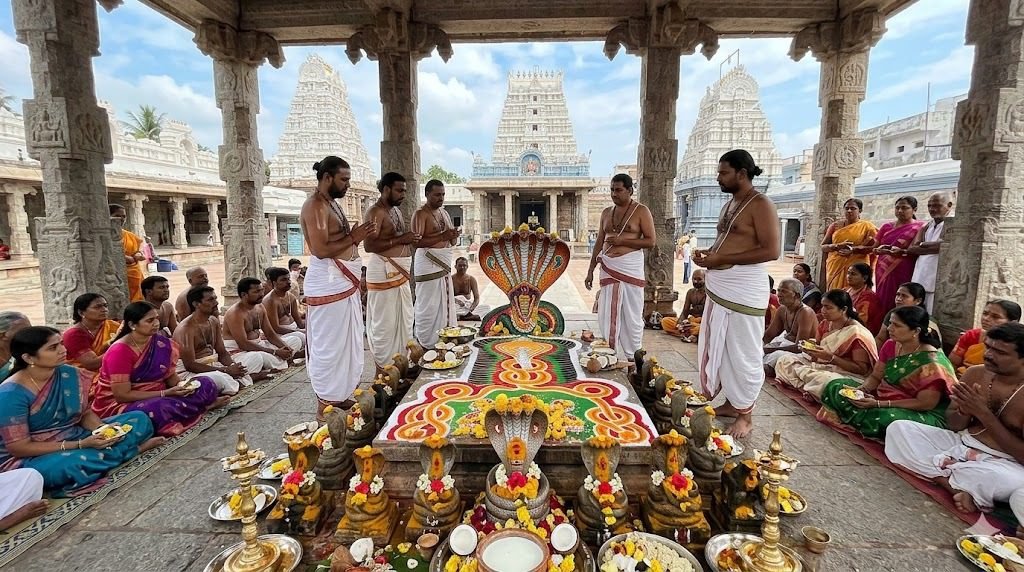
Planning to perform Srikalahasti Ashlesha Bali pooja ? Get all details — Nakshatra dates, ticket prices, booking procedure, dress code, and full ritual guide.
The Srikalahasti Ashlesha Bali pooja is one of the most sought-after serpent Dosha remedies in all of South India — and it is performed at a venue that carries a spiritual authority unlike any other: the sacred hills of Srikalahasti, where Lord Srikalahasteeswara Shiva is enshrined as the Vayu (Air) Linga of the Pancha Bootha Sthalams. Conducted on auspicious Ashlesha Nakshatra days at a dedicated mutt near Gate No. 3 of the temple complex, this ritual is specifically designed for devotees born under the Ashlesha star and for those afflicted with Sarpa Dosha — and planning it correctly makes the difference between a pooja performed with full devotional impact and one lost to confusion and crowd delays.
Srikalahasti Ashlesha Bali Pooja: Quick Reference
- Venue: Mutt adjacent to Gate No. 3 parking area, Srikalahasti Temple complex (outside the main sanctum)
- Best days: Ashlesha Nakshatra days (occurs once per lunar month); also auspicious on Tuesdays, Purnami, Chaturthi, Panchami, Shasti, and eclipse days
- Booking method: Counter tickets at the temple; minimum 7–10 days advance arrangement recommended
- Ticket range: From ₹500 (Sarpa Dosha Nivarana category); contact the mutt or temple counter for current Ashlesha Bali-specific pricing
- Duration: Approximately 2–3 hours
- Official temple portal: Sri Kalahasteeswara Swamy Vari Devasthanam, AP Endowments Department
- Rahu Ketu Pooja online booking: aptemples.ap.gov.in
- Temple address: Srikalahasti Temple, Srikalahasti – 517644, Tirupati District, Andhra Pradesh
About Srikalahasti Temple: Why This Kshetra Matters for Ashlesha Bali
Srikalahasti is not merely a famous Shiva temple — it is one of the five Pancha Bootha Sthalams of South India, representing the element of Air (Vayu). Ancient Tamil sources describe Srikalahasti as the “Kailash of the South,” and the Swarnamukhi River flowing at its base as the “Ganga of the South.” This cosmological status makes every ritual performed here exponentially more potent, according to Vedic tradition.
The temple’s very name encodes its power. Sri represents the spider, Kala the serpent, and Hasti the elephant — three devoted creatures from ancient legend, each of which worshipped the Shivalinga here with absolute faith and attained moksha. The serpent’s association with the temple name gives the Ashlesha Bali pooja here a deeper mythological grounding than at most other sites.
Moreover, Srikalahasti holds a distinction found at no other temple in India: it is the only shrine that remains open during solar and lunar eclipses, with Rahu and Ketu-related rituals actively performed on those rare days. This singular openness to Graha-related remediation — especially those connected to serpent planets Rahu and Ketu — positions Srikalahasti as the premier Andhra Pradesh destination for Naga Dosha and Sarpa Dosha healing, alongside Kukke Subramanya in Karnataka.
What Is Ashlesha Bali Pooja and Who Should Perform It
Ashlesha Bali Pooja is a Vedic ritual offering (Bali means food or sacrifice offering) made to the Ashta Nagas — the eight serpent deities — to seek their forgiveness and blessings. The ceremony is performed specifically during the Ashlesha Nakshatra, the ninth lunar mansion in Vedic astrology, which is presided over by the serpent deity Sarpa and associated with the qualities of Rahu.
However, a critical misconception surrounds this pooja. Not every person with Sarpa Dosha or Kala Sarpa Dosha needs Ashlesha Bali. The correct remedy depends on the horoscope. Specifically, Ashlesha Bali Pooja applies when the devotee is born in Ashlesha Nakshatra and is under the influence of malefic planets causing Naga Dosha. If Rahu and Ketu encircle all seven other planets in the horoscope — the classic Kala Sarpa Dosha configuration — the correct remedy is the Rahu Ketu Shanti Pooja, not Ashlesha Bali. Consulting a knowledgeable astrologer before choosing between these two remedies saves time, money, and prevents performing the wrong ritual.
Who Benefits Most from Srikalahasti Ashlesha Bali Pooja
The Srikalahasti Ashlesha Bali pooja is most directly beneficial for the following categories of devotees. Those born in Ashlesha Nakshatra who face persistent obstacles in life — regardless of their current zodiac period — are the primary beneficiaries. Couples experiencing prolonged fertility issues or unexplained delays in childbearing often perform this ritual as a dedicated Naga Dosha remedy alongside medical treatment.
Similarly, individuals with repeated marriage delays who have exhausted conventional explanations, devotees with chronic skin conditions that resist medical treatment, and those facing inexplicable career stagnation or financial setbacks with no clear cause are among those who seek out the Srikalahasti Ashlesha Bali pooja. Many shastras specifically mention that people born under Ashlesha Nakshatra experience a measurable easing of life’s difficulties after regular performance of this ritual.
Furthermore, this pooja can be performed on behalf of a family member who is unable to attend in person. A parent can perform the ritual for a child, or a spouse on behalf of their partner — the priests conduct the Sankalp (sacred declaration) in the absent devotee’s name, gotram, and nakshatra, linking the ritual’s benefits directly to them.
Ashlesha Bali vs. Rahu Ketu Pooja at Srikalahasti: The Essential Comparison
Pilgrims often arrive at Srikalahasti confused about which of the two major serpent-related rituals to perform. The table below clarifies the distinction decisively.
| Feature | Ashlesha Bali Pooja | Rahu Ketu Shanti Pooja |
|---|---|---|
| Primary Dosha Addressed | Naga Dosha / Sarpa Dosha (birth star affliction) | Kala Sarpa Dosha / Rahu-Ketu graha affliction |
| Who Should Perform | Born in Ashlesha Nakshatra with malefic planet influence | Anyone with Rahu-Ketu encircling all planets in horoscope |
| Best Days | Ashlesha Nakshatra days; Tuesdays | Tuesdays, Sundays, Purnami, Eclipse days, any day |
| Venue at Srikalahasti | Mutt near Gate No. 3 parking area | Dedicated Rahu Ketu Mandap inside temple complex |
| Ticket Range | From ₹500 (confirm at mutt counter) | ₹500 to ₹5,000 depending on category |
| Online Booking | Not available — counter only | Available via aptemples.ap.gov.in |
| Duration | 2–3 hours | 1 hour per batch |
Consequently, many experienced devotees perform both rituals in a single Srikalahasti visit — the Ashlesha Bali Pooja on the Nakshatra day and the Rahu Ketu Shanti Pooja as a complementary remedy. This combined approach is widely recommended by priests at the temple and significantly amplifies the spiritual impact of the visit.
Booking the Srikalahasti Ashlesha Bali Pooja: The Correct Process
Straightforward truth first: there is currently no dedicated online booking portal for the Ashlesha Bali Pooja at Srikalahasti Temple. Tickets are issued directly at the temple mutt counter near Gate No. 3. However, planning and arranging the pooja at least 7 to 10 days in advance — either by contacting the mutt directly or through a trusted local priest — is strongly recommended to secure the correct Nakshatra date and ensure priestly availability.
Step-by-Step Booking Procedure
- Identify the next Ashlesha Nakshatra date. The Ashlesha star occurs once in every lunar month, lasting approximately 24 hours. Consult a Telugu or Tamil Panchang (almanac) for the exact date and start/end time. The pooja yields the most potent results when performed within the Ashlesha Nakshatra window — planning your trip around this lunar calendar is the single most important preparation step.
- Plan travel to Srikalahasti around the Nakshatra date. Arrive one day before the Ashlesha Nakshatra begins. This allows time for rest, a head bath at your accommodation, and reaching the temple early on the day of the pooja before counter crowds build up.
- Contact the mutt near Gate No. 3 in advance. Ask at the temple enquiry counter for the mutt’s current contact details, and confirm the Ashlesha Bali Pooja schedule for your chosen date. Priests at the mutt can also confirm current pricing and preparation requirements.
- Reach the mutt counter early on the Nakshatra day. The temple complex opens at 5:00 AM daily. Arrive at Gate No. 3 and proceed to the mutt counter as early as possible. Purchase your ticket and collect the receipt — this is your entry pass for the Ashlesha Bali Pooja Mandap.
- Complete the Sankalp. At the Sankalp area, the priest records your name, gotram (lineage), nakshatra, and reason for performing the pooja. This Sankalp formally links the ritual’s spiritual benefit to you and your family lineage. Provide these details clearly and accurately.
- Attend the Ashlesha Bali Pooja. The priests conduct Vedic mantras from the Sarpa Sukta and perform Bali offerings to the Ashta Nagas. The complete ritual takes approximately 2 to 3 hours. Maintain silence and devotional focus throughout — no photography is permitted inside the Mandap.
- Receive prasadam and temple darshan. After the pooja’s Purnahuti (final offering), prasadam is distributed to participants. Proceed next to the main Srikalahasteeswara shrine for darshan, completing your spiritual circuit at this sacred Vayu Kshetra.
What About Online Booking for Rahu Ketu Pooja at Srikalahasti?
Devotees who wish to book the Rahu Ketu Shanti Pooja at Srikalahasti — as a complementary remedy on the same visit — can do so through the Andhra Pradesh Endowments Department’s portal at aptemples.ap.gov.in. Register with your mobile number and email, select Srikalahasti Temple, choose the Rahu Ketu Sarpa Dosha Nivarana seva, and complete payment online. Rahu Ketu Pooja tickets at the temple range from ₹500 to ₹5,000 depending on the category chosen. The ₹2,500 and ₹5,000 categories provide a more private and elaborate setting with dedicated priestly attention.
Best Days to Perform Ashlesha Bali Pooja at Srikalahasti
Performing the Srikalahasti Ashlesha Bali pooja on the Ashlesha Nakshatra day is the gold standard for maximum efficacy. The energy of the presiding serpent deity is at its peak on this lunar day, and the priests at the mutt prioritize this occasion with special intensity. Ashlesha Nakshatra occurs approximately once every 27 days — meaning there are roughly 13 to 14 opportunities per year.
Certain months within the Hindu calendar are especially auspicious for Ashlesha Bali. Specifically, Ashlesha Nakshatra falling in Shravana Masam (July–August), Karthika Masam (October–November), and Margashira Masam (November–December) is considered particularly powerful. Devotees who can plan their Srikalahasti visit around these triple-auspicious confluences report notably profound experiences.
Beyond Nakshatra days, Tuesdays are considered highly auspicious for serpent-related remedies at Srikalahasti. Eclipse days — both solar and lunar — are extraordinary opportunities, as Srikalahasti remains the only temple in India that stays open and actively conducts rituals during these celestial events. Amavasya (new moon) and Purnami (full moon) are also recommended for Sarpa Dosha remedies, and Chathurthi and Panchami tithis hold special planetary significance.
Days When Ashlesha Bali Should Not Be Performed
Certain restricted days exist across serpent-related poojas at Srikalahasti. The Ashlesha Bali Pooja is typically not conducted on Ekadashi (11th lunar day), during the temple’s annual festival period, and on specific days when the main temple schedule takes precedence over subsidiary rituals. Always confirm the current pooja schedule with the mutt counter on your arrival day — the priests will advise definitively.
Dress Code for Srikalahasti Ashlesha Bali Pooja
The Srikalahasti mutt enforces a strict traditional dress code for all Ashlesha Bali Pooja participants. The dress requirements are identical for those attending the main temple for other sevas and are enforced at the Mandap entrance.
| Devotee | Required Clothing | Strictly Prohibited |
|---|---|---|
| Male | White dhoti + shirt or kurta and pyjama | T-shirts, jeans, shorts, Western casual wear |
| Female | Saree or salwar kameez — pallu/dupatta compulsory | T-shirts, jeans, leggings without kurta, Western casual wear |
Specifically, T-shirts and jeans are prohibited for all age groups — children included. The pallu for women is not optional; it is a mandatory element of the dress code that the mutt priests enforce. Dhoti rental is available near the temple entrance for male devotees who have not brought their own. Remove footwear before entering the Mandap and all adjacent sacred spaces.
What to Bring and What to Expect
The mutt and temple priests at Srikalahasti provide all essential pooja materials for the Ashlesha Bali ritual. Devotees need not carry any separate pooja items from home. Bring your government-issued ID proof for counter verification, the names and gotra details of all family members in whose name the Sankalp will be performed, and traditional clothing that meets the dress code.
Additionally, carry cash for ticket purchase and any prasadam or additional seva offerings you choose to make. UPI payment availability varies at mutt counters — cash remains the safest option. Fasting until the Purnahuti (final offering) is complete is traditional and widely observed, though it is not compulsory. Many devotees consume only fruits or milk in the morning before the pooja.
The pooja itself involves Vedic priests chanting the Sarpa Sukta — ancient hymns dedicated to the serpent deities — while making Bali offerings of specific grains, flowers, and sacred materials to the eight Naga images. The ritual atmosphere is profoundly concentrated and devotionally intense. Participants are expected to sit quietly, follow the priests’ instructions for each step of the Sankalp and offering, and maintain an inner attitude of surrender and prayer throughout.
Srikalahasti Ashlesha Bali Pooja vs. Kukke Subramanya: Which Should You Choose
This is the question most devotees ask, and the honest answer depends on practical as much as spiritual factors. Both temples are legitimate, powerful, and Vedically authenticated sites for Ashlesha Bali Pooja — but the experience differs meaningfully.
Kukke Subramanya in Karnataka is India’s most famous and institutionally structured venue for serpent-related rituals. The Ashlesha Bali Pooja there costs just ₹400, runs three daily slots (7:00 AM, 9:00 AM, and 6:00 PM), and does not require a specific Nakshatra day — it is performed every eligible day year-round. The ritual takes approximately 60 minutes and accommodates up to 2 persons per ticket. For devotees seeking a streamlined, affordable, and day-of experience, Kukke is often the easier option.
Srikalahasti, however, offers a different kind of power. As a Pancha Bootha Sthalam — one of only five elemental Shiva shrines in the cosmos — its energy is uniquely charged for Rahu, Ketu, and Naga-related remediation. The Ashlesha Bali Pooja performed here on an Ashlesha Nakshatra day within this cosmological field carries a depth of astrological alignment that Kukke, for all its authority, does not replicate. Devotees who have visited both often report that Srikalahasti’s pooja experience feels slower, more intimate, and more personally attended by the priests.
Most experienced pilgrims with serious Sarpa Dosha or persistent life obstacles perform the ritual at both locations over time — treating them as complementary rather than competing. The ideal sequence, according to many astrologers, is Kukke for Sarpa Samskara and Ashlesha Bali, and Srikalahasti for Rahu Ketu Shanti Pooja — though the Ashlesha Bali at Srikalahasti on a Nakshatra day adds a powerful third layer to this spiritual program.
How to Reach Srikalahasti Temple
By Train
Srikalahasti Railway Station sits approximately 2 km from the temple and is well connected on the Chennai–Kolkata main line. Direct trains run from Chennai, Hyderabad, Visakhapatnam, and Vijayawada. From the station, auto-rickshaws and free temple buses (from around 4:00 AM) ferry pilgrims to the temple — the ride takes under 10 minutes.
By Road
Srikalahasti is approximately 36 km from Tirupati and about 120 km from Chennai via NH-16. APSRTC buses connect Tirupati, Chennai, Hyderabad, and Vijayawada to Srikalahasti regularly. Private taxis from Tirupati cost approximately ₹800–₹1,200 one way and take about an hour. Parking is available near the temple complex for private vehicles.
By Air
Tirupati Airport is the nearest airfield, approximately 40 km from Srikalahasti, with daily flights from Hyderabad, Chennai, and Bengaluru. From the airport, taxis reach Srikalahasti in about 45 to 60 minutes. Many devotees combine a Srikalahasti visit with Tirumala darshan, covering both in a single two-day pilgrimage — the two temples are easily accessible from each other.
Practical Tips for Srikalahasti Ashlesha Bali Pooja Visitors
- Beware of touts and brokers near Gate 4. Many pilgrims report being approached by middlemen who insist on guiding them to private priests or “guaranteed” pooja arrangements at inflated prices. Always use the official mutt counter near Gate No. 3 for the Ashlesha Bali Pooja and the temple’s own counters for Rahu Ketu Pooja tickets.
- Use Gate No. 4 (south gopuram side) for facilities. Bathrooms, washrooms, and cloakrooms are available near Gate 4. Drop off your bags and freshen up here before proceeding to the Gate 3 mutt for pooja.
- Plan a two-night stay for a Nakshatra-day visit. Arrive the day before Ashlesha Nakshatra, perform the pooja on the Nakshatra day, and complete your main darshan and additional sevas on Day 2. This structure ensures unhurried ritual participation and a full spiritual circuit.
- Visit Srikalahasti before Tirupati, not after. Many astrologers advise performing Dosha Nivarana rituals at Srikalahasti first and then proceeding to Tirupati for Lord Venkateswara’s darshan — completing the spiritual journey with the divine’s grace rather than the remedy.
- Carry a Panchang or check a reliable calendar app for the exact start and end times of Ashlesha Nakshatra on your chosen date. The nakshatra can begin as late as midnight and end by evening the following day — arriving within the active window is essential.
The Bottom Line on Srikalahasti Ashlesha Bali Pooja
The Srikalahasti Ashlesha Bali pooja is not a ritual to approach casually or book through an app. It demands a minimum of 7 to 10 days of advance planning, deliberate alignment with the Ashlesha Nakshatra calendar, and the willingness to travel to one of South India’s most cosmologically significant Shiva shrines for an experience that cannot be replicated elsewhere in Andhra Pradesh.
For current mutt contact details, exact pricing for the Ashlesha Bali Pooja, and the latest schedule confirmation, ask at the temple enquiry counter — the mutt does not publish these online. For online booking of the Rahu Ketu Shanti Pooja — the complementary serpent Dosha remedy at the same temple — use aptemples.ap.gov.in. Prices and schedules are periodically revised by the temple administration; always confirm directly before finalizing your travel.
Frequently Asked Questions About Srikalahasti Ashlesha Bali Pooja
Is there online booking available for Ashlesha Bali Pooja at Srikalahasti?
No dedicated online booking portal currently exists for the Ashlesha Bali Pooja specifically at Srikalahasti Temple. Tickets are purchased at the mutt counter near Gate No. 3 of the temple complex. Planning and arranging the pooja at least 7 to 10 days in advance is recommended — contact the temple enquiry counter for current details and schedule confirmation before travel.
What is the price of Ashlesha Bali Pooja at Srikalahasti?
Confirmed current pricing for the Ashlesha Bali Pooja specifically requires direct verification with the mutt near Gate No. 3 at Srikalahasti Temple. Sarpa Dosha Nivarana-category poojas at Srikalahasti generally start from ₹500. The related Rahu Ketu Shanti Pooja — which has an online booking system — ranges from ₹500 to ₹5,000 depending on the category selected. Always confirm the exact current price at the mutt counter on your arrival day.
Which nakshatra day is best for Ashlesha Bali Pooja at Srikalahasti?
Performing the Srikalahasti Ashlesha Bali pooja on Ashlesha Nakshatra day yields the strongest results. This lunar star occurs once every 27 days and remains active for approximately 24 hours. Among all Ashlesha Nakshatra occurrences in a year, those falling during Shravana Masam (July–August), Karthika Masam (October–November), and Margashira Masam (November–December) are considered especially powerful. Tuesdays, eclipse days, Purnami, and Amavasya are secondary auspicious windows.
Can I perform Ashlesha Bali Pooja on behalf of someone else at Srikalahasti?
Yes. The pooja can be performed on behalf of an absent family member. The performing devotee provides the absent person’s full name, gotram, nakshatra, and the reason for the ritual to the priest at the time of Sankalp. The priest then recites these details in the Sankalp, formally directing the ritual’s spiritual benefit to the designated person. This is widely practiced for family members who are elderly, unwell, or living abroad.
What is the difference between Ashlesha Bali Pooja and Rahu Ketu Pooja at Srikalahasti?
Ashlesha Bali Pooja targets Naga Dosha and is specifically for those born in Ashlesha Nakshatra under malefic planetary influence. Rahu Ketu Shanti Pooja addresses Kala Sarpa Dosha — where Rahu and Ketu encircle all seven other planets in the birth chart. Both rituals are available at Srikalahasti, but they treat different astrological conditions. Consulting an astrologer before choosing between them ensures you perform the correct remedy for your specific horoscope.
How far is Srikalahasti from Tirupati and Bangalore?
Srikalahasti is approximately 36 km from Tirupati — about a one-hour drive. From Bangalore, the distance is roughly 290 km via NH-44, typically a 5 to 6-hour road journey. Many devotees combine Srikalahasti and Tirupati in a single pilgrimage trip, typically spending one full day at Srikalahasti for Dosha Nivarana poojas and then proceeding to Tirupati for darshan at the Tirumala Venkateswara Temple.
Is there good accommodation near Srikalahasti Temple?
Several options are available within walking distance of the temple. The temple’s own choultries and dharmashalas offer basic accommodation at nominal rates. Private lodges and hotels in Srikalahasti town — clustered within 500 metres to 1 km of the temple gates — range from ₹400 to ₹2,500 per night. Booking a private hotel in advance is recommended for Ashlesha Nakshatra days, as these see noticeably higher pilgrim volumes than ordinary days.

Independent pilgrim guide for Sri Kalahasti Temple. Curating darshan timings, Rahu Ketu Pooja booking, sevas, accommodation, Vayu Lingam significance, and complete travel guidance for devotees visiting the temple.
