
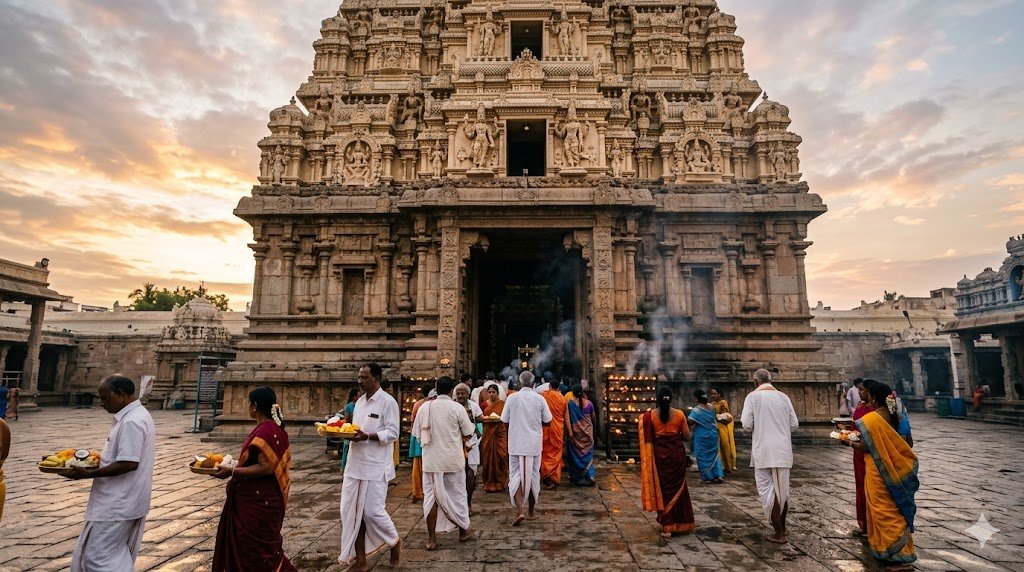
Srikalahasti Amavasya Pooja delivers powerful relief from Kalasarpa Dosha. Get dates, ticket prices, Rahu Kalam timings & step-by-step booking guide.
Performing the Srikalahasti Amavasya Pooja is widely considered the single most powerful astrological remedy in South India for clearing Rahu-Ketu Dosha and Kalasarpa Dosha. Devotees from Andhra Pradesh, Tamil Nadu, Karnataka, and even overseas plan their trip months ahead, because the spiritual energy on a New Moon day at this Vayu Lingam temple is believed to multiply pooja results several times over. If you are planning a visit, this guide covers everything that actually matters on the ground — exact timings, ticket prices, Rahu Kalam slots, the booking process, dress code, and the small mistakes that cost most pilgrims half a day of waiting.
However, most online articles skip the practical realities. Therefore, this guide is built from current temple procedures, the ticket structure, and patterns observed during peak Amavasya days when crowds cross 25,000 devotees.
Quick Summary: Srikalahasti Amavasya Pooja at a Glance
- Pooja timings: 6:30 AM to 8:30 PM (a short midday pause, time not fixed)
- Ticket categories: ₹500, ₹750, ₹1,500, ₹2,500, and ₹5,000
- Best slot on Amavasya: During Rahu Kalam (afternoon window)
- Crowd alert: Waiting time stretches to 2-3 hours on New Moon days
- Persons per ticket: Maximum 2 (single devotee or couple)
- Duration: Each batch runs roughly 30-45 minutes
- Booking: Mostly counter-based; reach by 7 AM for a clean slot
Why Amavasya Is the Most Powerful Day for Srikalahasti Pooja
In Vedic astrology, Rahu and Ketu are shadow planets without physical form. Yet they shape some of the heaviest karmic patterns in a horoscope — delayed marriage, repeated career setbacks, fertility struggles, and unexplained health issues. Srikalahasti is the only major temple in India dedicated specifically to neutralising these effects.
Amavasya is the New Moon day, when the Sun and Moon share the same celestial longitude. Consequently, the gravitational and astrological pull of Rahu and Ketu peaks. Most temple priests confirm that Srikalahasti Amavasya Pooja delivers faster karmic relief than the same ritual on any ordinary weekday.
Moreover, when Amavasya falls on a Sunday or Tuesday, the energy is considered doubly potent. Such combinations are rare, so devotees track the temple calendar a year in advance.
The unique status of Srikalahasti among Shiva temples
Srikalahasti is one of the Pancha Bhoota Sthalams, representing the Vayu (air) element. Notably, it is the only major Shiva temple in India that stays open during solar and lunar eclipses, since Rahu and Ketu themselves cause these grahanams. This single fact reflects how seriously the temple treats shadow-planet rituals.
According to local tradition, Rahu and Ketu received moksha from Lord Shiva at this very spot. Therefore, performing the dosha nivarana ritual here carries a weight no other temple can match.
Amavasya Dates for Planning Your Srikalahasti Visit
Below is the complete list of Amavasya dates in 2026. Furthermore, the year carries an Adhik Maas in Jyeshtha, which adds a rare extra Amavasya in June.
| Month | Amavasya Date | Day | Significance |
|---|---|---|---|
| January | 18 Jan 2026 | Sunday | Pushya Amavasya — observed as Mauni Amavasya |
| February | 17 Feb 2026 | Tuesday | Magha Amavasya — Bhauma (Tuesday) effect |
| March | 19 Mar 2026 | Thursday | Phalguna Amavasya |
| April | 17 Apr 2026 | Friday | Chaitra Amavasya |
| May | 16 May 2026 | Saturday | Vaishakha Amavasya — Shani (Saturday) combo |
| June | 15 Jun 2026 | Monday | Adhika Jyeshtha Amavasya — rare, closes the extra month |
| July | 14 Jul 2026 | Tuesday | Nija Jyeshtha Amavasya — Bhauma combo |
| August | 12 Aug 2026 | Wednesday | Ashadha Amavasya — closes Ashadha; Sravana Masam begins 13 Aug |
| September | 11 Sep 2026 | Friday | Sravana Amavasya — observed as Polala Amavasya in Andhra Pradesh |
| October | 10 Oct 2026 | Saturday | Bhadrapada Amavasya — Mahalaya Amavasya, pitru tarpan |
| November | 9 Nov 2026 | Monday | Ashwayuja Amavasya — Deepavali Amavasya, falls on a Monday (Somavati) |
| December | 8 Dec 2026 | Tuesday | Karthika Amavasya — Bhauma combo |
Among these, January 18, June 14, July 14, and November 9 stand out as the most spiritually charged dates of the year.
Srikalahasti Amavasya Pooja Timings and Daily Schedule
The temple opens at 5:00 AM with Suprabhatam. Then the main pooja batches begin around 6:30 AM and continue until 8:30 PM. A short midday pause is observed, though no fixed time is published.
On Amavasya, the temple often extends working hours and opens additional ticket counters. However, even with these arrangements, queues build up rapidly after 8 AM.
Rahu Kalam — the golden window for Amavasya pooja
Rahu Kalam is a 90-minute period each day ruled by Rahu. Performing the ritual during this slot is believed to deliver the strongest results. Below is a quick reference for daily Rahu Kalam (approximate, varies by sunrise):
| Day | Rahu Kalam (Approx.) |
|---|---|
| Monday | 7:30 AM – 9:00 AM |
| Tuesday | 3:00 PM – 4:30 PM |
| Wednesday | 12:00 PM – 1:30 PM |
| Thursday | 1:30 PM – 3:00 PM |
| Friday | 10:30 AM – 12:00 PM |
| Saturday | 9:00 AM – 10:30 AM |
| Sunday | 4:30 PM – 6:00 PM |
Always cross-check the daily Rahu Kalam against your local panchangam, since Tamil and Telugu panchangams calculate it slightly differently.
Ticket Prices and Categories
Srikalahasti offers six ticket tiers. The pooja ritual itself is identical across all categories — only the seating, location within the temple, and crowd density differ.
| Ticket Price | Seating Type | Best For |
|---|---|---|
| ₹150 | Common hall, large group batch | Budget-conscious devotees |
| ₹300 | Group batch, moderate space | Most pilgrims pick this |
| ₹750 | Smaller batch, better mandapam | Families wanting comfort |
| ₹1,500 | Premium hall, faster process | Time-bound visitors |
| ₹2,500 | Limited devotees per batch | Quick darshan needed |
| ₹5,000 | VIP / special guest seating | Senior citizens, NRIs |
Each ticket admits a maximum of 2 persons — either a single devotee or a married couple. Notably, two siblings or two friends cannot share one ticket; that rule is strictly enforced.
Pooja samagri (silver Naga idols, kumkum, flowers, turmeric) is provided free of cost at the counter. So you do not need to bring anything from outside.
How to Book Srikalahasti Amavasya Pooja: Step-by-Step
- Reach early: Aim to arrive at the temple by 6:30 AM on Amavasya day. Even earlier is better.
- Carry ID proof: Aadhaar card, passport, or any government ID is mandatory at the counter.
- Buy at the counter: Ticket counters near Gate 4 (south gopuram) sell pooja tickets. Lines move faster before 8 AM.
- Choose your category: Pick a tier that matches your time and comfort needs. The pooja result is the same in all categories.
- Collect samagri: The counter hands you a kit with silver Naga idols and ritual items.
- Reach the mandapam early: Be at the assigned hall at least 15 minutes before your batch starts.
- Perform Sankalp: The priest takes your name, gothra, nakshatra, and rasi before starting the ritual.
- Submit silver idols: After Lord Srikalahasteeswara darshan, drop the silver Naga idols into the temple hundi. Carrying them home is not advised.
For online booking attempts, the official portal at aptemples.ap.gov.in sometimes lists Pratyaksha Seva tickets. However, availability for Amavasya days is inconsistent. Therefore, counter booking is the most reliable route.
Dress Code, Fasting Rules, and Pre-Pooja Preparation
The temple expects traditional attire, especially on Amavasya. Men should wear a dhoti or kurta-pyjama. Women should wear a saree, salwar kameez, or half-saree. Jeans, shorts, sleeveless tops, and short skirts are discouraged.
Footwear is not allowed inside the temple premises. Cloakrooms near the entrance accept slippers and bags for a small fee.
Fasting and food rules
Strict fasting is not mandatory. Although you can eat light food before the pooja, it is preferable to consume only liquids on Amavasya morning. Furthermore, avoid non-vegetarian food and alcohol the day before and the day of the ritual.
After the pooja, regular vegetarian food is fine. However, non-veg should be avoided for the rest of that day.
Pro tip from regular pilgrims
Sleep on the floor the night before your pooja. Wake up early, take a head bath, and reach the temple in clean traditional clothes. Many devotees also perform abhishekam at the nearby Rudra Padam shrine — located about 100 feet from the main temple — with one litre of milk before starting the main ritual. This add-on is believed to amplify the dosha-nivarana effect.
What Happens During the Srikalahasti Amavasya Pooja
The actual ritual lasts roughly 30 to 45 minutes. The priest first performs Sankalp by chanting your name, gothra, nakshatra, and rasi. Then he leads you through Ganapati pooja, Kalasa pooja, and the main Rahu-Ketu Sarpa Dosha Nivarana mantras.
You hold the silver Naga idols throughout the ritual. Specifically, the priest invokes Rahu and Ketu energies into these idols and then transfers your karmic blockages onto them. Therefore, the idols carry the dosha out of your life.
After the pooja, you proceed to the main sanctum for darshan of Lord Srikalahasteeswara. Then you drop the silver Naga idols into the hundi. The ritual is complete.
What to do after the pooja — and what to avoid
- Go directly home after darshan. Do not visit other temples on the same day.
- Avoid social visits, restaurants, or shopping detours.
- Maintain a calm, prayerful mindset on the journey back.
- Do not reopen any pooja kit or carry silver idols home.
- Light a diya at home in the evening to seal the spiritual benefit.
The ritual energy is considered active for a few hours after the pooja. Hence, distractions or other temple visits dilute the effect.
Original Insight: Why Some Devotees Repeat the Pooja Yearly
Most astrologers recommend performing the Srikalahasti Amavasya Pooja for three consecutive years if your horoscope shows severe Kalasarpa Dosha. The reasoning is layered: Rahu and Ketu shift positions roughly every 18 months, so multiple poojas help neutralise the dosha across a full transit cycle.
Furthermore, the cumulative effect compounds. First-year devotees often report mental relief and clarity. Second-year visitors describe career or marriage breakthroughs. By the third year, deeper karmic patterns begin to dissolve. This pattern, while anecdotal, is consistent across thousands of pilgrim testimonies recorded over decades.
How to Reach Srikalahasti Temple
Srikalahasti town sits in Tirupati district of Andhra Pradesh, roughly 36 km northeast of Tirupati city.
- By air: Tirupati Airport (TIR) is the nearest, around 25 km away. Cabs cost ₹600-₹900.
- By train: Srikalahasti Railway Station lies just 2 km from the temple. Free temple buses run from the station from 4 AM.
- By bus: APSRTC and private buses connect Srikalahasti with Chennai (120 km), Bangalore (260 km), and Hyderabad (520 km).
- By road: NH716 from Tirupati takes about 45 minutes by car.
For accommodation, the temple’s SriKalahasteeswara Devasthanam guest houses near the temple cost ₹500-₹1,500 per night. Private hotels like Haritha Hotel, Hotel Bliss, and Mayura Inn range from ₹800 to ₹3,500.
Things to Avoid on Amavasya Pooja Day
- Reaching after Rahu Kalam — slots fill up by mid-morning
- Wearing jeans, shorts, or modern western outfits
- Carrying mobile phones or cameras inside the sanctum
- Following touts or auto drivers offering “shortcuts” — common scam near the bus stand
- Booking through unofficial agents promising VIP entry
- Attempting the pooja without ID proof
- Visiting Tirumala or other temples after the ritual on the same day
The Bottom Line
Srikalahasti Amavasya Pooja remains the most respected dosha-nivarana ritual in South India for one simple reason: this is the only temple where tradition holds that Rahu and Ketu themselves received moksha. For the dates that combine maximum spiritual potency with manageable crowds are the weekday Amavasyas in March, August, September, and December. If you carry serious Kalasarpa Dosha or Rahu-Ketu affliction, plan a Sunday or Tuesday Amavasya — January 18 and February 17 stand out. Reach by 6:30 AM, carry ID, dress traditionally, and trust the process.
Frequently Asked Questions
What is the cost of Srikalahasti Amavasya Pooja in 2026?
The Srikalahasti Amavasya Pooja ticket costs range from ₹150 to ₹5,000 across six categories. The most popular tier among devotees is ₹300, while families looking for comfort usually pick the ₹750 or ₹1,500 ticket. The ritual itself remains identical across all categories.
Can I book Srikalahasti Amavasya Pooja online?
Online booking is inconsistent for Amavasya days. The official APTemples portal sometimes lists tickets, but most pilgrims rely on counter booking at the temple. Therefore, reaching by 6:30 AM with valid ID proof is the most reliable approach.
How long does the Amavasya pooja take at Srikalahasti?
The actual ritual lasts about 30-45 minutes. However, on Amavasya days, total time at the temple — including ticket purchase, waiting, pooja, and darshan — typically runs 4 to 5 hours. Premium ticket holders finish in roughly 2 hours.
Can unmarried siblings perform Srikalahasti Amavasya Pooja together?
No. Each ticket admits one devotee or one married couple. Two siblings, two friends, or unmarried couples cannot share a single ticket. This rule is strictly enforced by temple staff.
Should I visit Tirumala after Srikalahasti Amavasya Pooja?
Tradition advises against visiting any other temple on the same day. The pooja energy is considered active for several hours, and additional temple visits may dilute its effect. Therefore, plan Tirumala darshan on a separate day — most pilgrims do it the next morning.
Is fasting mandatory for Srikalahasti Amavasya Pooja?
Strict fasting is not required. However, devotees are advised to consume only light or liquid food before the ritual. Additionally, non-vegetarian food and alcohol must be avoided the day before and the day of the pooja.
What ID proof is needed for Amavasya pooja booking?
Aadhaar card is the most commonly accepted ID for Indian devotees. Foreigners need to carry a passport. PAN card, voter ID, or driving licence also work. The counter staff verifies ID before issuing the ticket.

Independent pilgrim guide for Sri Kalahasti Temple. Curating darshan timings, Rahu Ketu Pooja booking, sevas, accommodation, Vayu Lingam significance, and complete travel guidance for devotees visiting the temple.
