
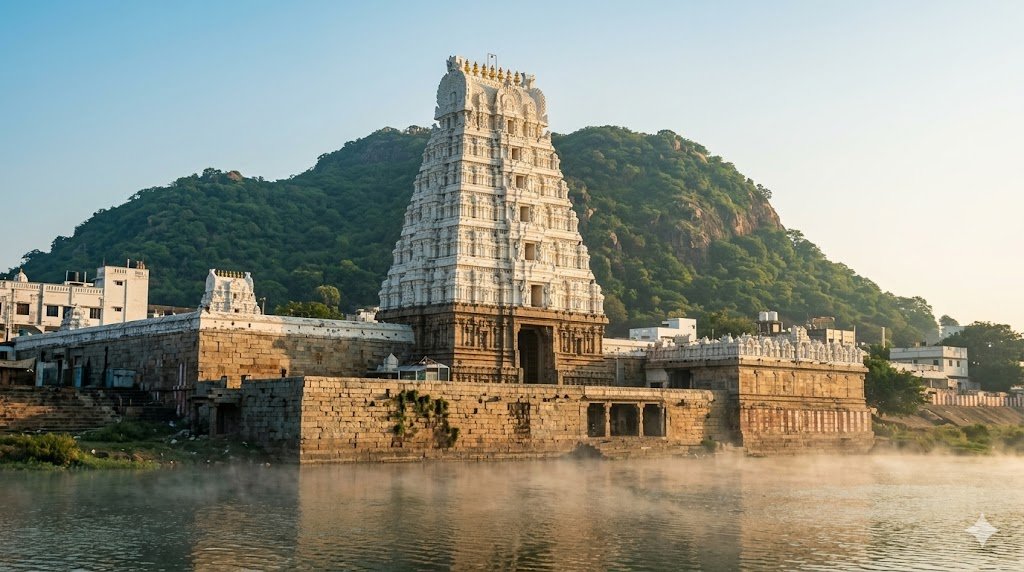
This Sri Kalahasti temple guide covers darshan timings, Rahu Ketu Pooja booking, ticket prices, accommodation, festivals, and complete travel tips for pilgrims.
This Sri Kalahasti temple guide is the only resource a first-time pilgrim actually needs before stepping onto the temple’s stone-paved courtyard. The shrine sits on the banks of the Swarnamukhi River, just 36 km from Tirupati, and draws lakhs of devotees every month for one specific reason — the Rahu-Ketu Sarpa Dosha Nivarana Pooja that no other temple in India performs with the same spiritual weight. However, most pilgrims arrive confused about timings, ticket categories, dress codes, and how to avoid the queue chaos on Amavasya days. This guide solves all of that.
Quick Summary at a Glance
- Location: Srikalahasti town, Tirupati district, Andhra Pradesh — 36 km from Tirupati, 120 km from Chennai.
- Presiding deity: Sri Kalahasteeswara (Vayu Lingam) and Goddess Gnana Prasunambika Devi.
- Temple element: Vayu (air) — one of the five Pancha Bhoota Sthalams of Lord Shiva.
- Temple timings: 5:00 AM to 9:00 PM daily; short ritual pauses through the day, with no fixed afternoon closing time published.
- Rahu-Ketu Pooja: 6:00 AM to 5:00 PM daily; tickets ₹500 to ₹5,000.
- Best months to visit: October to March (pleasant weather, lower crowds).
- Main festival: Maha Shivaratri Brahmotsavam, held around Maha Shivaratri — next on Saturday, 6 March 2027.
- Official booking portal: aptemples.ap.gov.in.
- Temple helpline: +91 8578 222240 / 222399.
Why Sri Kalahasti Temple Stands Apart
Most Shiva temples in South India share a common architectural family, yet Sri Kalahasti carries a distinct identity. The Vayu Lingam here is one of only five Pancha Bhoota Sthalams in the country — temples representing the five elements of nature. Furthermore, this is the only temple in India that performs the Rahu-Ketu Pooja continuously throughout the day, regardless of planetary timings.
Locals call it Dakshina Kailasam, the Kailasa of the South. Notably, the temple remains open even during solar and lunar eclipses, a tradition unique to this shrine. As a result, devotees facing Kala Sarpa Dosha or planetary afflictions travel here from every corner of India.
The Vayu Lingam: A Living Element
The Vayu Lingam inside the sanctum is believed to move on its own — a phenomenon devotees attribute to the air element. Therefore, priests never touch the main lingam during abhishekam. Instead, all rituals are performed on the Utsava Murti placed in front. Additionally, the flame of the oil lamp near the sanctum flickers continuously without any visible breeze, considered proof of the deity’s living presence.
Sri Kalahasti Temple Guide to Darshan Timings
The temple follows a remarkably consistent schedule year-round. However, minor adjustments occur during Maha Shivaratri, Karthika Deepotsavam, and major Amavasya days.
| Session | Timing | Notes |
|---|---|---|
| Temple opens | 5:00 AM | Suprabhatam begins |
| Daytime darshan | 6:00 AM – 6:00 PM | Sanctum pauses briefly for abhishekam and naivedyam |
| Rahu–Ketu Pooja | 6:00 AM – 5:00 PM | Moderate crowds |
| Evening darshan | 6:30 PM – 9:00 PM | Pradosha aarti most powerful |
| Rahu-Ketu Pooja | 6:00 AM – 5:00 PM | Continuous batches every 15 minutes |
| Abhishekam slots | 6:00 AM – 9:00 AM | Advance booking recommended |
Best Time of Day for Quick Darshan
Most local priests recommend the 6:00 AM to 8:00 AM window for the calmest experience. Furthermore, weekday mornings — Tuesday, Wednesday, and Thursday — see the lightest crowds. However, Saturdays during Rahu Kalam attract heavy footfall, and Amavasya days can stretch waiting times to four hours or more.
Rahu-Ketu Pooja: The Heart of This Sri Kalahasti Temple Guide
The Rahu-Ketu Sarpa Dosha Nivarana Pooja is what makes this temple globally famous. Devotees believe it removes the malefic effects of the shadow planets Rahu and Ketu — planets that traditionally affect marriage, career, health, childbirth, and financial stability.
Ticket Categories and Prices
The Devasthanam publishes five Rahu-Ketu Pooja ticket tiers, as published by the AP Endowments Department (tms.ap.gov.in). Seating and hall are assigned at the counter on the day.
| Official ticket price (₹) | Notes |
|---|---|
| ₹500 | Lowest tier published by the Devasthanam |
| ₹750 | Also bookable on the official portal |
| ₹1,500 | Also bookable on the official portal |
| ₹2,500 | Also bookable on the official portal |
| ₹5,000 | Highest tier; also bookable on the official portal |
Notably, prices are revised occasionally by the temple administration. Therefore, always confirm the latest tariff at the counter or on aptemples.ap.gov.in before booking.
Step-by-Step Rahu-Ketu Pooja Process
- Arrive at least 30 minutes before your slot at the South Gopuram entrance.
- Present your e-ticket or counter-purchased ticket along with photo ID.
- Take seats inside the assigned mandapam based on ticket category.
- Priests distribute a puja kit containing small silver Rahu and Ketu idols.
- Follow the collective chanting led by the priest — no prior knowledge needed.
- At the end, place the Rahu-Ketu idols inside the temple hundi.
- Walk straight to the main sanctum for Lord Shiva’s darshan — do not look back.
- Conclude with darshan of Goddess Gnana Prasunambika Devi.
Additionally, if you do not know your Gotra, Janma Nakshatra, or Janma Rashi, the priests can still perform the pooja. Most importantly, pregnant women are advised to avoid this particular pooja.
Best Days for Rahu-Ketu Pooja
Sunday, Monday, and Tuesday are considered the most auspicious days. However, performing the pooja during Rahu Kalam amplifies its spiritual potency — though queues become significantly longer. Amavasya, Pournami, and eclipse days are peak periods that require advance arrival.
How to Book Sri Kalahasti Temple Tickets Online
The official AP Temples portal handles all online seva bookings. Booking opens 60 days in advance, and tickets are non-refundable.
- Visit the official portal at aptemples.ap.gov.in.
- Select “Srikalahasti Devasthanam” from the temples list.
- Choose your seva — Rahu Ketu Pooja, Rudrabhishekam, or Kalyanotsavam.
- Enter pilgrim details including name, age, ID number, and contact.
- Select date and time slot from available options.
- Complete payment via UPI, debit/credit card, or net banking.
- Download the e-ticket PDF and carry a printout to the temple.
Furthermore, Rahu-Ketu Pooja tickets can also be purchased directly at temple counters on the same day if you prefer walking in.
Sri Kalahasti Temple Guide to Sevas and Special Poojas
Beyond Rahu-Ketu Pooja, the temple offers several powerful sevas worth considering.
| Seva Name | Approximate Cost | Best For |
|---|---|---|
| Rudrabhishekam | ₹1,000 | General prosperity, health |
| Mahanyasa Rudrabhishekam | ₹1,500 | Powerful spiritual cleansing |
| Kalyanotsavam | ₹501 | Marital harmony |
| Sahasra Lingarchana | ₹500 – ₹1,500 | Removal of obstacles |
| Annaprasanna | ₹250 – ₹500 | First-rice ceremony for babies |
| Aksharabhyasam | ₹216 | Beginning child’s education |
Accommodation Near Sri Kalahasti Temple
The temple Devasthanam manages several guest houses, while private hotels operate around the South Gopuram. Notably, Devasthanam rooms are allotted only on a walk-in basis — advance online booking is not yet available for temple-managed cottages.
Devasthanam Guest Houses
- Bhaktha Kannappa Sadan: Closest to the temple; non-AC rooms ₹400–₹600, AC rooms ₹1,000–₹1,200.
- Bharadwaja Sadan: Single ₹300–₹500, double non-AC ₹600–₹800.
- Bhudevi Complex Rooms: Nearest to the Rahu-Ketu Pooja mandapam — ideal for early-morning pooja attendees.
- Annapurna Sadan: Budget option for families, ₹500–₹900 per night.
Private Hotels and AP Tourism
For online advance booking, Hotel Haritha (managed by APTDC) is the most reliable option, bookable through the AP Tourism portal. Additionally, several private lodges near the bus station offer rooms in the ₹800–₹2,500 range. However, avoid touts at the railway station who push overpriced private hotels by falsely claiming Devasthanam rooms are unavailable.
Booking Tips
During Maha Shivaratri (February) and Karthika Masam (November), accommodation fills up six to eight weeks in advance. Therefore, book early or arrive on a weekday. Photo ID is mandatory at check-in, and rooms are allotted only for couples, families, or related groups — single occupancy and unrelated couples are not permitted.
How to Reach Sri Kalahasti Temple
Srikalahasti is exceptionally well-connected by all three major transport modes. Most pilgrims combine the visit with Tirumala darshan over two days.
By Train
Srikalahasti Railway Station sits just 2 km from the temple, with direct services from Chennai, Vijayawada, Visakhapatnam, and Hyderabad. Furthermore, Gate No. 4 of the railway station is the closest drop-off point to the South Gopuram. Most importantly, avoid auto drivers who claim Gate 4 facilities are closed — that is a known scam.
By Road
Government and private buses run frequently from Tirupati (36 km, 1 hour) and Chennai (120 km, 3 hours). Additionally, taxis from Tirupati cost ₹800–₹1,200 one way. APSRTC buses run every 15 minutes from Tirupati Central Bus Stand.
By Air
Tirupati Airport (Renigunta) is the nearest airport, just 40 km away. Major Indian cities including Delhi, Mumbai, Bengaluru, Hyderabad, and Visakhapatnam have direct flights. From the airport, prepaid taxis to Srikalahasti cost approximately ₹1,000–₹1,500.
| From | Distance | Best Mode | Travel Time |
|---|---|---|---|
| Tirupati | 36 km | Bus / Taxi | 1 hour |
| Chennai | 120 km | Train / Bus | 3 hours |
| Bengaluru | 210 km | Train / Car | 5 hours |
| Hyderabad | 520 km | Train / Flight | 10 hours / 1.5 hours |
| Vijayawada | 360 km | Train | 7 hours |
Dress Code and Temple Rules
The temple enforces a traditional dress code, although it is more relaxed than at Tirumala.
- Men: Dhoti and angavastram preferred; trousers with shirt also acceptable. Avoid shorts, sleeveless vests, and ripped jeans.
- Women: Saree, half-saree, or salwar kameez. Skirts above the knee, sleeveless tops, and Western dresses are discouraged.
- Footwear: Must be removed at the entrance; paid shoe-stand facilities are available near both gopurams.
- Photography: Strictly prohibited inside the sanctum and pooja mandapams.
- Mobile phones: Allowed in silent mode, but cameras must be deposited at the counter.
Maha Shivaratri Brahmotsavam 2026
The annual Maha Shivaratri Brahmotsavam is the temple’s most significant festival, celebrated over roughly two weeks around Maha Shivaratri; in 2026 it ran from 10 to 23 February, and the next Maha Shivaratri falls on Saturday, 6 March 2027. Furthermore, the festival features daily vahana sevas, special abhishekams, and grand processions across the streets of Srikalahasti.
The Nishita Kaal Puja on Maha Shivaratri night (15 February in 2026; 6 March in 2027) draws lakhs of devotees who stay awake all night for continuous abhishekam. As a result, accommodation must be booked at least two months in advance. The Teppotsavam (float festival) and Rathotsavam (chariot festival) are visual spectacles every pilgrim should witness at least once.
Insider Tips Most Pilgrims Don’t Know
- Eat before, not after: Free annadanam is served daily near Gate No. 4 from 11:30 AM, but most pilgrims prefer eating light before the pooja.
- Visit Bhakta Kannappa Hill: Just 1 km from the temple, this small hillock commemorates the hunter-devotee who offered his eyes to Lord Shiva.
- Take a dip in Swarnamukhi: The river ghats near the temple are considered sacred for pre-darshan baths.
- Combine with Veyilingala Kona: The Sahasra Linga Waterfalls, 8 km away, make a peaceful add-on for spiritually inclined travellers.
- Carry exact change: Vendors around the temple often cannot break large notes.
- Avoid eclipse weekends: Although the temple stays open, crowds on Grahan days are overwhelming.
- Save the temple helpline: +91 8578 222240 / 222399 is genuinely responsive for accommodation queries.
Nearby Temples and Attractions
Most pilgrims plan Sri Kalahasti as part of a wider South Indian temple circuit. Additionally, several powerful shrines lie within a short drive.
| Destination | Distance | Significance |
|---|---|---|
| Tirumala Venkateswara Temple | 36 km | Most-visited Vishnu temple in India |
| Sri Padmavathi Temple, Tiruchanur | 31 km | Goddess Padmavathi (Vishnu’s consort) |
| Kanipakam Vinayaka Temple | 108 km | Famous self-manifested Ganesha shrine |
| Veyilingala Kona Falls | 8 km | 1,000 Shiva lingams natural site |
| Sri Subramanya Swamy Temple | Within town | Lord Murugan shrine on adjoining hill |
| Bharadwaja Tirtham | 5 km | Sacred bathing ghat |
The Bottom Line
Sri Kalahasti rewards pilgrims who plan well. The Rahu-Ketu Pooja remains the temple’s spiritual centrepiece, but the broader experience — the Vayu Lingam, Bhakta Kannappa’s legend, the Swarnamukhi ghats, and the 13-day Brahmotsavam — makes this far more than a single-ritual destination. Book your pooja slot through aptemples.ap.gov.in at least two weeks ahead, arrive between October and March if possible, and pair the visit with Tirumala darshan for the complete South Indian temple circuit. Most importantly, surrender expectations at the gopuram and let the Vayu Lingam’s air do its quiet work.
Frequently Asked Questions
What are Sri Kalahasti temple timings in 2026?
The temple is open daily from 5:00 AM to 9:00 PM, as published by the AP Endowments Department (tms.ap.gov.in). Hours extend during Dhanurmasam (3:00 AM to 8:30 PM) and Kartika Masam (4:00 AM to 9:30 PM). Rahu-Ketu Pooja is performed from 6:00 AM to 5:00 PM.
How much does Rahu-Ketu Pooja cost at Sri Kalahasti?
The Devasthanam publishes five Rahu-Ketu Pooja ticket tiers: ₹500, ₹750, ₹1,500, ₹2,500 and ₹5,000. All five can be booked on the official AP Endowments portal or bought at the temple counter. Prices may be revised by the Devasthanam, so always verify on the official AP Temples portal before booking.
Can I book Sri Kalahasti temple rooms online?
Devasthanam guest houses like Bhaktha Kannappa Sadan and Bharadwaja Sadan are not yet available for online booking — rooms are allotted on a walk-in basis with valid photo ID. However, Hotel Haritha (APTDC) can be booked online through the AP Tourism portal, and private hotels are bookable via standard travel platforms.
What is the dress code at Sri Kalahasti temple?
Traditional Indian attire is strongly recommended — dhoti or trousers with shirt for men, and saree or salwar kameez for women. Shorts, sleeveless tops, ripped jeans, and Western dresses are discouraged. Notably, footwear must be left at the entrance, and cameras are not permitted inside the sanctum.
How far is Sri Kalahasti from Tirupati?
Sri Kalahasti is just 36 km from Tirupati and takes approximately one hour by road. Buses run every 15 minutes from Tirupati Central Bus Stand, and taxis cost ₹800–₹1,200 one way. Most pilgrims complete Tirumala darshan and Sri Kalahasti pooja over two days as a combined trip.
When is the best time to visit Sri Kalahasti temple?
October to March offers pleasant weather and moderate crowds, making it ideal for an unhurried visit. Furthermore, weekdays (Tuesday to Thursday) see the lightest footfall. However, avoid Amavasya, Pournami, and Maha Shivaratri week unless you specifically want to attend the Brahmotsavam celebrations.
Is Sri Kalahasti temple open during eclipses?
Yes, Sri Kalahasti is one of the very few major Hindu temples that remains fully open during both solar and lunar eclipses — a unique tradition specific to this shrine. Devotees believe pooja performed during Grahan periods carries amplified spiritual potency, though queues become significantly longer on these days.
Further Reading: 12 Types of Kaal Sarp Dosha
Devotees preparing for the Rahu-Ketu Pooja at Srikalahasti often want to identify which of the 12 classical Kaal Sarp Dosha types (Anant, Kulik, Vasuki, Shankhapal, Padma, Mahapadma, Takshak, Karkotak, Shankhachuda, Ghatak, Vishdhar, Sheshnag) applies to their chart. A complementary read is this comprehensive guide to Kaal Sarp Dosha and its 12 types with scripture-sourced remedies including Trimbakeshwar Kaal Sarp Shanti and the daily Rahu/Ketu beej mantras.

Independent pilgrim guide for Sri Kalahasti Temple. Curating darshan timings, Rahu Ketu Pooja booking, sevas, accommodation, Vayu Lingam significance, and complete travel guidance for devotees visiting the temple.
