
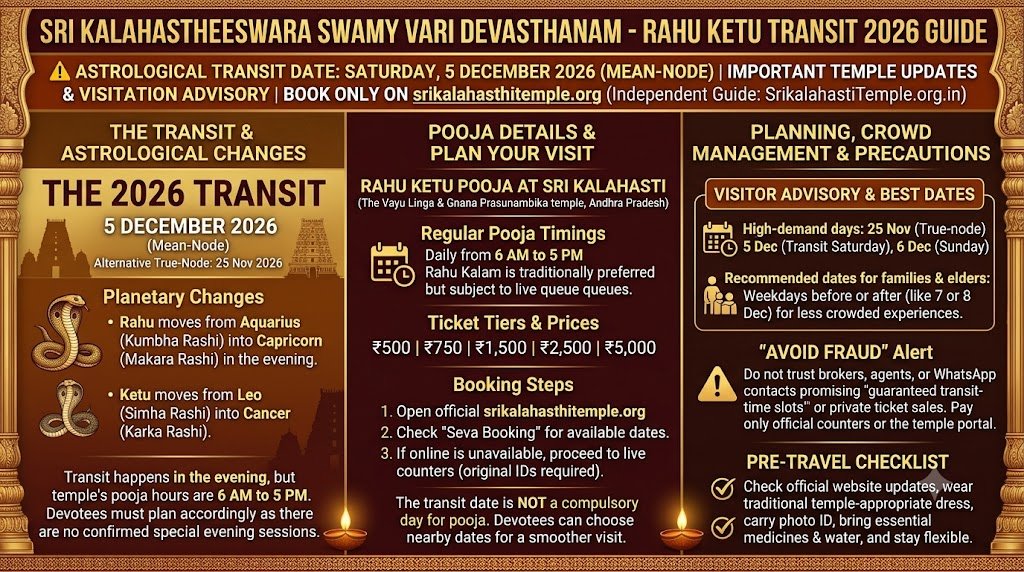
Rahu ketu transit 2026 falls on Saturday, 5 December, according to the mean-node system used in several Hindu panchang calculations. Rahu moves into Makara Rashi (Capricorn), while Ketu moves into Karka Rashi (Cancer). For devotees planning Rahu Ketu Pooja at Sri Kalahasti, the biggest questions concern the right date, expected crowds and genuine ticket availability.
The important distinction is this: 5 December is an astrological transit date, not a confirmed special-pooja programme at the temple. The transit takes place in the evening, while the temple currently lists its regular Rahu–Ketu Pooja hours as 6 AM to 5 PM. Devotees should therefore plan around the actual temple schedule, not assume a special evening session.
Independent guide: SrikalahastiTemple.org.in is not the official Sri Kalahastheeswara Swamy Vari Devasthanam website and has no affiliation with the temple administration. We do not accept pooja bookings, donations or payments. Please use the official Devasthanam website for confirmed arrangements.
Rahu Ketu Transit 2026: Quick Facts
- Mean-node transit date: Saturday, 5 December 2026.
- Alternative true-node date: Wednesday, 25 November 2026.
- Transit period: Evening of 5 December under the mean-node calculation. Exact published times differ.
- Rahu’s new sign: Capricorn, called Makara Rashi.
- Ketu’s new sign: Cancer, called Karka Rashi.
- Temple: Sri Kalahastheeswara Swamy Vari Devasthanam, Sri Kalahasti, Andhra Pradesh.
- Regular Rahu–Ketu Pooja hours: 6 AM to 5 PM, according to the temple website.
- Special transit-day arrangements: No separate confirmed programme or booking instructions identified as of 23 October 2026.
- Expected crowd: A busier-than-usual visit is possible, but no official crowd forecast has appeared.
For most visitors, the practical decision is simple. Choose 5 December if observing the mean-node transit date matters to your family. Otherwise, a nearby regular pooja day may offer a more flexible visit. Neither choice requires an unverified special ticket.
When Is the Rahu Ketu Transit 2026?
The mean-node Rahu Ketu transit 2026 takes place on Saturday, 5 December. Rahu moves from Aquarius into Capricorn, while Ketu moves from Leo into Cancer. The India Meteorological Department’s Rashtriya Panchanga also lists an earlier date under the true-node calculation. This difference explains why two transit dates appear online.
The Rashtriya Panchanga transit tables distinguish the mean lunar nodes from the true lunar nodes. These are different mathematical ways to describe the nodal positions. As a result, the published entry dates need not match.
Why do different panchangs show different transit times?
Different panchangs may use different node calculations and astronomical conventions. Drik Panchang lists a 5 December evening transit for the mean nodes, while another published calculation gives a later evening time. Some sources also use the earlier true-node date of 25 November. Therefore, devotees should not treat one exact minute as universal.
For local religious observance, check the Telugu or Tamil panchangam followed by your family or priest. A Tamil almanac may apply a different convention or religious-day boundary. The temple has not confirmed a separate ritual schedule based on any particular transit minute.
Which zodiac signs are changing?
Under the mean-node sidereal calculation, Rahu leaves Kumbha Rashi and enters Makara Rashi. Ketu leaves Simha Rashi and enters Karka Rashi. The pair continues to occupy opposite positions in the zodiac, as lunar nodes do in astronomical calculations.
In traditional Jyotisha, astrologers interpret these movements in relation to a person’s birth chart. However, transit interpretations vary by school and individual horoscope. No transit date alone establishes that every devotee needs a remedial pooja.
Why Sri Kalahasti Matters for Rahu–Ketu Worship
Sri Kalahasti is a major Shiva pilgrimage centre in Andhra Pradesh. The temple honours Lord Kalahastheeswara, associated with the Vayu Linga, and Goddess Gnana Prasunambika. Its Rahu Kethu Sarpadosha Nivaarana Pooja attracts devotees from across India.
Within Hindu religious tradition, devotees perform this ritual while praying for relief from difficulties they associate with Rahu, Ketu or Sarpa Dosha. These are matters of faith and personal belief. A ritual cannot guarantee marriage, employment, recovery from illness or any other life outcome.
The Devasthanam website confirms that Rahu–Ketu Pooja forms part of its regular worship services. Importantly, it does not describe the 5 December transit as a compulsory day for the ritual.
For the normal ritual procedure, see our guide to performing Rahu Ketu Pooja at Sri Kalahasti. This article focuses specifically on the December transit and visit planning.
Best Dates for Rahu Ketu Pooja Around the Transit
There is no confirmed temple announcement naming one mandatory pooja date for this transit. Therefore, the most useful approach is to compare the main transit day with nearby regular dates. This helps devotees balance religious preference, travel convenience and possible crowd pressure.
| Date | Planning advantage | Important limitation |
|---|---|---|
| 25 November 2026 | True-node transit date | Check your panchang convention |
| 4 December 2026 | Day before the mean-node transit | Not the actual mean-node entry day |
| 5 December 2026 | Mean-node transit day; Saturday | Possible extra demand; no special schedule confirmed |
| 6 December 2026 | Sunday after the transit | Weekend demand may continue |
| 7 December 2026 | Regular weekday alternative | No guaranteed shorter queue |
| 8 December 2026 | Tuesday option for devotees who prefer that day | Religious suitability depends on family custom |
These are planning options, not temple-approved auspicious dates. In particular, 4 and 7 December do not become special ritual days simply because they fall near the transit.
Is 5 December the best day to visit?
Saturday, 5 December is the relevant date for devotees following the mean-node transit calculation. It is also a weekend, so demand could increase. However, the temple has not published a special crowd estimate or priority system. Visit that day for a religious preference, not because a particular result is guaranteed.
The regular pooja period also ends before the transit’s reported evening time. Consequently, pilgrims should not assume they can perform an ordinary ticketed session at the precise changeover moment.
Is a weekday better for families and senior citizens?
A nearby weekday may be more practical for visitors who value a flexible schedule. It can also reduce the pressure of reaching Sri Kalahasti on one particular date. Still, ordinary weekdays can attract large groups, and no waiting time is guaranteed.
Families travelling with children or older relatives should allow time for ticket verification, the ritual and darshan. Avoid tight return journeys because queues or temple arrangements may change.
Rahu Ketu Transit 2026: Expected Crowd at Sri Kalahasti
The Rahu Ketu transit 2026 could bring additional interest in Sri Kalahasti around 5 December. That expectation follows from the temple’s established association with Rahu–Ketu worship and the Saturday timing. However, it remains a planning forecast, not a measured attendance figure or an official crowd warning.
No reliable official estimate currently establishes how many extra visitors will arrive. Similarly, there is no verified transit-day waiting-time forecast. Guides promising an exact two-hour or four-hour queue several weeks in advance should be treated cautiously.
What could make 5 December busier?
Three factors may increase visitor interest: the widely publicised transit, the weekend and the temple’s popularity for this ritual. In addition, some devotees may travel from Tirupati or other parts of Andhra Pradesh for a same-day visit.
Yet increased online interest does not always translate into a fixed crowd level. Travel conditions, temple schedules and local events can change the final turnout. A crowd estimate should never be mistaken for a ticket guarantee.
How to avoid unnecessary waiting
- Check the official temple website again shortly before departure.
- Reach Sri Kalahasti with a flexible margin before your preferred pooja session.
- Confirm the active ticket counter and entry instructions with authorised temple staff.
- Keep the day’s travel schedule open rather than booking a very tight return connection.
- Carry water and any essential medicines, while respecting temple entry and storage rules.
- Use a nearby regular date if the transit-day crowd would make your visit difficult.
For wider travel planning, the site’s Sri Kalahasti Temple Calendar 2026 provides context for other temple occasions. Do not assume those dates imply any special Rahu–Ketu transit arrangements.
Rahu Ketu Pooja Timings on 5 December
The Sri Kalahastheeswara Swamy Vari Devasthanam website currently lists Rahu Kethu Sarpadosha Nivaarana Puja from 6 AM to 5 PM daily. It has not confirmed separate opening hours or a late-evening session for 5 December. The published regular hours should therefore serve as a planning reference, not a guaranteed event-day timetable.
This distinction matters because the mean-node transit takes place in the evening. A devotee cannot assume that the temple will run a special pooja at the precise astronomical transition.
The temple website also highlights Rahu Kalam as a traditional period of interest for Rahu–Ketu worship. However, a preferred Rahu Kalam period does not override current seva availability, temple instructions or the day’s authorised schedule.
Must the pooja coincide with the exact transit time?
No official temple instruction currently requires devotees to perform Rahu–Ketu Pooja at the exact transit minute. Moreover, published astronomical times vary across calculation methods. Follow the temple’s authorised daily schedule and seek religious guidance from a trusted priest if your family observes a specific panchang tradition.
Do not pay an agent who claims to provide exclusive entry at the transit minute. Such a claim needs direct confirmation from the Devasthanam before anyone relies on it.
Ticket Prices and Booking Channels
The official Devasthanam website currently displays five Rahu–Ketu Pooja ticket amounts: ₹500, ₹750, ₹1,500, ₹2,500 and ₹5,000. It does not establish a separate transit-day tariff on the information reviewed for this guide. All amounts remain subject to the temple’s latest instructions.
| Listed ticket tier | Officially displayed amount | Transit-day position |
|---|---|---|
| Tier 1 | ₹500 | No special availability confirmed |
| Tier 2 | ₹750 | No special availability confirmed |
| Tier 3 | ₹1,500 | No special availability confirmed |
| Tier 4 | ₹2,500 | No special availability confirmed |
| Tier 5 | ₹5,000 | No special availability confirmed |
These are the website’s published price tiers, not a guarantee that all categories will operate on 5 December. Seating areas, included materials, eligibility and ticket rules require confirmation from the official channel.
How to check genuine booking options
- Open the official Sri Kalahastheeswara Swamy Vari Devasthanam website.
- Use the website’s own Seva or Booking navigation to reach the authorised service.
- Check whether Rahu–Ketu Pooja appears for your chosen date and ticket category.
- Read the current service terms before proceeding with any official payment.
- If no suitable online option appears, confirm same-day counter arrangements through authorised temple channels.
- Keep any official receipt or confirmation accessible during your visit.
The temple website links to booking services, but that alone does not prove that a particular Rahu–Ketu Pooja date or category supports advance online purchase. Counter availability also remains subject to temple rules.
Our Rahu Ketu Pooja timings and tickets guide explains the regular procedure in more detail. Always give priority to newer instructions on the official portal if the two differ.
Rahu Ketu Transit 2026: Booking Mistakes to Avoid
The Rahu Ketu transit 2026 creates a natural opportunity for misleading booking claims. Someone may advertise a premium transit-day ritual, guaranteed entry or an exclusive evening slot. None of those offers should be accepted without direct confirmation from Sri Kalahastheeswara Swamy Vari Devasthanam.
A devotional date does not automatically create a new ticket type. Likewise, paying more through a private contact does not establish priority access or official authorisation.
What if online booking is unavailable?
If the authorised portal does not show a suitable booking option, first check whether the service operates through temple counters. Next, confirm the current counter hours and admission rules through the Devasthanam. If neither route is available for your date, choose another official session or another day.
Do not assume that a failed online search means all temple rituals have sold out. Equally, do not assume counter tickets will remain available when you arrive. Both conclusions need current confirmation.
How to spot a suspicious booking offer
- The seller claims guaranteed pooja entry without an official ticket.
- Payment must go to a personal UPI ID or unrelated bank account.
- A WhatsApp contact promises a newly announced VIP transit slot.
- The seller uses the temple’s name but cannot link to an authorised Devasthanam service.
- A private website asks for sensitive personal details before proving its authority.
Use the temple website as the starting point for official actions. This independent guide does not issue tickets, collect payments or process bookings.
A Practical Sri Kalahasti Visit Plan
For visitors coming from Tirupati or another nearby town, a same-day visit may be practical. However, those travelling longer distances should consider arriving the previous evening. This allows more flexibility if queues or local travel conditions change.
Before leaving home
First, check the official website for any new transit-day notice. Then confirm travel tickets, accommodation and the current pooja procedure. Keep a suitable photo ID and any authorised booking proof if the temple requires them.
Choose modest, temple-appropriate clothing and practical footwear. Carry only essential belongings because security and storage rules may limit what you can take inside.
At the temple
Follow the signs and instructions for authorised seva counters. After obtaining a valid ticket, staff can direct you to the applicable pooja area. Avoid relying on private guides who claim to control access.
Allow enough time after the ritual for darshan and departure. If you travel with senior citizens, ask official staff about any available assistance rather than assuming a separate priority queue exists.
Accommodation and transport
Sri Kalahasti has road and rail connections, while Tirupati serves as a wider regional transport hub. However, services and operating schedules may change. Confirm your train on IRCTC or through Indian Railways before setting off.
For accommodation, use the authorised temple accommodation link where applicable. Alternatively, compare established commercial hotels through their genuine booking channels. No particular room category, tariff or vacancy is guaranteed for the transit weekend.
What the Transit Does Not Mean
Astrological language can make this date sound like a deadline. In reality, the astronomical calculation and the religious interpretation are separate matters. Rahu and Ketu describe the lunar nodes, while Jyotisha assigns symbolic meanings to their positions.
It does not follow that everyone born under a particular zodiac sign must visit Sri Kalahasti immediately. Nor does it follow that missing 5 December causes harm or that a costly ritual guarantees protection.
Devotees may choose the pooja as an expression of faith, prayer or family tradition. People who do not follow these practices need not treat online predictions as evidence of danger.
For those with health concerns, fasting or long periods of standing may need special care. Keep prescribed medicines accessible and seek medical advice before any demanding religious practice. Spiritual worship is not a substitute for medical care.
What to Check Again Before 5 December
The key missing information is not the existence of the transit. It is the temple’s event-specific operating plan. As of 23 October 2026, no confirmed special arrangements have appeared in the official information reviewed here.
In late November, check whether the Devasthanam has issued instructions covering these points:
- Any additional pooja sessions for 5 December.
- Changes to daily seva or darshan hours.
- Special queue arrangements or crowd-control measures.
- Any different ticket rules for that Saturday.
- Current online and counter booking availability.
- Restrictions affecting bags, entry routes or visitor movement.
If the temple issues no separate announcement, do not invent an event programme from social media posts. Plan using the confirmed regular services and remain flexible on the day.
Final Advice for Devotees
The 5 December date matters to devotees who follow the mean-node calculation for Rahu and Ketu. Yet the best temple visit depends on more than an astrological calendar. Official opening hours, ticket access, personal health and travel comfort matter just as much.
Choose the transit day if it holds special meaning for you, but avoid claims of guaranteed results or exclusive bookings. Check the official Devasthanam website again before travelling. A well-planned visit on a regular day can also be a meaningful act of worship.
Frequently Asked Questions
What is the Rahu Ketu transit date in 2026?
The mean-node transit falls on Saturday, 5 December 2026, with Rahu entering Capricorn and Ketu entering Cancer. The true-node calculation gives 25 November 2026. Check the panchang convention your family follows if the exact religious observance date matters.
What time is the Rahu Ketu transit on 5 December 2026?
Published mean-node calculations place the transit during the evening of 5 December, but they differ on the precise time. The Rashtriya Panchanga and other calculation services do not all show the same value. Therefore, consult your preferred panchang before relying on a specific minute.
Is there a special Rahu Ketu Pooja at Sri Kalahasti on 5 December?
No separate special programme was confirmed in the official temple information reviewed as of 23 October 2026. Regular Rahu–Ketu Pooja remains the confirmed service to investigate. Any new event-day announcement should come directly from the Devasthanam.
Can I perform Rahu Ketu Pooja before 5 December?
Yes, the temple lists Rahu–Ketu Pooja as a regular daily service. A visit before the transit can therefore be considered, subject to current schedules and tickets. The religious preference for a particular date depends on your own tradition.
Is online booking available for the transit day?
Specific online ticket availability for 5 December has not been confirmed. The official Devasthanam website provides booking links, but those links do not guarantee access to every pooja category. Check the live service options or confirm authorised counter arrangements.
What is the Rahu Ketu Pooja ticket price?
The official temple website currently displays ₹500, ₹750, ₹1,500, ₹2,500 and ₹5,000 categories. These published prices can change, while category availability may differ on individual days. Confirm the applicable ticket and inclusions before payment.
Will Sri Kalahasti be crowded on 5 December?
A larger crowd is possible because the transit falls on a Saturday and attracts devotional interest. However, the temple has not published a verified transit-day crowd forecast. Plan a flexible schedule rather than relying on a fixed waiting-time estimate.
Is Rahu Kalam compulsory for the pooja?
The temple website identifies Rahu Kalam as an important period for Rahu–Ketu worship. However, devotees must follow the authorised pooja schedule and ticket rules. A preferred religious time does not guarantee that entry or a particular session will be available.
Can senior citizens perform Rahu Ketu Pooja?
Senior citizens may plan to participate, subject to their health and the temple’s normal visitor rules. Confirm current assistance and seating provisions directly with the temple. If long standing periods are difficult, consider a quieter regular date and discuss health concerns with a doctor.
Does Rahu Ketu Pooja guarantee relief from doshas?
No result can be guaranteed. Devotees perform the pooja as a religious observance within Hindu tradition, while astrological interpretations remain belief-based. The ritual should not replace professional medical, financial or other practical advice.

Independent pilgrim guide for Sri Kalahasti Temple. Curating darshan timings, Rahu Ketu Pooja booking, sevas, accommodation, Vayu Lingam significance, and complete travel guidance for devotees visiting the temple.
